
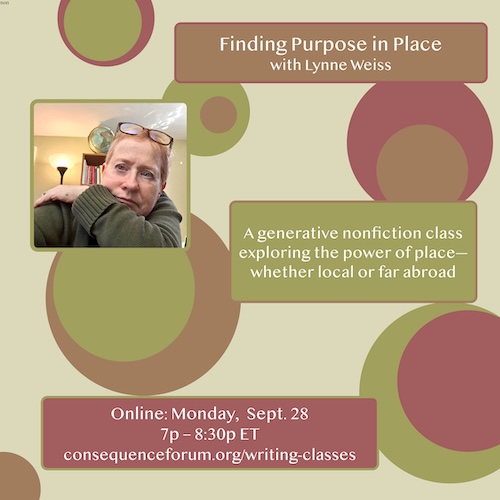
Place can serve as an anchor or prompt for an essay that examines the human consequences of war, political violence, and other forms of injustice or oppression (as well as of examples of struggles for freedom and equality). Travel may allow us to see things afresh and find ways to examine such themes, but so can digging into our own neighborhoods and surroundings. For example, who occupied the land on which our homes stand today? Or, what role did war or political violence play in bringing newcomers to the places where we live or visit? What are the markers—monuments, architecture, place names, land use—that provide evidence of these human experiences?
We will examine excerpts from essays published in Consequence (and perhaps elsewhere) to find examples of ways writers explore these themes through their consideration of place.
These excerpts will be distributed the week before the class, but we will also provide time to read them during the class. We will look at the ways writers use sensory details—sound, touch, scent, sight—to bring a place alive. We will also examine the ways writers make the transition from the concrete experience of place into a consideration of larger themes.
Participants will have a few minutes to brainstorm a short list of places they have recently visited or would like to visit, either in their immediate neighborhood or through travel. Then we’ll take a longer period of about fifteen minutes to begin drafting (or if students arrive with work in progress, polishing) a piece of writing that explores these themes through place. Following this period, students will be invited to read aloud from their work. Class will end with a discussion of the experience of the process. Students will be encouraged to articulate a goal for moving forward with their draft or another writing project.