Writing Classes
We offer a sliding scale for each course.
We also offer a reduced rate for those who can’t make a course but would like to have
access to its materials and video recordings.
For more info, please email info@consequenceforum.org
Upcoming Classes
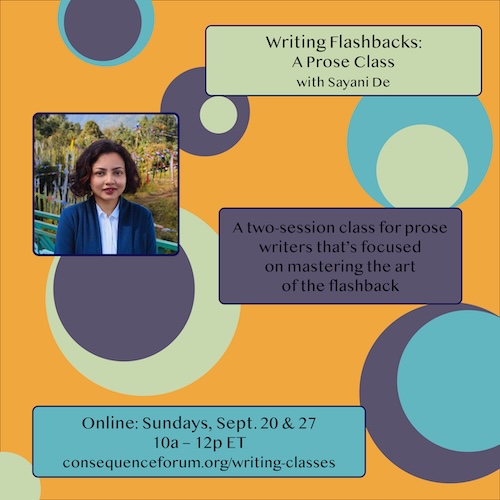
Writing Flashbacks
What: This course will focus on mastering the art of the flashback as a crucial narrative technique for writing powerful, emotionally resonant stories about war and its aftermath. We will explore how to seamlessly weave memories into a narrative to reveal character motivation, contextualize trauma, and deepen the reader’s understanding of conflict’s shadow, without disrupting the flow of the story. For writers tackling themes of displacement, memory, and loss, flashback as a tool is essential for moving beyond simple chronology to capture the fragmented nature of wartime experience and memory itself.
The sessions will blend concise mini-lectures with hands-on, generative writing exercises designed to practice different flashback structures and triggers. We will analyse examples from literature and discuss participants’ work in a supportive workshop environment. Activities will focus on practical skills like crafting seamless transitions, using sensory details to anchor memories, and determining the emotional weight a flashback should carry.
Students will leave with a toolkit of techniques for writing effective flashbacks, including several starter drafts or revised scenes of their own. They will gain a clearer understanding of how to use memory to propel a narrative forward rather than halting it, and a set of constructive peer feedback on their work. Each writer will have a stronger, more nuanced approach for integrating the past to enrich their stories of war and its ramifications.
Who: Sayani writes fiction and creative nonfiction. Her work has been longlisted for the 2025 Commonwealth Short Story Prize, Asian Prize for Short Story 2025, and shortlisted for the 2025 Rama Mehta Writing Grant. Her WIP debut novel based on war, displacement, and identity was a finalist at the Alliance Pitch fest. Her stories have been published/are forthcoming in Solarpunk, Tamarind Literary Magazine, The Selkie Anthology, The Bangalore Review, Muse India, and Indian Literature. She lives in Kolkata.
When & Where: Online: Sundays, Sept. 20 & 27 from 10a – 12p ET
Class Limit: 12
Cost: $60
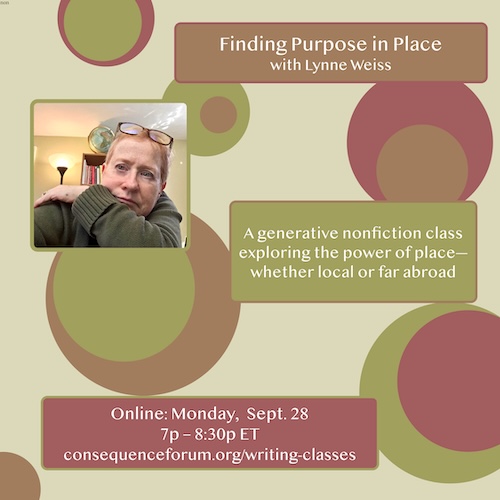
Finding Purpose in Place: Nonfiction
What: Place can serve as an anchor or prompt for an essay that examines the human consequences of war, political violence, and other forms of injustice or oppression (as well as of examples of struggles for freedom and equality). Travel may allow us to see things afresh and find ways to examine such themes, but so can digging into our own neighborhoods and surroundings. For example, who occupied the land on which our homes stand today? Or, what role did war or political violence play in bringing newcomers to the places where we live or visit? What are the markers—monuments, architecture, place names, land use—that provide evidence of these human experiences?
We will examine excerpts from essays published in Consequence (and perhaps elsewhere) to find examples of ways writers explore these themes through their consideration of place. These excerpts will be distributed the week before the class, but we will also provide time to read them during the class. We will look at the ways writers use sensory details—sound, touch, scent, sight—to bring a place alive. We will also examine the ways writers make the transition from the concrete experience of place into a consideration of larger themes.
Participants will have a few minutes to brainstorm a short list of places they have recently visited or would like to visit, either in their immediate neighborhood or through travel. Then we’ll take a longer period of about fifteen minutes to begin drafting (or if students arrive with work in progress, polishing) a piece of writing that explores these themes through place. Following this period, students will be invited to read aloud from their work. Class will end with a discussion of the experience of the process. Students will be encouraged to articulate a goal for moving forward with their draft or another writing project.
Who: Lynne Weiss is a writer, theater critic, and social justice activist. She has an MFA from UMass Amherst and has received residencies from Yaddo, the Millay Colony, and Vermont Studio Center. Her work has appeared in multiple literary journals and sites, including The Common, Black Warrior Review, the Ploughshares blog, Christian Science Monitor, and Radcliffe Magazine. Her reviews and essays are on CambridgeDay.com, StageandCinema.com, and LiteraryLadiesGuide.com as well as on her substack.
When & Where: Online: Monday, Sept. 28 from 7p – 8:30p ET
Class Limit: 15
Cost: $30
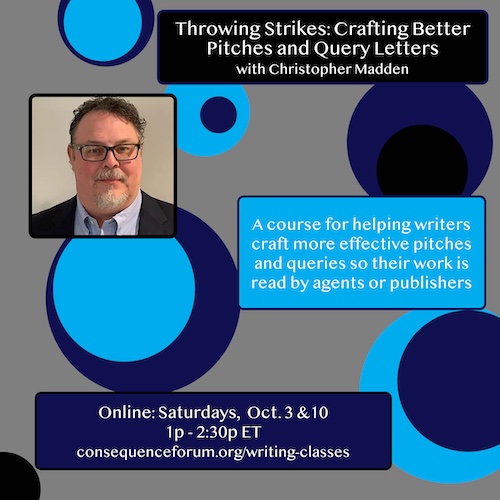
Throwing Strikes: Crafting Better Pitches and Query Letters
What: Querying agents and publishers can feel as mysterious as writing the book itself—but a compelling pitch can make the difference between a manuscript being overlooked and being read. This workshop demystifies the querying process and gives writers practical tools for presenting their work with clarity, confidence, and impact.
We’ll explore how to craft memorable log lines, elevator pitches, and vivid query letters that capture what makes your book distinctive. Through examples and hands-on exercises, participants will assess successful pitches and develop or strengthen their own. We’ll also discuss platform, building connections with readers, and finding effective comp titles.
You don’t need a completed manuscript to participate—bring a brief synopsis or description of your project. By the end of the workshop, you’ll have a stronger understanding of how to position your book, a draft query letter, and a compelling book pitch designed to get agents and publishers interested.
Who: Christopher Madden is an educator, writer, and editor. He is the co-founder of Woodhall Press where he serves as executive editor. Woodhall titles have won Foreword Indies Gold awards, Kirkus Best Books of the year, and IBPA awards. He has presented publishing seminars and workshops at the Yale Writer’s Workshop, NYU, Clark University, The Atlanta Writer’s Conference, Johns Hopkins, and the Fairfield University MFA. He is the author of Alice’s Adventures in #Wonderland, a gentle update of the Lewis Caroll classic. He holds a BA in English from the University of Wisconsin, and an MFA in Fiction Writing from Fairfield University. He is a thesis advisor at the Johns Hopkins MA in Creative Writing and teaches a publishing workshop in Fairfield’s MFA program.
When & Where: Online: Saturdays, Oct. 3 & 10 from 1p – 2:30p ET
Class Limit: 15
Cost: $50
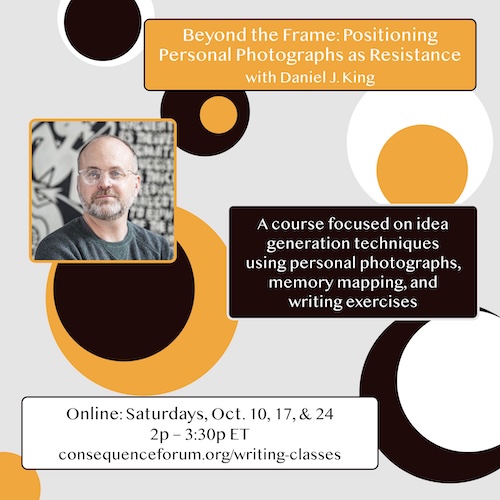
Beyond the Frame: Positioning Personal Photographs as Resistance
What: Photographs hold personal memories, individual and collective histories, and notions of identity. They are records both subjective and objective. But how do these pictures relate and link to other types of images? Can our personal photographs resist images of power, destruction, violence and war? Are there ways these pictures can activate, inform, or move us to action and generate a new narrative or poem?
This class will focus on delivering a range of idea generation techniques using personal photographs, memory mapping, and writing exercises. Participants will be guided through a process exploring how personal photographs and image linking can spark new narrative routes, expanded personal meanings, and compelling visual and textual backgrounds. Each session will include a brief unpacking of creative technique, with examples from the instructor’s own work, and the work of others, followed by a prompt for generative engagement.
By the end of this course, students will have:
1. drafted a variety of short form writings generated through mapping personal photographs through time and place.
2. developed an understanding of at least three techniques for idea mapping using photographs as a route for new writing and
3. gained a fuller understanding of the rich possibilities that photographs can play in creative practices of writing.
No photographic experience necessary.
Who: Daniel J. King is an artist and US Air Force veteran making lens-based work with a tendency toward the idiosyncratic human relationship to place, geography, and representation. He teaches studio art and photography courses at Ohio University and Otterbein University, and maintains ongoing community based workshops connecting ideas, people, and place through creative practice. Daniel’s commitment to using the arts as a bridge for community engagement and personal transformation has developed over decades of experiences fostering growth, mentorship, and collaboration in diverse spaces—from cultural centers and college classrooms to veteran and recovery communities.
When & Where: Online: Saturdays, Oct. 10, 17, & 24 from 2p – 3:30p ET
Class Limit: 15
Cost: $75
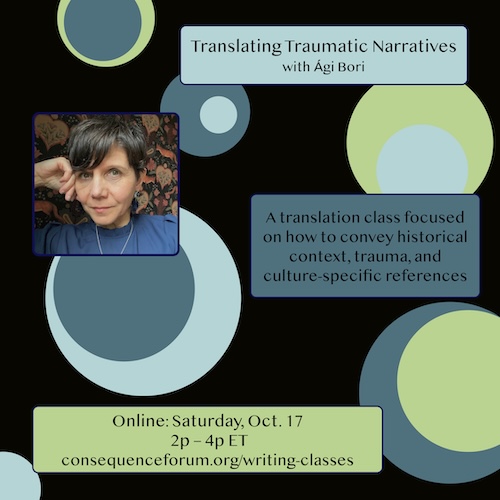
Translating Traumatic Narratives
What: This class focuses on understanding and conveying historical context, trauma, period- and culture-specific references within the language, and cultural memory. Participants will be shown sample translations from multiple novels that will aid them in appreciating and understanding the challenges of translating both historical fiction and fiction that is steeped in either war-related trauma or disturbances in emotion, thinking, or behavior, with a specific focus on mental illness.
The two-hour session will start with a brief talk about translation in general, focusing on the importance of translators successfully understanding challenging and deeply emotional source texts, and on resonating with the plot and its characters in order to effectively render the source text into English. There will be specific examples detailing a variety of approaches on how to stay true to the rhythm and the style of the writing, whether it’s stream of consciousness or prose that is more traditional. There will be one or two “reverse translation” exercises that will center around short translated passages, and participants will be asked to make assumptions about the source text. Students will also have a chance to ask questions throughout the class as we look at sample texts together, as this is a discussion-heavy class that welcomes questions, ideas, and feedback.
Students will leave with the samples discussed in class and a better understanding of the complexities of the craft of translating.
Who: Ági Bori originally hails from Hungary and has lived in the US for more than thirty years. She translates between Hungarian and English, working in both directions. Her translations and writings are available in 3:AM, Anomaly, Asymptote, The Baffler, Litro Magazine, Maudlin House, The Rumpus, Tablet, Trafika Europe, Turkoslavia, Words Without Borders, and elsewhere. She is a translation editor at the Los Angeles Review.
When & Where: Online: Saturdays, Oct. 17 from 2p – 4p ET
Class Limit: 15
Cost: $30