Writing Classes
We offer a sliding scale for each course.
We also offer a reduced rate for those who can’t make a course but would like to have
access to its materials and video recordings.
For more info, please email info@consequenceforum.org
Upcoming Classes
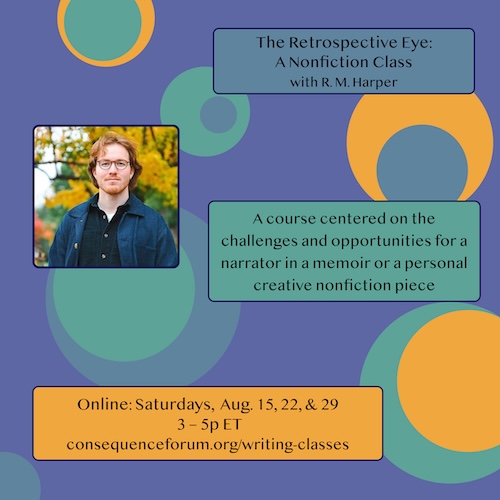
The Retrospective Eye: A Nonfiction Class
What: This course focuses on the challenges and opportunities for a narrator in a memoir or a personal creative nonfiction piece that deals with events from the past. What are the tools a writer can employ to effectively recreate setting, tone, etc., and what is the point of retrospection from which the narrator is looking back toward these elements? By exploring the friction between the fictive self on the page and the writer of the present, we get at the essential meaning of the piece and of memoiristic writing in general—to say something of what it all means.
Through lecture, reading, and discussion, we will explore examples of how authors handle retrospection and point of view. We will isolate specific techniques and their effectiveness, and employ them in our own writing, which begins with short free-write sessions leading into after-class assignments.
Students will complete a draft utilizing class techniques, with the opportunity to share a portion of their writing in the final session. More importantly, they will leave with an understanding that memoir/personal CNF is a recreation of the past tethered always to the moment of narration, which is to say, the evolving future. With this synthesis in mind, they will be prepared to explore the greater meaning of their work.
Writers of all levels welcome.
Who: R.M. Harper is a genderqueer writer and US Navy veteran whose work explores the intersections of state power, storytelling, and identity. A native of California’s Central Valley, they served as a military photojournalist in the Indo-Asia-Pacific before earning an MFA from Saint Mary’s College. Their writing has appeared in The New Ohio Review and elsewhere. They are currently based in Edinburgh, where they are at work on a collection of essays that examines the friction between systems of empire and the reclamation of identity.
When & Where: Online: Saturdays, Aug. 15, 22, & 29 from 3 – 5p ET
Class Limit: 10
Cost: $75
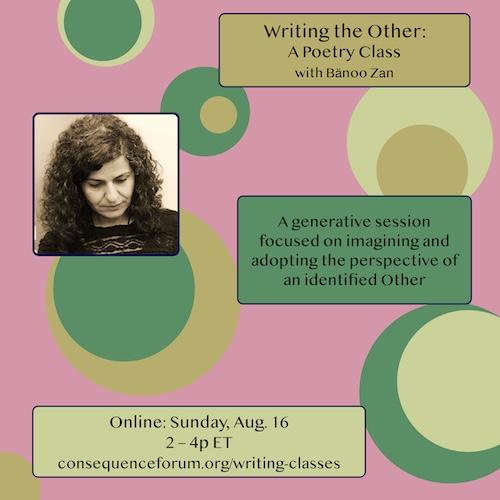
Writing the Other: A Poetry Class
What: This class focuses on writing exercises that encourage participants to actively imagine and adopt the perspective(s) of an identified Other or Others. Participants will be encouraged to write pieces employing first-person viewpoints different from their own lived experiences.
The two-hour session will focus on prompts and exercises. Material(s) will be sent ahead of time to facilitate the grounding and focus on the topics taken up in class activities. The class will start with a brief talk, and if time permits, will end with class discussions.
Participants will leave with first drafts of their creative pieces, mostly in the genre of persona poems. They will also leave with a better understanding of the complexities of the act of writing, and a more empathetic imagination to write pieces focused on universal justice and human rights.
Writers of all levels welcome.
Who: Bänoo Zan is a poet, translator, and curator, with numerous published pieces and books including Songs of Exile and Letters to My Father. She is the founder of Shab-e She’r (Poetry Night), Canada’s most diverse and brave poetry open mic series. Bänoo, with Cy Strom, is the co-editor of the anthology: Woman Life Freedom: Poems for the Iranian Revolution. She was given Life Membership in the League of Canadian Poets in 2024 and is the recipient of the 2025 Writers’ Union of Canada Freedom to Read Award.
When & Where: Online: Sunday, Aug. 16 from 2 – 4p ET
Class Limit: 15
Cost: $30
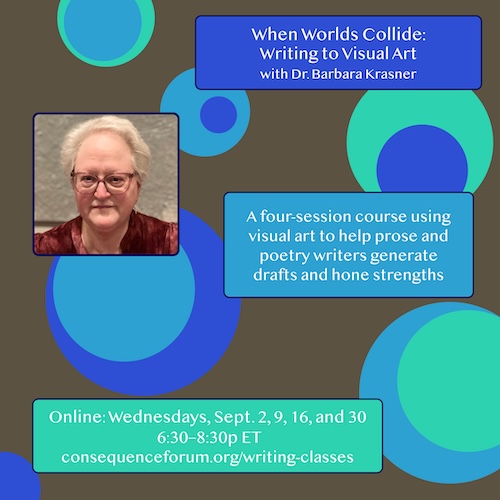
When Worlds Collide: Writing to Visual Art
What: For millennia, writers have expressed their thoughts in response to visual art through ekphrasis, the Greek word for “description.” Visual art provides sensory entry into writing about the complexities of conflict and collision. It lends itself to strong imagery, rhythm, and history.
No previous knowledge of art or art history is necessary. You will receive ten images in 60-second intervals to spark ideas. Then you’ll choose two of them for more in-depth generative writing in fifteen-minute intervals. Using the Amherst Writers & Artists method, we’ll read our work aloud (optional) and give strengths-based feedback on what’s strong and memorable. There is no critique.
Upon completion of the workshop, students will:
~Have a minimum of eight drafts of ekphrastic writing
~Discover where the strengths in their writing shine
~Gain an appreciation of visual art to prompt creative writing
All experience levels and multiple genres welcome.
Who: Barbara Krasner is an award-winning multi-genre author. She holds an MFA from the Vermont College of Fine Arts and a PhD in Holocaust & Genocide Studies from Gratz College. Her work has appeared in more than seventy literary journals and she is the author of ten poetry collections, including the ekphrastic Poems of the Winter Palace (Bottlecap Press, 2025), The Night Watch (Kelsay Books, 2025), Insomnia: Poems after Lee Krasner (dancing girl press, 2026), and the forthcoming The Wanderers (Shanti Arts, 2026). She lives and teaches in New Jersey.
When & Where: Online: Wednesdays, Sept. 2, 9, 16, and 30 from 6:30 – 8:30p ET
Class Limit: 12
Cost: $100
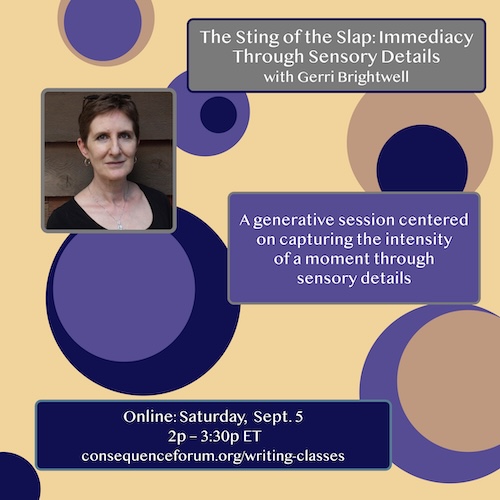
The Sting of the Slap: Immediacy Through Sensory Details
What: Whether you’re writing fiction, nonfiction, or poetry, it can be hard to get the immediacy of an experience onto the page. The aim of this ninety-minute class is to help you capture the intensity of a moment through thinking strategically about which sensory details to use, and how best to use them. We’ll also spend time on an editing technique that helps trim away words that get between a reader and the experience you want them feel in their bones. Our short readings will include those that capture the experience of violence.
We’ll start by looking at a story excerpt that uses a variety of sensory details to embed us in the experience of a point of view character. After a little discussion, we’ll move on to a writing activity that prompts you to use similar techniques. We’ll take time to talk about the work you’ve produced, and how and why certain sensory details make writing vivid. For the last part of class, we’ll move on to an editing technique, looking at how writing can get bogged down, and giving you the opportunity to rework a short piece to make it sing.
You should leave class with a clearer idea of how to use sensory details, and how best to avoid certain habits that get in the way of the vivid writing.
Writers of all levels welcome.
Who: Gerri Brightwell is originally from southwest Britain. Her fourth novel, Turnback Ridge (Torrey House Press), was a finalist for the 2022 Foreword Indies Award (adult thriller & suspense). Her short work has appeared in many venues including The Best American Mystery Stories 2017, Alaska Quarterly Review, Raritan: A Quarterly Review, Copper Nickel, Redivider, and BBC Radio 4’s Opening Lines. She teaches in the creative writing program at the University of Alaska, Fairbanks.
When & Where: Online: Saturday, Sept. 5 from 2 – 3:30p ET
Class Limit: 15
Cost: $30
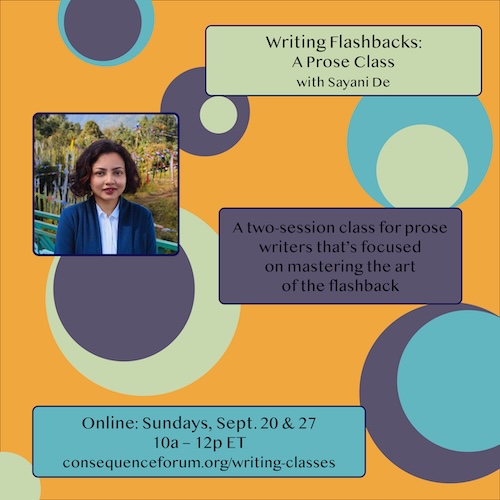
Writing Flashbacks
What: This course will focus on mastering the art of the flashback as a crucial narrative technique for writing powerful, emotionally resonant stories about war and its aftermath. We will explore how to seamlessly weave memories into a narrative to reveal character motivation, contextualize trauma, and deepen the reader’s understanding of conflict’s shadow, without disrupting the flow of the story. For writers tackling themes of displacement, memory, and loss, flashback as a tool is essential for moving beyond simple chronology to capture the fragmented nature of wartime experience and memory itself.
The sessions will blend concise mini-lectures with hands-on, generative writing exercises designed to practice different flashback structures and triggers. We will analyse examples from literature and discuss participants’ work in a supportive workshop environment. Activities will focus on practical skills like crafting seamless transitions, using sensory details to anchor memories, and determining the emotional weight a flashback should carry.
Students will leave with a toolkit of techniques for writing effective flashbacks, including several starter drafts or revised scenes of their own. They will gain a clearer understanding of how to use memory to propel a narrative forward rather than halting it, and a set of constructive peer feedback on their work. Each writer will have a stronger, more nuanced approach for integrating the past to enrich their stories of war and its ramifications.
Who: Sayani writes fiction and creative nonfiction. Her work has been longlisted for the 2025 Commonwealth Short Story Prize, Asian Prize for Short Story 2025, and shortlisted for the 2025 Rama Mehta Writing Grant. Her WIP debut novel based on war, displacement, and identity was a finalist at the Alliance Pitch fest. Her stories have been published/are forthcoming in Solarpunk, Tamarind Literary Magazine, The Selkie Anthology, The Bangalore Review, Muse India, and Indian Literature. She lives in Kolkata.
When & Where: Online: Sundays, Sept. 20 & 27 from 10a – 12p ET
Class Limit: 12
Cost: $60
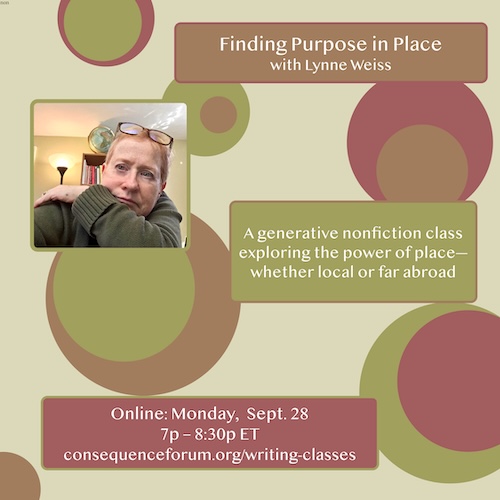
Finding Purpose in Place: Nonfiction
What: Place can serve as an anchor or prompt for an essay that examines the human consequences of war, political violence, and other forms of injustice or oppression (as well as of examples of struggles for freedom and equality). Travel may allow us to see things afresh and find ways to examine such themes, but so can digging into our own neighborhoods and surroundings. For example, who occupied the land on which our homes stand today? Or, what role did war or political violence play in bringing newcomers to the places where we live or visit? What are the markers—monuments, architecture, place names, land use—that provide evidence of these human experiences?
We will examine excerpts from essays published in Consequence (and perhaps elsewhere) to find examples of ways writers explore these themes through their consideration of place. These excerpts will be distributed the week before the class, but we will also provide time to read them during the class. We will look at the ways writers use sensory details—sound, touch, scent, sight—to bring a place alive. We will also examine the ways writers make the transition from the concrete experience of place into a consideration of larger themes.
Participants will have a few minutes to brainstorm a short list of places they have recently visited or would like to visit, either in their immediate neighborhood or through travel. Then we’ll take a longer period of about fifteen minutes to begin drafting (or if students arrive with work in progress, polishing) a piece of writing that explores these themes through place. Following this period, students will be invited to read aloud from their work. Class will end with a discussion of the experience of the process. Students will be encouraged to articulate a goal for moving forward with their draft or another writing project.
Who: Lynne Weiss is a writer, theater critic, and social justice activist. She has an MFA from UMass Amherst and has received residencies from Yaddo, the Millay Colony, and Vermont Studio Center. Her work has appeared in multiple literary journals and sites, including The Common, Black Warrior Review, the Ploughshares blog, Christian Science Monitor, and Radcliffe Magazine. Her reviews and essays are on CambridgeDay.com, StageandCinema.com, and LiteraryLadiesGuide.com as well as on her substack.
When & Where: Online: Monday, Sept. 28 from 7 – 8:30p ET
Class Limit: 15
Cost: $30
Previous Workshops
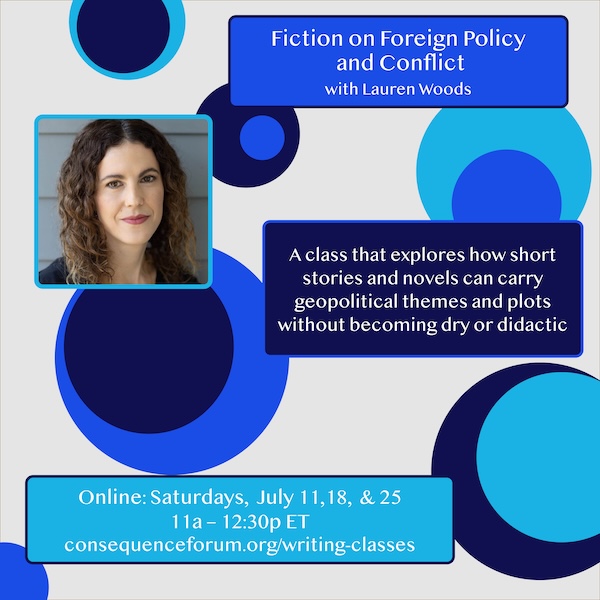
Fiction on Foreign Policy and Conflict
What: War, diplomacy, and global conflict have animated some of the best-known fiction around the world, but writers with firsthand knowledge of these worlds often struggle to translate their expertise into compelling storytelling. This course explores how short stories and novels can carry geopolitical themes and plots without becoming dry or didactic. Across three sessions, moving from classic texts to contemporary voices to formally experimental work, this course will examine how authors transform foreign policy and conflict into character and craft.
Each session divides its time between close reading and generative writing. The class will discuss excerpts together, identifying the specific techniques authors use to render inner conflict, moral ambiguity, pacing, and place, and then immediately put those tools to work in short generative exercises. Writers will have the opportunity to share pieces of new or revised drafts and receive feedback from the group.
By the end of the course, students will leave with several pages (either new or revised from works in progress) that consciously deploy techniques drawn from the authors covered. Students should be introduced to at least one writer they hadn’t read closely before and should have a clearer sense of whose writing resonates with them and why. More importantly, they’ll have an expanded set of craft strategies for writing about conflict.