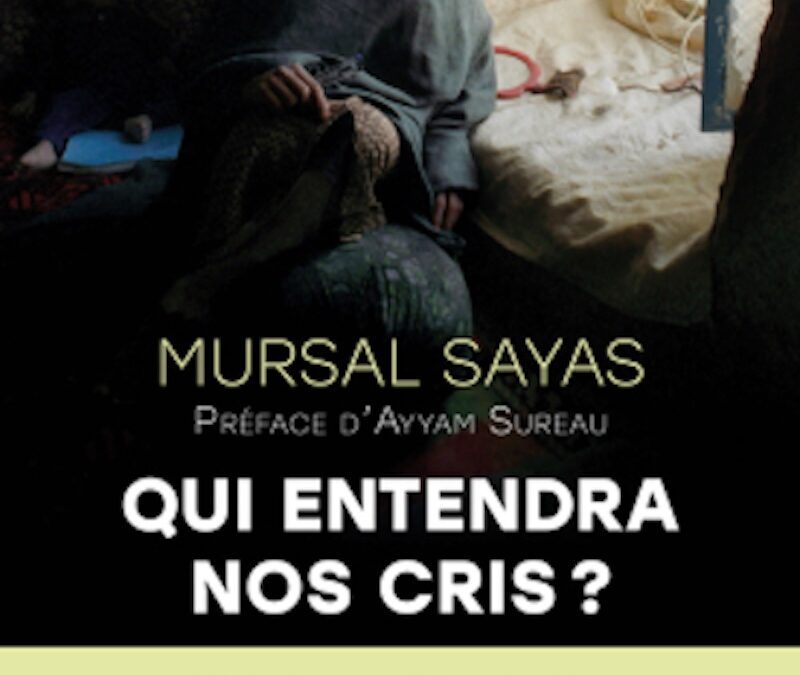
Qui Entendra Nos Cris? | Published by Éditions de l’Observatoire, Jan. 2024
Translated from Farsi (Afghanistan) to French by Zaher Divantchegui
Author’s Note: The story you are about to read is not an ordinary tale. It is the life story of one among millions of Afghan women who, simply for being women, have endured oppression, violence, and erasure. In this narrative—and throughout the book—I have intentionally avoided overwhelming statistics and figures because I believe human beings are not numbers. They have lives, souls, families, and bodies. The erasure of women is not just a humanitarian crisis; it is a threat to the healthy continuation of humanity itself because future generations cannot thrive without the mental and physical well-being of women.
These narratives are the product of my years of work at the Afghanistan Independent Human Rights Commission, in the department dedicated to the protection and development of women’s rights—as well as my own lived experiences. Even as I write this sentence, the very idea of having a human rights commission and an institution to protect women’s rights feels like a distant luxury—something no longer accessible.
Think about this: How is it that in a country where the US and NATO entered under the banner of defending human rights, democracy, and women’s freedom, women were still being whipped for the slightest act of disobedience, locked away in their homes, and subjected to harassment and abuse? Hundreds of women’s organizations were operating at the time. But today, with Afghanistan handed over to the Taliban, who remains? Who speaks for these women? Who stands by them?
Four years have passed since the fall of the Republic and the withdrawal of international forces. In these four years, not a single girl has graduated from school or university. Every day, Afghan women face relentless and systemic violence—at home and in the streets. Gender apartheid in Afghanistan is no longer just a term; it is a painful and undeniable reality. Worst of all, this situation has been made possible by the silence of the international community—especially the very partners of the United States who once placed bounties on the heads of Taliban leaders, yet have now left Afghanistan defenseless in their hands.
In such a context, I’m grateful for the chance to speak about my book, Who Will Hear Our Cries? I wanted to dedicate this introduction to myself—to write about exile, about starting over, about racism, and about the foreignness in which I had to rediscover meaning and identity. I wanted to write about what happened to me, as a woman and a mother, after the US and NATO left—how I haven’t seen my children for years, and how my heart melts daily in their absence. My daughter learned to fall asleep with longing when she was only three. My son learned to live without a mother when he was just five.
But no—I cannot speak only of my own pain, when all the women of my country have been pushed to the margins. When my daughter’s cousins—just four years older than her—have been forced into confinement at home, their lives reduced to washing dishes and polishing their brothers’ shoes so they can go to school tomorrow. When nine-year-old girls are sold off under the name of marriage just to feed their family members (mostly male members), become pregnant within months, and die along with their unborn child—because midwifery education is banned and taking a woman to a male doctor is considered shameful. When I think of my children, whom I have not seen in four years and no longer know their favorite meals, I suddenly remember the thousands of children who, due to the cuts in humanitarian aid, now face poverty, malnutrition, and a slow, silent death.
I remember the days I had to fight a misogynistic legal system to get a divorce. I was insulted, humiliated. Even when the court ruled in my favor, they still tried to force me not to sign the papers. They said, A respectable woman does not get divorced. It was then that they predicted my future for me: You will be separated from your children. And that is exactly what happened.
Today, countless other women don’t even have access to a court. They face violence not only in their homes, but from a system, a religion, a society, and a Taliban regime that have institutionalized that violence. Women are imprisoned in Taliban detention centers simply for “disobeying their husbands,” without any institution to document their wounds or amplify their voices to the world. No one is fighting for their justice.
In this book, I write about domestic violence. But today, that violence has multiplied, become layered and more brutal. If yesterday, traditional patriarchy was to blame, today the responsibility also lies with all of America’s international partners—those who abandoned Afghan women to gender apartheid, and walked away indifferently from a systematic crime.
This book is for those who are silent, but still alive. For those who cannot scream. This book is my attempt to preserve their voices.
You may ask: Who will hear their cries? I still have hope. Maybe you will.
—Mursal Sayas, June 2025
(All names have been changed)
Palwashah or Silence in the Darkness
Somewhere in the south of Afghanistan, summer 2020.
I was finishing my month-long monitoring mission in one of the six safe houses in Kabul whose residents were mainly women, underage girls, and a few children with their mothers. I was responsible for keeping track of how these women’s lives were evolving, and notably anything related to the non-respect of human rights. The very smallest details of their stories were recorded and put on file.
Anyway, my mission was coming to an end. To be sure that I had not forgotten anything, I came back to the office one evening to check certain documents. I went through the building, passing through the living accommodation of the women and children whom I had come to know quite well. In one of the rooms, I was struck by the vision of a haggard-faced girl whose big, dark eyes stared at the window in front of her. She crouched, seemingly plunged in the most extreme of solitudes, resembling nothing so much as a small bird with broken wings. As I was saying good-bye to the man in charge of the safe house, I asked whether I might spend some time with this particular girl whom I hadn’t in fact had the opportunity to interview. “Of course,” he replied, “we can’t refuse a professional like you such a request.” He laughed and I smiled back. Very quietly, I went back to the room where the girl at the window was living.
It was evening. The room with its blue painted walls was half in darkness. Thick red curtains stopped the light of the setting sun from entering. The furnishings comprised three sets of bunk beds in corners of the room; the middle of the room was occupied by a big red rug sitting atop the pale fitted carpet. The girl was sitting on the bed nearest to the door. She was pale-faced and her thin body was lost in folds of a pleated purple dress. I greeted her warmly and remarked on how beautiful her eyes were. Smiling timidly, she said: “But is beauty going to cure the sufferings of an unlucky girl like me?” I said nothing, my heart stopped at such a remark coming from one so young. I knew of course that none of the girls in the safe houses was exactly happy, given the appalling situations they had lived through. Such spaces of refuge were their last possible solution, where they came seeking protection and shelter. I was always struck and touched by the extreme singularity of their trajectories; all of them were marked by the same pain.
Gently, I began to talk to her, trying to note down the most important things, a difficult task for although she spoke slowly, events seemed confused in her head. I didn’t want to record her, I didn’t want her to realize that I was doing my professional duty, conducting research into her trajectory. I didn’t want to inhibit her in any way.
The notes taken during such interviews help us to put together individual accounts of the experiences of the women who have been victims of violence, merely because they are born women in an inegalitarian, patriarchal society. From the dozens and dozens of women I have listened to, I have heard the same pain and sufferings time and time again.
The room was growing darker. I listened attentively to the girl. She said she was seventeen. I wrote down her age: seventeen. Later, as I was transcribing her words, I thought of her age. Just seventeen. It was heart-breaking to hear the painful cry of this girl. An adolescent like her should have been living life to the full, in all happiness. But here she was in a safe house, her heart full of sadness. In such places, women on the run come seeking refuge.
The girl was called Palwashah. She was from southern Afghanistan, a victim and a survivor of the wars which have ravaged the country. She spoke Farsi with a Pashto accent. Her gaze and her words revealed the depth of her misfortune. She was very lost.
We can look at the tragedy of Afghanistan’s women in figures, of course. Between 2001 and 2021, 47,242 civilians lost their lives in the country, notably in aerial bombardments. All the members of Palwashah’s family had died in a bombardment by the foreign allied forces. She was the only member of the family to survive.
Hardly had she come out of coma, lying between wakening and unconsciousness, hardly had she opened her eyes than she heard words like: “Long life to you. Thanks be to God, you are alive” and “You are in a hospital for war victims.” These were words hard to hear. “Long life to you.” She had already heard the phrase many times; these were the words used to express condolences to the relatives and neighbors of a bereaved family. She hadn’t been expecting to hear this phrase addressed to her. But now she would have to face up to the nightmare of having lost her entire family.
Said Palwashah with a quiet sigh, her forehead wrinkled: “I would have liked to die with the rest of my family. But now I’m terribly alone to face a life of unhappiness”.
Palwashah stayed just a few days in the emergency room of the hospital. An aunt on her mother’s side took her in. In Afghanistan, a saying goes that ‘an aunt is like a mother.’ However, this old magic formula could not console her in such deep distress. In her grief, her aunt had decided to take her in almost as a form of homage to her lost sister. She was fulfilling a duty to the deceased.
Very unfortunately, the aunt’s new mission was filled with obstacles. With Palwashah now part of the family, there was another mouth to feed. There were worries about the girl’s future, too. There was a real risk that she could not be married. And the aunt had several young sons still at home. It was not such a good idea that Palwashah come to live in a household with her husband and sons, since the latter were not mahram, male relations with whom marriage was not permitted.
So the aunt contracted a marriage for her with the first suitor who came along. He was a fine, lively young man with a big heart. Palwashah herself was happy about the match. In any case, she needed a roof over her head, she needed to build a home.
After the engagement ceremony, the future husband gave his new fiancée a very valuable present: a mobile phone. Palwashah was no longer single and she actually had a smartphone. Now she could communicate with her fiancé and speak to him of love and their shared future. Little by little, the young woman regained her taste for life. Her orphaned heart had been frozen with the loss of her family. Now she felt safe. Her fiancé’s arms would warm her and she would be able to found a family and build a new life in Kabul.
A year passed. The two families were preparing for the marriage ceremony, which was to take place in a month’s time. Palwashah was busy buying things for her new home. She had new aims. Confident and happy, she was about to begin a new life.
But that new life was not to be. Her fiancé, a simple civilian, was killed in a combat zone where Taliban insurgents were battling with the government forces. Inadvertently, he had been in a high-risk area at the wrong time.
The pattern was a familiar one, of course. The Taliban’s operations were highly unpredictable. They could appear at any time of the day: in a crowded market, at a junction, in a school or university, a hospital or even in a hotel. They would kill as many people as they could. Thousands of innocent individuals with their hopes and dreams were killed in cold blood like this.
The victims of Taliban massacres could be students on the way to university. They could be girls out with their mothers to buy clothes for a family event or religious holiday. The innocent victims could be happy children at play in the narrow streets of their neighborhood. Or they could be fathers who worked to provide for their families. Suddenly, such innocent folk could be destroyed by the explosion of a bomb or in a suicide attack. Behind them they left the grief of their nearest and dearest.
It was in just such an attack that Palwashah’s fiancé was to perish, like all the other innocents who found themselves caught in the crossfire between the Taliban and the government security forces. With this unforeseen death, Palwashah found herself alone again.
This death too was to have a huge impact on the course of her life. She had been about to marry and live a quiet family life. Now destiny was to lead her in a very different direction. What was she to do, a girl of seventeen with neither family nor material resources. Given the situation in Afghanistan at that point, as an orphan and now a widow, she could be hunted down and harassed in all impunity by any male. How could life be so cruel?
According to certain strongly held beliefs in Afghan society, death is always legitimate. But in Palwashah’s case, death was horribly unjust: Her despair was so strong that she hoped to die.
After the prayers and the funeral ceremony, her fiancé’s brother suggested that he take her to Kabul. He was a very influential mullah, some fifty years old. He asked her aunt’s permission, arguing that a trip to the capital would do the newly widowed girl a lot of good. Despite her worries about such an adventure, the aunt gave her permission. She had great feelings of compassion for her niece and her family-in-law.
Palwashah’s fiancé had described Kabul in glowing detail: “It’s a fine and comfortable city. There are big markets, luxurious restaurants and cafés where young men and women can spend an evening together.” This was the image of the city that the girl had retained. In fact, Palwashah’s fiancé had spent some time in the capital before moving south. He had many stories to tell: “In Kabul, not all the women wear the chador and the hijab! There are places like Shahr-e Naw right in the centre, Koch-e Murgha, called Chicken Street, where they sell souvenirs to the foreigners, there are antique shops and lots of clothes with the latest patterns. . . .” The clothes he was talking about used to be worn mainly by Pashtuns and nomad Kochis. Now they were made in Kabul with modern forms and motifs.
Palwashah would have liked to see these shops with her fiancé, of course. She would have liked to buy elegant wedding clothes for them there in Kabul. But of course, this dream was gone. With very little enthusiasm, she set out for Kabul with her brother-in-law, the mullah.
The capital was 618 kilometres from her aunt’s home in the south. The road crosses plains and mountains. After eleven hours on the road, Palwashah reached Kabul. She was lost in an unfamiliar world of tall buildings and massive traffic jams. The air was filled with the cries of street vendors, amplified by portable loudspeakers; there were handcarts piled high with fruit and vegetables. From bakeries came the smell of fresh bread. Men and women pushed and rushed along; there were faces tense, happy, angry. She heard jeers and laughter. All this was unfamiliar, strange. Without her much-loved fiancé, this unfamiliar city had no taste. In fact, it was insipid.
She came back to her senses. Like a child in an unfamiliar situation, a natural instinct led her forward. She managed to ask a passerby for the address of the Ministry of Women’s Affairs. Even though she had grown up far from Kabul, she was aware, like many women and girls from the countryside, that there were institutions in the capital that could help women.
The man looked at her. Seeing her there all alone with her tired face and worn clothes, he understood that she had just arrived. Taking pity on her, he took her all the way to the ministry in question. There she was able to tell her tale—and her words were recorded as follows: This girl has lost her family. Provisionally, she will be placed in a safe house until such time as her case can be examined. So it was that Palwashah introduced herself as a homeless girl to the director of the safe house.
Now she was among women and girls who had been victims of violence. She had a bed in a room with three other girls. The girls chatted and joked together; Palwashah was unable to participate. Such optimism and laughter were unbearable to her. She had one desire: to be sheltered from others’ eyes. She had no desire to hear their laughter and tears, she wanted to weep in a corner by herself. When her roommates showed affection, asking whether they could help her in any way, she could only reply that she was missing her family terribly. Nevertheless, she felt safe in this new house.
But any taste for life had gone. She would spend her days staring blankly at the window of her room. Though she tried to get used to this new place and get on with the people around her, such a shift was beyond her. Palwashah could not shake off the vast sadness gnawing away within her.
Shortly after her arrival, she began to grow weak. Her features hollowed out, her skin grew pale, dark rings around her eyes darkened her expression. She could no longer eat properly. After each meal, she would feel nauseous and vomited the food she had just eaten. Caused by her difficulties in adapting to the new environment, the nausea was the reflection of her unhappiness—perhaps.
These symptoms worried the director, a conscientious and hardworking woman. She decided that Palwashah must have a general check-up. The health officer prescribed a series of tests that the girl accepted without asking any questions.
The health officer called on her in her room where she was lying listlessly on her bed, as was the case every day. He saw her in his office, asking his colleagues to leave them alone so that the girl might feel more at ease. Looking over his papers, he informed the girl of the results of the tests: Palwashah was pregnant.
It was as though the sky had fallen in. The news pushed her down even more. She trembled, hot and cold, all over. She could hardly speak, repeating the words “Pregnant? But . . . where has this pregnancy come from?” Her first thought was that she would live a life of wandering if she became a mother. Aged just seventeen, how would she survive as one who had become a mother against her will, outside the established social norms? Her tragic life had given her yet another hard knock.
She didn’t understand how this could have happened. Happily, the person responsible for the safe house had a lot of experience and knew how to talk to her. The house had already taken in many women and girls who had become pregnant as a result of non-consensual sexual relations, in many cases due to rape. To ensure that her case could be managed properly, she was asked to provide precise information so that the origin of her pregnancy could be determined. She had to get over her fear and recount what had happened. She would have to go back over burning wounds so that solutions could be found and healing could take place.
Palwashah remembered the accursed journey to Kabul, the journey during which she was accompanied by her brother-in-law, the fifty-year-old mullah in whom she had placed her confidence. This man had posed as her protector. The events of that journey add Palwashah to that long list of women who have been victims of rape in Afghanistan.[1]
During the eleven-hour journey, her fiancé’s brother had raped her several times.
The sun had gone down now, the room was dark. Though I didn’t ask Palwashah for any details, I could feel her soul’s suffering. I was married; I had the law’s protection in my relationship. I felt great compassion for one so young, a victim of rape, of a non-consensual sexual relation. What can one do in the face of such suffering? She had believed in a man with a certain status in society, a man who should have been virtuous in any situation. . . . even if he had not been her future brother-in-law.
A weak and fragile girl had been crushed by the body of this man. No-one had been there to hear her cries, no-one had been there to help her. On the way to Kabul, the mullah had threatened her: if she dared to speak out at one of the police or Taliban checkpoints, he would say that she was a prostitute who had had many relations with men. The Taliban would arrest her and execute her immediately.
Everyone in Afghanistan knows that the Taliban will have more faith in the words of a mullah than in those of a young woman. Palwashah remained silent. She had seen several of the summary executions broadcast on the television. She had seen images of the girls and women cruelly whipped in public; she had seen images of the women stoned to death by angry traditionalist men. Resigned to keep silent, she had endured her suffering for the length of that endless seeming journey, punctuated with rapes. At the end of the road, she found herself abandoned in Kabul.
On the evening when she confided in me, Palwashah was already three months pregnant. She had no idea what she should do with the future child, living as she was in a country where abortion is strictly forbidden. The criminal code, article 572, states that If a pregnant woman, aware of her acts, takes medication or uses instruments in order to abort, or if she initiates this act intentionally, or if she allows another person to use the devices mentioned, she will be sentenced to a short period of imprisonment or will pay a fine ranging from thirty thousand to sixty thousand afghanis.
It is not surprising then that Afghan society looks at the children born of an illicit sexual relation or as a result of rape should be one of contempt and disdain. For their whole lives, their origins will be a burden to such individuals, starting right from childhood. They will be the object of mockery and scorn. Today, a woman like Palwashah cannot abort under any circumstances given the ever-stricter interpretations of Sharia law. Probably, she would not have any desire to give birth to a child whose future will be one of humiliation and insults. At the meeting point of these frightening hypotheses and certitudes, her only hope would be that justice be done and her aggressor brought before a court of law. In 2020, out of 287 cases of rape, individual or by a group, 173 people were found guilty and sentenced.
Words cannot really express the infinite sadness that I could see on the faded face of this young woman. For me, Palwashah remains one of the most striking victims of the wars, poverty and rape, of the unjust patriarchal laws and traditions of Afghanistan’s profoundly misogynistic society.
Mursal Sayas
Journalist and author Mursal Sayas is twenty-eight years old. After living her entire life in Kabul, she is now exiled in Paris where she is involved in the defense of human rights.
Justin McGuinness is an Anglo-French translator and university lecturer who lives and works in Paris. He collaborates with an independent organization that helps enable refugees to integrate into French society.
Zaher Divantchegui was born in the village of Dewancheh near Herat. He continued his studies in Europe and eventually settled in the city of Strasbourg. He holds a Master’s degree in Sociology and a diploma in Social Services, and has spent many years working with migrants in various cultural, civic, and social fields. As an experienced translator, he specializes in translating texts from Persian to French and vice versa. He has also been actively involved in theater, writing about music (particularly on Ahmad Zahir Afghan singer), and various cultural projects. He currently serves as the head of the Afghan Cultural Center in Strasbourg and as the Deputy Director of the AFRANE Association.