Art by Glenn Shaw
A Song for the End of Everything
Five-and-a-half weeks before Toshihide Nakagawa dies, his son Yusaku takes him to see a rerun of the film Rocky at the Paradise Repertory Theatre in Burakuricho, Wakayama, a theater known for its continuous state of disrepair. Toshihide has reservations about going. He’s seventy-seven years old, after all, too advanced in years to be mousetrapped in some dirty, air-conditioned theatre for a prolonged period when at any moment his assortment of ailments—duodenal ulcer, myocardial ischemia, polyuria, hyperthyroidism, arthritic back, not to mention his recent flirtation with an enlarged prostate—might all implode in a cacophony of bodily malfunctions. And then there’s the matter of the subtitles. Toshihide’s eyes and subtitles have been at odds with each other for the past six years, ever since the 1993 Jurassic Park fiasco when, halfway through the movie, the subtitles grew hair, fused into a furry ball, and oscillated in front of the screen like a bloated cat. But Toshihide’s wife Momoko insisted he go, chiding him for not spending enough time with their son. How much longer does Toshihide think he’ll be around at his age anyway, she said. Life is short, and Yusaku is their only child—isn’t it time Toshihide got out of his armchair and away from his game shows and did something useful? This is family, after all. What more does he want out of life?
Yusaku drives them in his Daihatsu pick up. The syrupy theater floor sucks at Toshihide’s shoes. The seats are too pillowy, the arm rests too wooden. Of course, somebody parks his fat head in front of Toshihide, and he has to crane his neck to see the opening commercials. As they wait for the movie to start, Yusaku shakes a bag of popcorn under Toshihide’s chin, but Toshihide shoes him away.
“Popcorn gives me gas,” he says.
“You’ll enjoy the boxing, father,” Yusaku says. “Just like in the navy.”
Before being assigned to the aircraft carrier Kaga at the start of the war, Toshihide boxed for the Naval Academy. His trainer had nicknamed him the “Kanto Kamaitachi” for his slippery speed, likening Toshihide to three mythical weasels riding a gust of wind.
“That was over half a century ago,” Toshihide says.
The lights dim.
§
Trumpets. A foreigner, Rocky, boxes in a ring. He resembles a hosed-down gorilla. He sniffs too much, smokes, drinks. Clearly, he’s a failure in life. This movie is too slow, too much talking, why are we here again? Rocky’s trainer, Mickey, kicks him out of his locker at the gym—Toshihide can at least relate to this. Ten years earlier, Aktio, the used machinery corporation, forced him to retire after thirty years of loyal service. More talking; a slow, plinking piano. Boring. Where’s the action? Rocky takes his friend’s sister, Adrian, ice skating, but she doesn’t seem interested—no surprise there. Halfway through the movie, Rocky gets a chance at the title. The champ, Apollo Creed, picks his name from a list. An unlikely twist, but we’ll go with it for now. “He’s Italian,” Creed says of Rocky at a news conference, “if he can’t fight, I bet he can cook.” This Creed—arrogant! Like my neighbor, Kaku. Here, Toshihide scoops a handful of popcorn from Yusaku’s bag. The kernels crackle in his mouth. Mickey ties string to Rocky’s ankles to improve his balance, not a bad idea. Rocky guzzles raw eggs, snaps the ribs of frozen cattle at a meat-packing plant. Beside Adrian on a bed, the springs groan—“Nobody’s ever gone fifteen rounds with Creed,” Rocky says. “It don’t matter if I lose, it don’t matter if he opens my head, all I wanna to do is go the distance.” Go the distance . . . Toshihide’s body shifts, slightly, in his seat. The big fight, America’s Bicentennial. Creed, dressed as George Washington, floats down the aisle in a boat, casting fistfuls of confetti over the crowd. In the ring he wears stars and stripes shorts and a top-hat the size of a stock pot, pointing his glove at Rocky: “I want you, chump! I want you, chump!” Toshihide reaches for more popcorn and Yusaku lets him have the bag. All that’s left are unpopped seeds. Rocky is a lumbering mule; Creed, a thoroughbred. The cut man slices Rocky’s eye and blood jets out, but Creed has weak ribs, the ribs, go for the ribs. Crack! Crack! Creed grimaces; he feels those rib shots. Fifteen rounds and their faces are raw meat. Then the final bell and Rocky’s still standing; it’s a split decision. The belt remains with Creed. Fans swarm the ring. A crescendo of trumpets. Rocky’s arms fold over Adrian; her red beret is gone. “Where’s your hat?” “I love you, I love you.” “I love you.” “I love you.”
Lights. Toshihide remains in his seat. He looks in his hands. He’s wrung the empty popcorn bag like a wet cloth.
Yusaku drops Toshihide off at home after the movie. Momoko is curled on the sofa, watching the news. As Toshihide passes in the hallway, she asks how the movie went, but he only complains about the uncomfortable seats and continues into the bedroom. He kneels on the tatami in front of the closet and slides open the door. His old military footlocker, a battered pine box, is buried at the back under a stack of towels. He pulls it out and opens the lid.
An odor of liniment and tobacco escapes the box. Inside are three folded sets of his old seaman’s uniforms, a half-empty packet of Bat cigarettes, his military medal of honor, and a pair of cracked boxing gloves, the ones he boxed with at the naval academy. Somewhere near the bottom of the locker, he recalls, lies his old rubber mouth guard. He reaches in and squeezes one of the gloves. The outer crust has hardened into a crackly seaweed. Still usable, though, he thinks. How long since he’s worn them? When he was twenty? It would have been during the scrimmage matches at the academy, days before getting shipped to Midway . . .
Toshihide recalls every detail of the battle as if it were yesterday—the currents of adrenaline spiking his blood, the hairs on his arms wired with live voltage, the mottled green ocean like sheets of oxidized copper. The sky, spattered with flak. The explosions were so violent they cracked open the clouds. His ship, Kaga, was hit. He remembers the odor of scorched wood from the deck, and then a white flash of light. He later awoke in the water, his leg bleeding from a shrapnel wound, and swam to the husk of a defective torpedo floating near Kaga. He clung to it with three other men for hours beside their burning ship until a Japanese destroyer finally pulled them out. Toshihide recalls shivering on the crowded foredeck of the destroyer at sunset, watching two torpedoes scuttle his ship. Down it went, out of sight, with over eight hundred comrades in her belly.
Toshihide has lived over half a century beyond that moment. Like Rocky, he’s gone the distance. And now, in his bedroom, as he holds his old boxing glove, he feels that current of adrenaline coursing through him once again. Has he really lived another fifty-seven years?
§
0530. Toshihide stands at his kitchen sink in a pair of Reeboks, gardening pants, and a thermal undershirt, and chuggs four raw eggs from a pickling jar. He executes five minutes of deep knee bends, calf raises, neck swivels, and torso twists. Two more minutes of hamstring stretches—foot on counter, groaning lean at the waist, the underused hamstrings taut as piano wire—and he’s ready for Wakayama Castle Park.
The jog to the castle grounds is a slow shuffle. It’s late December and Toshihide’s breath steams in front of him. His knees crack. Hatchets split his shins in two. The footbridge to the grounds spans a moat with flocks of rainbow koi fish nibbling at the surface of the water. Over the bridge and down the gravel path, up the castle steps one at a time. At the top, he shuffle-jogs his way to the main entrance to the castle and stops near a park bench. He cups his knees and lets the air scramble in and out of his lungs. Then he notices something. The daily irritation of his ulcer, his ischemia, his polyuria, his hyperthyroidism, his arthritic back, his enlarged prostate—they’ve all dissolved with each whistling breath, every metronomic beat of his heart. He counts to sixty and swings both arms up over his head, yanking his body into a kind of half-leap, then two more. On the final one, a shout, a cross between “Banzai!” and “Ehhhya!” and then the punching fists—two slow air jabs, a creaky right hook, a clumsy foot shuffle, a head duck, and a counter jab.
Toshihide is shadow boxing.
§
“Slap my belly,” Toshihide says.
He’s sitting at the kitchen table in his gardening pants and thermal undershirt, his cheeks still red from his morning jog. Momoko has just squeezed miso paste into simmering water and is now chopping lettuce and tomato for a breakfast salad. Toshihide points to his stomach.
“Solid as a block of wood.”
“So is your head.”
Momoko tells him he’s too old for this, to be acting like some Hollywood boxing big shot. “You haven’t even renewed your eyeglasses prescription yet,” she says.
“I could be forty-five,” he says. Momoko plunks down a bowl of miso soup in front of him, and here he feints a soft jab at his wife’s chin. “You worry too much.”
§
January 1. Momoko has decorated the living room with paper lobsters. Toshihide has noosed a rope of straw around the house to ward off evil spirits. The grandchildren and Yusaku’s wife arrive. They sing a Japanese song to the tune of “Auld Lang Syne” called “Hotaru no Hikari,” a traditional song signifying the end of one thing and the beginning of another. The family then plays a gift-exchange game, passing around gifts as they count down from ten. Yusaku deliberately waits before passing Toshihide a gift as the countdown ends. Toshihide opens it.
“Coffee cups?” Toshihide says.
There are two.
“Look at the pictures, father.”
On one cup, Rocky flexes his gloved arms over the English words “Meat Tenderizer.” On the other cup, a top-hatted Apollo Creed grins above the words “Master of Disaster.”
Yusaku translates the meanings of the words.
“I found them in a souvenir shop in Tokyo last week. Aren’t they great?”
§
0603. The cold has chased the leaves off the camphor and cherry blossom trees. Bare hedges line the paths like electrified hairdos. The sloping stone walls dazzle with constellations of hoarfrost. Toshihide practices a double right cross, left hook combination near the entrance to the castle. Then, a noise—the sound of something heavy being ripped from the ground. He stops. The castle has torn itself free of its foundation and is floating. It hovers in front of Toshihide, wobbles, and then crashes back down in the same spot. The ground shakes. Toshihide smells ocean. A white flash of light stabs through the side of the castle and pierces Toshihide’s eyes, the very same light flash he saw fifty-seven years ago when the first bombs struck Kaga.
He removes his glasses and pinches the bridge of his nose. He sits on the bench beside him and the light softens. The retaining wall, the vending machines. They’re as before. The castle is undamaged. It looks peaceful.
Momoko made curry rice for dinner the night before, and Toshihide didn’t sleep well. That’s what it is, he thinks. Or maybe Momoko was right—Toshihide really does need new eyeglasses. He stands up and jogs in place. Nothing. No shaking, no ocean smell, no white flash of light. He punches the air and his feet jab at the dirt.
When he reaches the bottom of the steps, he pauses to catch his breath. Further down the path, a man jogs towards him. Spotting another person on the castle grounds this early doesn’t surprise Toshihide. He occasionally runs into a dog walker or fellow jogger. But this man is different—a foreigner, a black man—a rare sight in Wakayama city, famous only for its castle, satsuma tangerines, and white bincho-tan charcoal.
The man lets fly punches in front of him just like Toshihide. A fellow boxer! By the way he moves, he looks like a pro. Toshihide watches him approach. There’s something familiar about this man. The thin mustache; the dome-shaped haircut. His tracksuit is baby blue. The man doesn’t make eye contact but fixes his gaze on a line of trees in the distance. As he passes, he smirks.
“Chump,” he says in English.
Then he continues along the path punching the air, turns the corner, and disappears.
§
Momoko sits at the kitchen table eating rice with pickled radish and reading the newspaper. The kerosene heater is on, a kettle of water steaming on top to moisten the air. Toshihide stands over the kitchen sink holding the Apollo Creed cup Yusaku gave him for New Year’s.
“I saw this man today,” he says. “The man on this cup.”
“Don’t be an idiot,” Momoko says. “What would an American actor be doing here in Wakayama? Your eyes are going. You were supposed to get them checked.”
“I think he made a joke. He called me shoomp–u.” Toshihide has difficulty pronouncing the English word. “It’s a word from the Rocky movie. It means fool, I think.”
“Maybe your ears are going, too.”
“He just looked like him, that’s all I’m saying.” He doesn’t mention the castle, the flash of light, or the ocean smell. “He’s a boxer. Maybe he has a few tips for me.”
Momoko scoops a wedge of sticky rice to her mouth with her chopsticks.
“You’re going to Doctor Nobusada. I’ll make the appointment today.”
§
Somebody is pounding his body. Thump, thump. Toshihide opens his eyes. Momoko is on the balcony, beating the futons with her broom. It’s just past 1100. He fell asleep in his chair after breakfast. Momoko comes inside and begins vacuuming the living room tatami. He stands, staring at the vacuum hose, his hands in his pockets.
“You’re hovering,” she says. “Why don’t you weed the garden?”
In the garden, Toshihide crouches and pulls the weeds. They snap as he yanks them up.
“Nakagawa-san, are you well?”
Kaku. Toshihide’s neighbor is standing behind the slatted privacy fence, craning his neck over the top rail. A shadow pools on his bald head.
“You know,” Kaku says, “my group is playing mah-jongg tomorrow. We could use a fifth.”
“I’m busy,” Toshihide says. He knows I don’t play, he thinks. He wants to mop the floor with me.
“How’s the jogging?”
Ehh? What’s he been doing up so early in the mornings? That sneak! He’s been watching me?
“I’m training.”
“For what?”
“A fight.”
“With who?”
Toshihide snaps another weed from the ground.
“Momoko needs me inside.”
The plaid checks of Kaku’s shirt fill the fence slats. He stands there, breathing. Toshihide gets up. His knee cracks.
“Careful,” Kaku says.
§
0549. A low fog slinks over the castle grounds. Gravel crunches beneath Toshihide’s feet. A bird whistles. He sucks the fog into his mouth as he jogs. Then the bright flash again, the ocean smell, and this time a new smell—scorched wood.
Toshihide leans against the high stone wall skirting the path and waits until the flash and smells recede. Then he peers into the fog. Thick clouds have swallowed the manicured grounds. Something’s moving up ahead, towards him. Two dark globes appear, swirling the fog, punching it, then a larger globe floating in the center above the first two globes, and then a thick trunk emerging, connecting the three globes into a moving tree. The tree bounces towards Toshihide, scattering gravel with each step.
It’s the man who looks like Apollo Creed. He’s wearing a kimono patterned with orange-gold peach leaves that swim in the material like the disembodied eyes of a peacock’s fan. On his feet he wears wooden geta. The bottom blocks of the sandals slap against the path.
Toshihide brushes a twig from his shoulder. Strange, he thinks. A kimono? Anyway, maybe he’ll stop this man to have a chat. After all, how often does one get to speak to a foreigner in Wakayama? But then Toshihide recalls what the man said the day before— “chump.” Maybe the man can’t speak Japanese. No bother. They can just use gestures to communicate.
But before Toshihide gets the chance to gesture at him, the man approaches and stops in front of him.
“Chump,” he says in English, jogging in place. He lets fly two air punches.
“Tsst, tsst!”
The arms of his kimono ripple.
Ha! Again, that joke! “Shoomp-u,” Toshihide mimicks, nodding, smiling.
“Didn’t you hear me? I called you a chump, chump!”
Toshihide’s face drops. He does speak Japanese. It sounds flawless.
“Your Japanese is excellent,” Toshihide says.
The man spools off two more air punches.
“You’re not listening, old man. This is my path, chump. Get it? Come here again, see what happens.”
“Ehhh?”
The man stops jogging in place. A muscled forearm slides out of one of the kimono sleeves. He balls his fist in front of Toshihide’s nose.
“Next time I see you here, I push that nose of yours back into the hole it came from.”
Toshihide stands rooted to the path. The man laughs, a deep boom of a laugh.
“You’re messing with the champ, chump. Don’t you get it, old man? The World Heavyweight Champ. The King of the Ring. The Master of Disaster. I’ll crack you open like a rotten egg. I’ll rearrange your face so bad your grandchildren will call you grandma. I’ll knock you so hard you’ll forget your name and ask to borrow mine, but you can’t have it, because there’s only one of me. Apo-ll-o Creed!”
He pokes Toshihide in the chest.
“Stay away. Or you finished, chump.”
The man starts jogging in place again, his head jerking from side to side. He lets fly two final air punches, turns, and continues jogging, disappearing into the fog.
§
The warm bath water is soothing. Momoko has put some kind of oil into it, something fruity. Toshihide slides deeper into the water up to his neck. There’s a knock. Momoko stands in the doorway holding a clean towel.
“I made natto,” she says.
Toshihide shrugs.
“What’s wrong?”
Toshihide scoops water over his arm. A shiny island of the fruity oil wobbles from one side of the tub to the other.
“I’m old.”
Momoko puts the towel on the mat beside the tub. She pulls a spray bottle and paper towel from the cupboard below the sink and begins cleaning the mirror.
“We have a family,” she says. “We have grandchildren. We’ve had a good life, Toshihide.”
The mirror squeaks. He stares at the moving island of oil. It breaks against the side of the tub and splits into three smaller islands, then joins back into a single one again.
“You’ll feel better after breakfast,” Momoko says.
She leaves and Toshihide sinks deeper into the water. The water starts to cool, and Toshihide feels his body break into sections and then join back together. A pot bangs in the kitchen. Toshihide pulls the plug and drains the tub. The water pulls something out of him. He sits until the tub is empty.
§
0600. He jogs the path. In the distance, the brown mats of the tennis courts are empty. No fog. There are no dog walkers today. The path is clear.
On the steps, Toshihide hears voices at the top. Halfway up he nearly runs into a man in a blue blazer talking with two other men. All three are munching cobs of corn. He continues up. When he reaches the top he sees more people, dressed up as if attending a cocktail party, squeezing plastic cups with beer foam sloshing over the sides. Two men in wool hats stand behind a drum barbecue passing out boiled corn and skewers of grilled chicken. Toshihide pushes his way through the crowd. There’s an open space in the center, a square ring marked off in the dirt.
“I waaant you! I waaant you, chump!”
Creed, bouncing in front of the castle gate. He’s half naked in his boxing outfit, the same stars-and-stripes shorts, vest, and stock-pot top hat he wears in Rocky. In one gloved hand he holds a skewer of grilled chicken, the cubes dripping with brown sauce. The thumb of his other glove points at Toshihide:
“I waaant you, chump!”
Creed tilts his head back and plunges the skewer into his mouth. His teeth close over it and he slides it back out, clean. His throat bulges as he forces down the chicken pieces all at once, unchewed, before releasing a satisfied “ahhh!”
Momoko sits on a bench ringside wearing a sun hat. She’s watching Toshihide, squeezing her hands, her face anxious.
“You want to be a hero?” Creed says. “Kiss your wife, weed your garden. Pay your taxes and rotate your tires. But don’t come into my house and expect to win. You can’t win, old man. Nobody beats me.”
Toshihide looks over at Momoko and she nods at him, a tight jerk, hardly noticeable. You can do this, she’s saying. I’m with you.
Toshihide sticks out his chest, turns, and bows to Creed. Creed has already taken off his vest and top hat. His body is shiny. Abdominal muscles pop like eggs from his stomach. Toshihide’s hands feel strange. His old navy boxing gloves are on, laced at his wrists. Did I do that? He chomps down and feels his teeth fit snugly into his old mouth guard. A microphone dips into the center of the ring and his neighbor Kaku catches it. Kaku! What’s he doing here? He’s wearing a tuxedo.
“Goooood morning, ladies and gentlemen, and welcome to the main event! It is with great pleasure that I stand here before you this morning with two of the greatest prize fighters in the known and unknown worlds.”
The crowd stops talking and turns to face the ring. They sip their drinks. Toshihide hears the crunch of boiled corn.
“On my left, the challenger, in gardening sweats, coming in at a sinewy 158 pounds, the Kanto Kamaitachi, Toshihide Naaaakaagaaaawaaaaa!”
Somebody coughs. A vending machine clunks near the back of the crowd as a man pulls out a can of Pocari Sweat.
“And on my right, wearing red, white, and blue, weighing in at a bone-crunching 209 pounds, last year alone he was undefeated in over fifty-one million fights, the Master of Disaster, the undisputed heavyweight champion of the world, the one, the only, Apollo Creeeeeed!”
Creed raises his arms and then executes a jab-hook sequence so fast and precise it makes Toshihide dizzy. The microphone disappears and Kaku moves to the side of the ring where he lights a cigar. Toshihide spots three judges sitting ringside at a collapsible card table. One of them blinks owl eyes from behind the magnified lenses of his glasses. He wobbles his eyes at Toshihide and fans his face with his score card. A referee dressed in a white Oxford shirt and bow tie appears from out of the crowd, and Toshihide and Creed meet him in the center of the ring.
“No low blows, gentlemen. Watch your heads—no butting.”
Creed bounces in place, shiny with sweat, glaring at Toshihide. He slams his gloves on top of Toshihide’s and speaks around his mouth guard: “Come on, Kamaitachi! Come on, Kamaitachi!”
Back to their corners.
Ding! Ding!
Creed snaps his gloves together, crouching, swaying, and dipping. Toshihide holds his gloves in front of his face. I don’t want a bruise, he thinks. If Momoko sees a bruise, that will be the end of me.
Womp!
The glove sinks into Toshihide’s forehead. Something inside his skull sloshes to the back.
“Chump.”
Snap!
Toshihide’s right cheekbone this time. He shakes the blurriness from his eyes. He may as well be hitting me with a frying pan, he thinks. Creed circles him, takes his time, chisels away. Toshihide’s gloves fly in front of him, the same jab-combo routine he’s been practicing for weeks, but Creed sidesteps them as if the punches are thrown in slow motion.
Womp! Snap!
The crowd hoots. A glove sinks into the soft dough under Toshihide’s ribs. His lungs vent with a whoosh. Light slices through packed muscle, spills out of his eyes and mouth. Are my gloves still up? Is Creed still hitting? Toshihide’s body turns, floats.
He’s under water. Kaga is burning above him. He can see the bottom of the hull and the flames shooting out on the surface. Am I dead? Toshihide thinks. No . . . not yet. A column of bubbles detonates before his eyes. His leg throbs. It’s bleeding and he begins to feel his whole life spill out of him along with the blood. He looks up and sees Kaga’s hull growing smaller above him. He’s sinking. Momoko . . . she’s still ringside, waiting for him to finish. I need air, he thinks. He kicks his legs, forces himself upwards. His wound screams. Kaga’s hull expands. As he reaches the surface, the water turns brown. His hands push up through the dirt and he hauls himself up out of the ground.
And there’s Creed, bouncing in place in the corner of the dirt ring, waiting.
“He’s back!” someone shouts.
The crowd is still watching, eating, drinking. Momoko looks at him intently, fanning a hand in front of her face.
Toshihide realizes his jacket and pants are now gone. He’s bare chested, the hem of his old boxing shorts tickling his knees.
Ding! Ding!
He snaps his gloves together, and Creed does the same. They circle each other.
“You a hero, Kansai Kamaitachi?” Creed says.
Toshihide bites down on his mouth guard. “Dying is easy,” he says. “Living is hard. I was alive. I lived my life.”
Creed fires off two jabs—tsst, tsst—but Toshihide sidesteps his fists. He’s lighter on his feet now. Faster. The ribs. Go for the ribs.
Crack, crack!
Two hard body blows. Creed backs off. The crowd starts cheering for Toshihide.
“You think ‘cause you survived a war, you get a free pass?”
Tsst, tsst!
Creed misses again. Toshihide counters with a jab and another body blow. His fists feel like bricks now. He’s pounding frozen meat. Another body shot. More cheers. Creed grunts. His eyes twinkle. He likes it. He likes the fight in Toshihide.
“You know who I am, chump? You don’t know!”
Creed jab counters. Another frying pan tags Toshihide on the side of his head.
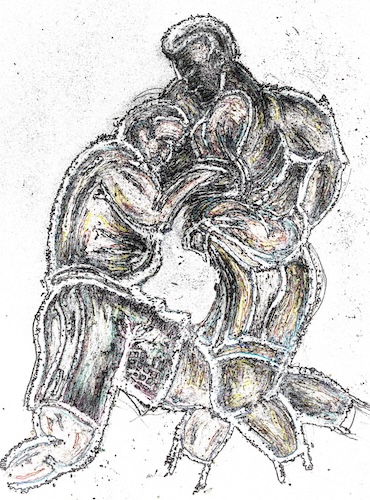
“You can’t win, old man,” Creed says. Toshihide lands two more shots to Creed’s ribs and Creed staggers. The crowd has been chanting for a while now, “Ka-mai-ta-chi! Ka-mai-ta-chi!” but Toshihide is under no illusions. He knows what will happen next. Don’t we all? This fight could last minutes, hours, days, our two boxers continuing to circle each other, Toshihide administering more body blows to the dry popping of Creed’s ribs; Creed countering, his fists slamming into Toshihide, and with each hit, Toshihide disappearing piece by piece like shavings cut from a joint of wood. “You can’t beat me,” Creed will keep saying, but by now Toshihide will have stopped listening—he’ll have already gone the distance, beyond the moment, and he’ll come to realize that perhaps nothing is as it appears, that our bodies are mere instruments for something we’re trying to learn, our lives loosening within us moment by moment to bring us to this final point, the final bell, Toshihide and Creed still punching until the crowd pulls them apart and the judges raise their score cards and the microphone drops.
Kaku: “Laaadies and gentlemen! We have a split decision!”
The crowd will start singing “Hotaru no Hikari” to the tune of “Auld Lang Syne”:
Before one knows it, years have passed.
The door we resolutely open . . .
Toshihide will spot Creed, his shoulders slumped, surrounded by a group of men and women, all singing:
This morning, we part ways.
Kaku will hold Creed’s arm up: “The winner, and still the undisputed heavyweight champion of the world . . .” and Creed will jump with his arms raised. Beer cups will fly through the air. The singing will grow louder. Some in the crowd will lift Creed onto their shoulders, others will slap Toshihide’s back and rub the crown of his head. Momoko, Toshihide will think. Where is she? There, pushing people out of her way, rushing towards him. When she reaches him, he’ll pull his gloves off with his teeth.
“Where’s your hat?” he’ll say. Her hat must’ve fallen off. But he won’t really care. She’s there now, with him. He’ll draw her close and hug her. Her skin will hold the blueness of heated wax. He’ll smell soap, feel her breath like hot tea. The ring will be so crowded he won’t be able to see Creed anymore.
“I love you. I love you,” Momoko will say.
“I love you.”
“I love you. I love you.”
And the confluence of bodies, the singing, Toshihide, Momoko—they’ll all converge into a single ball of light and float above the ring, the song gushing out as if it’s the last song ever to be sung.
G. S. Arnold
G. S. Arnold has an MA in English in the field of creative writing from the University of Toronto and works at a career college in Toronto, Canada. His work has appeared in literary journals such as The Malahat Review, Event Magazine, Ninth Letter, Asia Literary Review, Glimmer Train, Prairie Fire, and The Masters Review. His short story collection Pagodas of the Sun was twice a finalist for the AWP Grace Paley Prize for Short Fiction as well as the Prairie Schooner Book Prize, and it won both the Letter Review Prize and the Eyelands Prize for unpublished manuscripts. Along with receiving numerous Toronto, Ontario, and Canada Arts Council grants as well as a Pushcart and a Journey Prize nomination, his stories have been short or long listed in contests such as the Writer’s Union of Canada Short Prose competition, the CBC Short Story Prize, the international Bridport Prize for short stories, and The Masters Review short story anthology. He has recently finished his debut novel Sea of Clouds, set during the 1923 Tokyo earthquake, which was a finalist for the 2025 Killer Nashville Claymore Award for unpublished manuscripts.