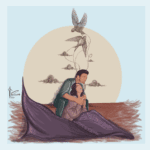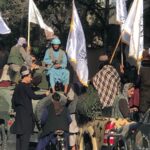
 Kabul Airport, 2024 | Mixed media on canvas
Artist Statement
I am Ali Rahimi, an Afghan artist working in the field of painting. In my works, particularly in my recent paintings, I utilize a vast and dark space upon which small figures are placed. This large empty space in my paintings is drawn from my life as a migrant; I believe that life in migration can be as ambiguous as this, where nothing is clearly visible. This expansive space is often black, and this visual composition symbolizes my feelings of loneliness and alienation in the contemporary world.
The dark and vast space transforms the work into a deep sense of infinity and void, while the smaller figures at the bottom represent the existence of individuals and everyday experiences that may disappear or be overlooked in the larger world. This inclination to portray the contrast between the vastness of space and the smallness of humanity allows me to express profound feelings of isolation, struggle, and the quest for meaning in my artwork.
The techniques I employ in my paintings include the use of contrasting colors and rich textures that add depth and dimension to the pieces. I believe that art is a tool for reflecting on human experiences, and I aim to provoke thought and emotion in my audience.
My goal in creating these works is to emphasize the human condition in the face of life’s challenges and to explore one’s meaning in a world that sometimes feels lost. I hope that my artworks invite viewers to reflect on their place and role in the world.
* * *
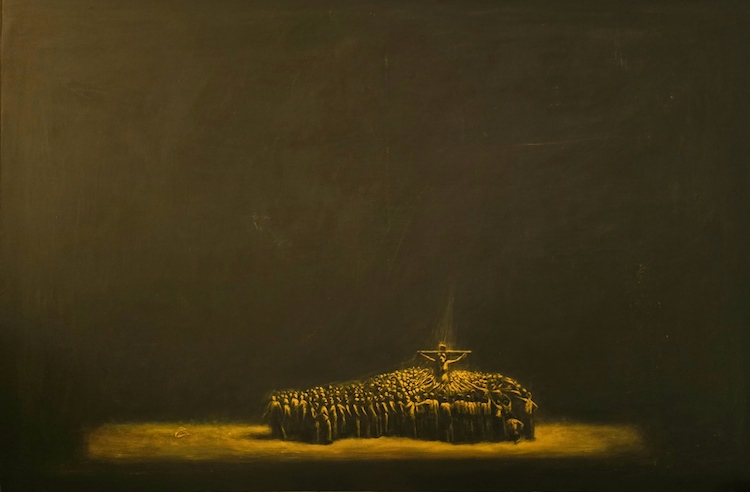 The Messiah is a Woman: A Quiet Place Series, 2024 | Mixed Media on canvas
AS: You grew up in Afghanistan but now live in Iran. Would you mind sharing what that journey has been like for you?
AR: I was born in Afghanistan and migrated to Iran at the age of seven with part of my family. Living in migration is different and difficult, but living in Iran as a migrant is much harder. The war and poor economic conditions in Afghanistan have forced many Afghans to migrate. The first destination for many Afghan migrants is Iran and Pakistan.
Afghanistan has long been the center of trade, culture, religion, and various military conquests. How do you think this history informs (or doesn’t) your artistic practice?
I live as a person in an environment, and the environment always has its impact. Afghanistan is a land that has historically been a battlefield for powerful governments. War, migration, poor economic conditions, and discrimination have grown in this environment and continue to grow. According to official statistics, about half of Afghanistan’s population is facing hunger, and approximately 6 percent of children lose their lives each year due to hunger. There are about ten million forced migrants who are either beaten in Pakistan and Iran or living in the worst conditions. Considering this environment in which I grew as an artist, it has certainly influenced the concepts of my work. Undoubtedly, artistic works with bitter content emerge from this environment, and if that weren’t the case, it might seem strange.
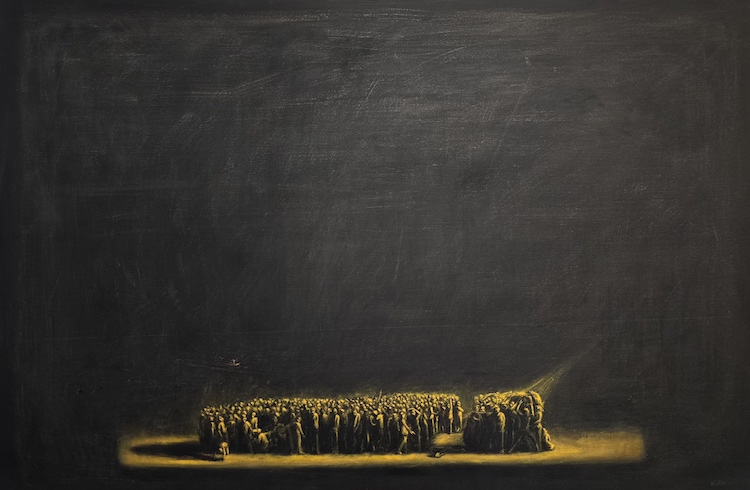 Dead Hero: A Quiet Place Series, 2024 | Mixed media on canvas
In your artist statement you state that utilizing empty space is a reflection on your life as an immigrant. Would you mind elaborating on this experience more?
The empty space in my paintings is very vast, yet it remains empty, possibly devoid even of air. The life of a migrant in a country like Iran or Pakistan, as I have experienced, resembles this black void—it lacks anything substantial. There is no such thing as a bright future; we may strive for many things, but at any moment, everything we have achieved could be taken away from us. Many of us lack even an identity. We don’t belong anywhere. Yet my subjects struggle in this expansive and dark space, trying to survive, trying to exist. It seems that a glimmer of hope remains, perhaps that one day everything will be set right. This hope, however small, can be a powerful force, driving us to persist despite the overwhelming darkness and uncertainty. Even in the toughest circumstances, the belief that change is possible can inspire resilience and a sense of purpose.
I also notice that quite a few of your works highlight the plight and resistance of women. Can you share how you explore this theme?
In Afghanistan, women have always faced oppression, and the same is true in Iran. This is a very serious issue in both countries. Our goal is to achieve a normal life that occurs in a healthy society—a society where we are not categorized based on gender, race, or beliefs, and where we do not face discrimination. In Afghanistan, men have yet to reach the awareness needed to stand beside women and advocate for their rights in society. As a man, I strive to work alongside women in my efforts, aiming to support and uplift their voices and rights.
 A Sunny Day: A Quiet Place Series, 2024 | Oil on canvas
What do you think are the benefits and challenges for contemporary artists living and working in Iran or Afghanistan?
Being an artist in Afghanistan has no advantages and is likely to put the artist’s life at risk as well. For this reason, many artists fled Afghanistan after the rise of the Taliban, while some were killed or imprisoned.
In Iran, becoming an artist is very difficult for a migrant because they are considered third-class citizens and, according to Iranian laws, must engage in hard labor.
However, being an artist has one benefit for the individual themselves, which is that a person gains awareness through learning art.
Is there anything else you would like to share about your artwork or your experience as an artist?
In the end, I want to say that art is a way of salvation for the migrant community and for Afghanistan, as it leads to awareness. However, unfortunately, there is no platform for education, and all these opportunities have been destroyed.
Powerful countries have turned Afghanistan into a battlefield and have never sought to develop this country. The result of this war has been millions of migrants in different countries, many of whom have faced beatings and discrimination, along with the hunger of millions of innocent people and the destruction of culture and humanity.
Every migrant carries multiple wounds from the bitter experiences of their life, and I have these experiences as well. I try to narrate these experiences, which may make my artistic works feel bitter.
 Civilization: A Quiet Place Series, 2025 | Acrylic on canvas
 Untitled, A Quiet Place Series, 2024 | Oil on canvas
 My Brother 1: A Quiet Place Series, 2024 | Acrylic on canvas
 My Brother 2: A Quiet Place Series, 2024 | Acrylic on canvas
Ali Rahimi
Ali Rahimi was born in 1995 in one of the villages of Daikundi province of Afghanistan. He lost his father at the age of five. Two years later, he migrated to Iran with a part of his family. He continued his studies in Iran until the graduate level. He was about ten years old when he began to learn painting and at the age of fifteen he continued painting seriously. He spent most of his life as an immigrant and is well familiar with the problems of an immigrant's life. Therefore, many of his works were formed with the essence of immigrant life. He has exhibited his work internationally with more than fifteen group exhibitions in Iran, Armenia, and Australia. He also had four solo exhibitions in Tehran.