Writing Classes
We offer both a sliding scale for each course and a reduced rate for those who can’t make a course
but would like to have access to the video recordings.
For more info, please email info@consequenceforum.org
Upcoming Classes
Seeing Through Your Poem: The Art of Revision
What: Revising can be difficult. Cutting parts you like, figuring out what might work better, determining if a section is working at all—these realities can make writing a less than enjoyable process.
In this class, we’ll focus on strategies to make this process less onerous and more fruitful. We’ll discuss, among other ideas, how to approach revision by making small and intentional choices, and why current practices may or may not be working. We will also explore and dispel many of the myths about the revision and editing process (i.e., it’s hard, it takes too long, etc.), the difference between the two (subtle, but important), and how to infuse joy and curiosity into these processes. We’ll also engage in several writing exercises and provide actionable strategies that will allow you a chance to practice these new techiques.
By the end of the course, writers will understand what revision is and how it serves the poet and their poems, have developed various strategies for revising their work, and have a curated reading list for future reference.
All levels of writers are welcome.
Who: Benin Lemus (she|her) is a Los Angeles-based poet, librarian, and educator. Her debut poetry collection, Dreaming in Mourning, was published in 2022 by World Stage Press. She is a 2022 Inaugural Workshop Fellow with Obsidian Magazine’s O|Sessions: Black Listening–A Performance Master Class and the 2022 Honorable Mention in the Furious Flower Poetry Center’s annual poetry competition. Benin served as the 2024 poetry judge for AWP’s Intro to Journals competition. She is an adjunct professor at Bennett College and teaches poetry at UCLA Extension Writers’ Program.
Where & When: Online: Saturdays, April 4, 11, and 18 from 12 – 2p ET
Class Limit: 12
Cost: $80
Seeking Peace through Poetry: Reading Palestinian and Israeli Poets
What: After more than two years of devastation in Israel and Palestine, and decades of loss and dispossession, those who care about the fate of all people on the land are heartbroken and weary. Poetry may not be able to repair broken agreements or bring the dead back to life, but it can help us pick up the broken pieces of our world, bear witness, and imagine a different way forward.
We will read Palestinian and Israeli poets in translation who express the human cost of war, the pain of loss, and the longing for home. Among the poets we will read and discuss are those who paid the ultimate price in this latest war: Hiba abu Nada, a Gazan poet killed by an Israeli airstrike, and Amiram Cooper, an Israeli poet who was taken hostage and died in captivity. Other poets we will read are Mosab Abu Toha, Adi Keissar, Hosam Maarouf, Tuvia Ruebner, among many others.
In each session, we will create a safe and supported space to read and discuss the poems. We will then engage in writing exercises inspired by the poems in which we will be invited to contemplate our own relationships to this fraught material. We will consider: How do we make sense of events we read about in the news that feel incomprehensible? How do we look inward during a time of war? What does home mean to you? What could peace look like?
You will leave the class with several poem drafts and an expanded sense of humanity that comes from bearing witness through poetry to the costs of war. All are welcome regardless of background, knowledge, poetry experience, or relationship to the topic.
Who: Hila Ratzabi is the author of the poetry collection There Are Still Woods (June Road Press, 2022), which won a gold Nautilus Book Award and was a finalist for a National Indie Excellence Award. Her poetry has been published or is forthcoming in Prairie Schooner, Narrative, Linebreak, Alaska Quarterly Review, The Adroit Journal, and other journals, and in The Bloomsbury Anthology of Contemporary Jewish American Poetry and Ghost Fishing: An Eco-Justice Poetry Anthology. She has taught poetry for the Hudson Valley Writers Center, Yetzirah: A Hearth for Jewish Poetry, Ritualwell.org, and other venues.
Where & When: Online: Wednesdays, April 8 – 29 from 7 – 8:15p ET
Class Limit: 15
Cost: $125
Flash Fiction as Resistance
What: Flash fiction can feel intimidating as a form. How can a writer convey a full story or emotion in under a thousand words? And how can we do justice to war and geopolitical violence in such a short space?
In this two-hour intensive, we’ll explore the power of flash through examples of published work from Consequence and writing prompts tailored to help you create a new piece around themes of conflict. We’ll discuss how flash can be a tool for resistance through hyperfocus on a particular image or the use of inventive structures. Through the compression of language, writers can communicate nuanced ideas and experiences that lend themselves to rereading.
By the end of this intensive, students will have 1) A draft or outline of a new flash fiction piece themed around the human consequences of war or geopolitical violence, 2) developed an understanding of at least three tools for approaching flash fiction as a genre, and 3) a deeper understanding of the purpose and possibilities of flash.
All levels of writers are welcome
Who: Diane Callahan is the former Fiction Editor for Consequence as well as the Managing Editor for Story Garden Publishing, an indie writing co-op. She strives to capture her sliver of the universe through writing fiction, nonfiction, and poetry. Her YouTube channel, Quotidian Writer, provides practical tips for aspiring authors. You can read her work in Aseptic and Faintly Sadistic, Short Édition, Tales to Terrify, Translunar Travelers Lounge, and The Sunlight Press, among others.
Where & When: Online: Saturdays, May 2 from 12 – 2:30p ET
Class Limit: 15
Cost: $30
Translating Poetry
What: Translating poetry is not merely a semantic or a lexical exchange. It requires one to have empathy, something that goes beyond one’s linguistic identity and enables us to see a different world altogether. In sombre times like what we are facing today, translating poetry can become an act of resistance or a symbol of resilience.
These two sessions aim to provide insights into the theoretical intricacies involved in translating poetry. Participants will translate poems that speak to the larger context of broken homes and violence. Though both sessions are designed to be standalones, the second session will build off of and further develop ideas and skills explored in the first.
By the end of these two classes, students will not only hone the translation skills but will also enhance the confidence to translate complex texts.
Who: Dr. Fathima M is an academic based in India. She teaches various graduate courses, including Translation Studies and World Literature. She was a Fulbright scholar at the University of Texas at Austin from 2017–18.
Where & When: Online: Saturdays, May 9 – 16 from 10:30a – 12:30p ET
Class Limit: 10
Cost: $35 for one class (either one) / $60 for both
Previous Workshops
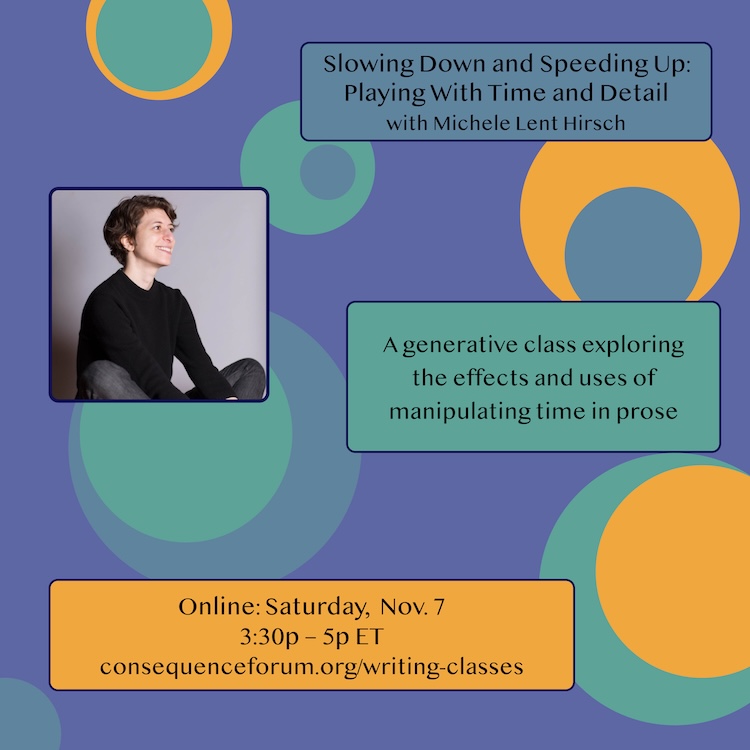
Slowing Down and Speeding Up: Playing With Time and Detail
What: Even when we write about less difficult subjects, choosing what speed we use to recount them can change our own, and our readers’, understanding. If we’re reflecting on how conflict affects our world or the people we come from, experimenting with time and detail can make a big difference.
When might zooming out or zooming in, speeding up or slowing down, help us convey the profound effect something has had on us, our family, our community? What happens when we play with the pace of events in unexpected ways?
We’ll read a few short examples together, talk about how they expand or compress time—and use them as prompts to try some new writing of our own. By the end of class, participants will have new ways of thinking about pacing and detail—the big picture and the small—as well as examples and drafts to keep experimenting with.
How to Write the Where: The Role of Place in Your Writing
What: Place. Whether you are writing memoir or fiction, it is easy to forget that place can, and should, be an essential character in your story. The taste of the dust, the drip of the rain, the smell of the diesel—by weaving multi-sensory descriptions of where your story takes place you make the story more visceral, accessible, and impactful.
This two-session class (four hours total) will combine short readings (PDFs provided in advance), lecture, generative exercises, and discussion to give each student an understanding of the many ways in which they can bring place alive, as well as hands-on practice in integrating this into their writing practice.
At the end, each student will have a better understanding of the role place can play in their writing, and concrete ideas on how to apply these concepts.
All levels of writers are welcome, especially Vets and those affected by conflict.