Credit: Benjamin Busch
“Hale? Who is Hale?”
The bartender told Jacob that she hadn’t seen Hale, that besides, the description he’d given her matched hundreds of foreign men in the city. Then she said he needed to order or step out of line. He felt his face crumple a bit. It had been a long day getting here. This place was his only lead, provided by a short Reddit conversation he’d found online. Then the bartender took something like pity on him.
“We are more for press and volunteers,” she said. Her voice was colorless and her accent thick and clumpy, at least in Jacob’s ears. “The fighters go elsewhere.” Then she drew a map on a napkin to an Irish pub deep in the Podil district. If she heard Jacob’s appreciation, she made no sign of it, turning to pour shots of rum for the group behind him. Jacob shuffled out of the way. An attempt at repeating himself strangled out in the folds of his throat.
“You’re Fay’s camera guy, right?” A young man with eyes far too sour for his bare face looked over from the line. “Kharkiv was some crazy shit.”
Jacob didn’t bother with a response. He’d never held a TV camera in his life and couldn’t have pointed to Kharkiv on a globe with a gun to his temple. He’d been in Ukraine all of nine hours and was feeling every day of his fifty-four years surrounded by drunk child journos with mean ambitions. He walked to the stairs, the vibrant percussions of the band on stage following him upward.
Strange place for salsa music, he thought, but what the hell. It made about as much sense as anything else. All wars were the same in this way. They attracted freaks and goons and lost souls like bugs to a picnic, and only a newly-arrived freak could ever see it straight. Jacob hadn’t felt new in a long time. What had been the name of that hotel in Erbil? There’d been a swimming pool in the basement and plates of toasted English muffins in the morning and an honest to Christ sword-swallower who performed at Saturday dinners. People stateside always looked at him crazy when he talked about English muffins in Iraq, but what did they know about the world?
Jacob held little regard for civilians. They weren’t like him. He wasn’t like them. He’d stopped thinking he could be around the time he’d stopped feeling new.
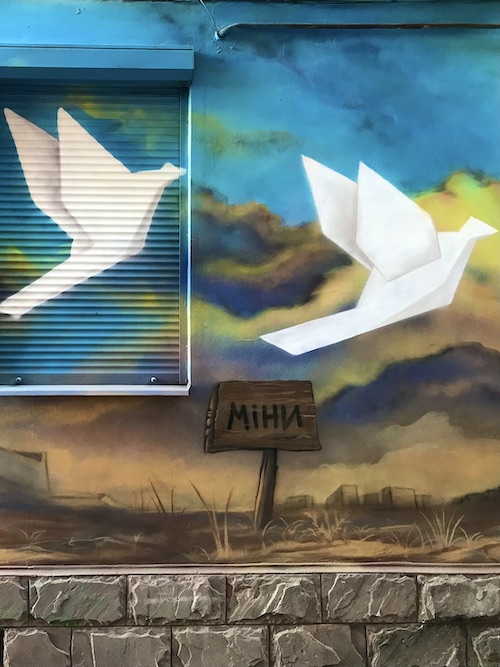
He followed the napkin’s directions through Kyiv. He passed a military recruiting poster marked in Ukrainian script, then a mural with doves flying over barren ruins. The air was wet and dark and the sidewalks steep and clean. Jacob admired neatness in a foreign country. It was a rare thing, he thought. Even America no longer valued it the way he thought it should.
As with anywhere, the people of the city maintained a pattern to their steps. They were hurried here, decided. Jacob fell into it with simulative grace. He hadn’t spent decades in procurement without learning how to recognize local rhythms. A shabby peacoat, dark slacks, and off-brand dress boots he’d found in an Abu Dhabi bazaar conveyed he could be anyone, from anywhere. Any big-shouldered, middle-aged white man from anywhere, at least. He was surprised at how many others weren’t even trying. Along every avenue, on every corner, he saw olive-drab puffer jackets, snapback camo hats and worn, desert-tan boots that all but shouted Western military veteran, please clap.
Fucking kids, Jacob thought. They all want to look like operators now.
He paused under a streetlight to square the napkin with Google Maps. The robot in his phone recommended a nearby monument to Afghanistan veterans. Hey now, Jacob thought in response, I wasn’t Red Army. Still, he might explore the thing the next morning. A smile reached his lips as he imagined the ironies of someone like him paying homage there. Well, why not? They’d had a shared enemy. And a shared defeat. One of Jacob’s guilty pleasures these days was reading articles about the Taliban grunts struggling with the drudgery of city administration in Kabul. Turned out, fighting an empire was easier than regular life.
The Irish pub lay exactly where the napkin said it would. He took a stool at the bar and looked around under hooded eyes. It was half-full, less crowded than the first place had been, heavy traces of sweat and testosterone coursing the dim air. A Brit with bloated cheeks and a stub of an arm was sermonizing at a booth about the international legion’s advances at the front. The audience of youngish, bearded men holding pint glasses was rapt, Jacob saw, though one in the corner with a subdued American-flag ballcap watched him watching them. Jacob watched back until the other man glanced away. The old paranoia, he thought. Everyone wary that everyone else wasn’t who they suggested; everyone not-so-secretly thrilled by the same prospect.
Jacob understood. He’d stuck around the fringes of war, become a defense professional, for the same huffs of purpose. Turned out, fighting for empire was easier than regular life too.
He shifted his body and focus from the booth toward the bar, waiting for someone to come take his order. His eyes found a display case mounted to the wall next to a cheap pendulum clock of a black cat with a wagging tail. Various velcro patches and emblems filled the display—most with symbols he didn’t recognize and figured Ukrainian, and a few that he did, Royal Marines and French Foreign Legion and the Screaming Eagle insignia of the 101st Airborne. In the top left corner of the display case stretched a nametape. It was American, MultiCam pattern, the kind soldiers had worn in Afghanistan from the surge there a decade past all the way through the withdrawal. Blocky, all-caps letters spelled out the nametape’s owner, and Jacob felt his blood turn alpine.
“Did Joey give you that?” A bartender had neared. Jacob attempted no caution. “Do you know? Is Joey here?”
He flitted his attention from the “HALE” nametape in the display to the person who should be asking if he preferred stout or whiskey. It was a woman, tall, stocky, mid-twenties or so, with angled black bangs and a messy chignon. She crossed her arms, scrutinizing Jacob as if he were more nemesis than nuisance. A tattoo of a clenched fist splayed across the side of her neck, gleaming in bright, fresh ink.
“Joey has not been here for some months,” she finally said, her words careful, deliberate. “If you locate him, I would very much like to know.”
He peered over the bar top. He was half-expecting a belly bump, but firm abs instead emerged under a cropped sweater. He returned to the woman’s face and watched her watch him. She had grabbed a tumbler glass and sipped an amber-brown liquid from it. Something approaching recognition was reaching her glare.
Not pregnant, Jacob thought. That’s good. That’s one thing my son hasn’t done wrong over here. For the first time in weeks, a little relief brushed over him.
*
In 2017, the satirical website The Onion published an article about Jacob’s war. “Soldier Excited To Take Over Father’s Old Afghanistan Patrol Route,” the headline read. Jacob laughed when he first saw it. Then a couple dozen people texted or emailed him the same article over the course of the next month. He considered it less funny each time.

Jacob found himself remembering that article and his various responses to it a half-decade later in a café many miles and hours west of Kabul. He’d spent a tour there early enough in the war that they’d thought it was nearing an end. He’d been what they called a pogue, an enlisted supply chief far better at the logistics of bullets than the shooting of them. He’d slogged through twenty-two years of service to earn a retirement check and the right credentials to join most any mid-sized defense contractor the world over. He’d had a plan and he’d held to it, even as life in the green machine cost him a marriage, a functional shoulder, and interest in normal civilian matters like movies or sports.
Joey, his only child, his pride and joy, his little clone, proved a different type of soldier. Brawny and driven, Joey had made it as a trigger-puller to Bravo Company, 3rd Battalion of the fabled 75th Ranger Regiment, something Jacob suspected was a bit of a middle finger to the career choices of his father. One phone call every Saturday and one week of summer vacation at whatever dustland base he was stationed at was more than Jacob had received, paternally speaking, but Joey “needs more from you,” his ex-wife always chided, and sometimes, Jacob even thought she might’ve been right. One of those instances had been when Joey called him from jail, asking for bail money. Apparently a BAC of 0.21 and telling a highway patrolman “I hope your next blowjob is from a shark” was frowned upon in Georgia. Drummed out of the Rangers, a second DUI and other-than-honorable discharge soon followed.
Jacob knew his son had come to Ukraine in pursuit of a second chance, maybe even redemption. Instead, it seemed Joey had only found more of himself.
Jacob checked his watch again in the café, squinting through a vine of morning sunlight curling through the tableside window. Half past ten; the Ukrainian fixer was fifteen minutes late, which he considered a poor sign. Jacob valued punctuality, not so much because the military had drilled it into him but because business had. You could trust punctual people, Jacob believed. It meant they recognized time was finite and so was money and the lone thing that mattered more than either was breathing. An acquaintance of an acquaintance affiliated with the State Department had passed along a phone number with assurances this “Petro” was legitimate. Something which mattered to Jacob less and less with each larcenous second that went by.
“Mister Hale?”
The voice arrived with a tentative hand on the shoulder. Jacob felt his body spasm. He let his chest settle for a few beats before instructing the young man who’d snuck up on him to sit down.
Petro—who insisted Jacob call him P3, because that’s what the Green Berets had called him at the NATO base at Yavoriv before they’d left the country at the order of President Biden—dressed in the outfit of modish cosmopolitans everywhere, skinny black jeans and a charcoal-gray turtleneck. He was in his late twenties, Jacob thought, no older than Joey, with the same sour eyes of the child journos he’d encountered the night prior. Petro smelled of fruity cologne and kept rubbing at the dark scraggles of his goatee as he listened to Jacob explain what he needed in an interpreter and fixer.
“So I guess P1 and P2 aren’t available?” Jacob had meant it kiddingly, but it was answered in high earnest.
“Negative,” Petro said. “P1 joined the army after the invasion. His unit now fights in Bakhmut. P2?” The young Ukrainian shrugged. “Last I know, his mother was paying a Moldovan gang to smuggle him out.”
Draft dodgers, Jacob thought. Don’t read about them in the Western newspapers. He asked Petro’s rate.
“Two hundred dollars per day. Plus expenses.”
“American?”
Petro nodded.
“Why dollars over hryvnia?”
The Ukrainian sniffed. “Better to be a safe ass than a sorry asshole. The Green Berets teach me this. I have a Labrador puppy at home. I must be a good protector for him.”
It was as fine a response as any. Jacob felt his face bend with assent. He asked the dog’s name.
“Franko. We call him Frank.”
“You named your pup after the Spanish dictator?”
For the first time, Petro allowed himself to frown. Jacob didn’t mind. It was an honest reaction. It made him trust the kid more.
A Kyiv hipster, he thought. Who says soft power ain’t real?
“I don’t actually care.” Jacob interrupted a history tutorial about another Franko, some dead socialist poet. The bartender at the pub had mentioned a medical charity. He asked Petro what contacts he had in that world. They’d begin there.
*
Joey’s Christmases as a boy were spent with his mom, with one exception: in middle school, during a particularly rebellious phase of teenage delirium, she’d fled the continent for a Caribbean vacation with a boyfriend, leaving Jacob the dual responsibilities of warden and Santa Claus. He’d been stationed at Fort Riley and had just undergone the first of four shoulder surgeries for a torn labrum. Which meant that while he’d intended to prepare for a nice domestic holiday with his only child, he’d never gotten around to doing so until a reedy skater kid with blue hair and a new Adam’s apple the size of a billiard ball stepped off the plane and asked what the hell there was to do in freaking Kansas.
Unsure how to answer that, Jacob had driven them to the local Buffalo Wild Wings. Jacob liked their ultimate nachos, and it was known as a place where senior noncoms could congregate and officers and junior enlisted would not. But then he didn’t know how to speak to his son. None of the old talking points landed. For his part, Joey seemed to have no interest in even trying. Jacob was dreading bringing the boy home to a bedroom with bare walls, a mattress on the floor, and Ninja Turtles sheets he’d found in storage. He’d ordered a second and third Bud Heavy in quick succession. Meanwhile, Joey got bored and started flinging coasters at a nearby booth to try and get a girl’s notice.
“Stop it. That’s the Sergeant Major.” Jacob had flashed the Sergeant Major and his family a taut grin before promising his son forty dollars if he’d behave. When he reached for his wallet, though, a loud crack sounded from his freshly-repaired shoulder. A thunderbolt of blinding pain followed. He’d removed his sling that morning, weeks early, to not look feeble in front of his boy.
“Shit, Dad. You okay?” Joey’s voice cracked about as much as Jacob’s shoulder had. Jacob swallowed away his wincing, best he could, and pulled out the two twenties.
“How’d that happen?” For the first time since arriving, Joey appeared attentive, engaged, even interested in something to do with his father’s life. “The war?”
They’d never before discussed Afghanistan, not in any substance. Which had suited Jacob fine, because he hadn’t had much to say. Pogues did not leave the large bases. Pogues did not come home with war stories. But as a teenager with a mercurial air stared at him with his own face, his own hooded contemplation, he knew telling the truth—that he’d hurt himself unloading frozen pork riblets for the dining facility at the Fort Riley airfield—would not suffice. This was a moment to connect. This was a moment to bond. This was a moment for outright lying.
He’d nodded, solemn as a zealot.
“I was one of the lucky ones,” he’d said.
Had it been worth it? Jacob wondered, some fifteen years later, in a rental car pushing south from Kyiv, more than half-a-world away from that Buffalo Wild Wings that almost definitely still hosted awkward conversation between senior noncoms and their visiting offspring. Had it been worth the ten minutes of respect and awe, tricking Joey into thinking his old man was something more than he was?
Something cold and clawing twisted in his chest.
Yes, he thought. Crazy thing is, it had been.
Petro was steering with both hands, his seat forward and back straight, as prim and particular behind the wheel as he was with his goatee. Maintaining the exact speed limit was causing Jacob some consternation, but the fixer said this wasn’t America, there were rules in Ukraine, and they were to be abided or a highway camera would notice. So Jacob focused on the terrain. It was pretty country between Kyiv and Dnipro. Harvested fields of wheat ran along their sides. A falling sun traced them with amber light. It’s hard to believe there’s a war on here, Jacob thought, or anywhere close. But that was the difference between calm and peace. An appreciation for what was instead of idle assumption that it was just supposed to be like this.
“Ever been to Dnipro?” Petro kept trying to force small talk. Contracting had plenty of these sorts, folks that needed to fill the void of silence either to pass the time or because they were energy vampires. Jacob only shook his head. The vastness of his ignorance for all things Ukraine was not something he felt like revealing.
“Good city to be a bachelor. Even with your age, Mister Hale. Though they speak too much Russian. It makes my guts howl.” The fixer reached with his right hand for the vape in his skinny jeans, then recoiled. His fruity cologne hadn’t been cologne at all but the permanent stench of electronic cigarette. And Jacob had made it quite clear there was to be no smoking in the rental.
“Anyways. I know places where you can meet ladies of your generation. We cannot look for your son without breaks. It is important to rest. A teaching of Christ himself.”
They’d learned from the medical charity in Kyiv that Joey had worked for them for only three weeks after getting booted from the international legion. That was when he’d stopped responding to his father’s emails, and one of the self-described volunteers, a Canadian with a lumberjack beard, had commiserated with Jacob over the endless depths of paternal agony.
“I got four back home, worry about them every minute,” he’d said behind big, metallic sunglasses. “You sure look like Joey—you must be his pops.” Then he’d supplied the name of a group of gunrunners in Dnipro.
“What’s this have to do with my son?” Jacob had asked, firm but polite as he could manage.
“Not for me to say,” the Canadian had replied. “But I believe that’s where he was headed once we told him to get going.”
Jacob hadn’t needed to ask about that. It was the same reason the legion had given him the axe. Pills and booze, unpredictability and rage. All poor ingredients to mix with violent men in a conflict zone.
“Why Dnipro?”
“I suppose,” the Canadian had said after pondering the question, “that type of aid needs to keep away from the flagpoles of a capital.”
“You travel much?” Petro dragged him back to the moment, changing lanes to get around a sluggish farm tractor. “Or are you one of those who rarely leaves America?”
Jacob stared at the driver, hard. He considered himself a man of the world. “What do you think?”
The Ukrainian chuckled. Not laughed, Jacob noticed, but chuckled.
“The wrinkles on your face say you have seen much. But your boots?” Petro wiggled an eyebrow. “Walmart, yes?”
“The fuck?” Jacob was incensed. Had this punk negotiated million-dollar contracts in conference rooms across Abu Dhabi? Had he pitched a two-star general on the merits of state-of-the-art route-clearance hazard rollers minutes after a mortar attack in Kandahar? Had he ever hustled the full length of Amman during high July on the dubious tip of a taxi driver to talk brass tacks with the freaking sheik of sheiks?
Jacob racked his mind for something that would impress this fool, this child, baiting him. “You damn mouthbreather. What do you know? You ever seen a sword-swallower in Erbil?”
Petro allowed that he had not. Then he tilted his head. “Is this like a sex show thing?”
Jacob could only growl.
Three hours into the drive, about halfway to Dnipro, Petro stopped at a gas station for a vaping break and a hot dog. Jacob got out to stretch. When Petro returned, he asked Jacob who he’d voted for.
“Trump, of course.” Politics was a civilian matter Jacob did indulge. His one core belief was that work was what separated people from monkeys. He peered at the Ukrainian from the sides of his eyes. He thought about the Labrador puppy’s name, which Petro had insisted was a joke. “Why?”
“Do not get it bent. I am like you, a capitalist.” Petro merged them back onto the highway. “Reagan, what a chief! But Donald Trump …” The other man trailed off for a bit. “We are not maybe sure what to think of him here.”
Jacob considered that. “Yeah,” he allowed. “I can see that.”
A few seconds later Petro added, “But it was Joe Biden who made the Green Berets leave. So.”
“Why haven’t you joined up?” The question had come to Jacob the night before in his hotel, when he’d been trying to sleep and failing at it, and trying not to think about Joey, and failing at that, too. To him, this seemed a situation where every able-bodied man with any sense of pride, national or otherwise, should be in uniform. “Like your friend, P2.”
“P2 left. It is P1 who enlisted.”
“Sure. Okay.” Jacob kept his hooded stare fixed on the car’s driver until Petro finished chewing his last mouthful of hot dog.
“I would say that I exist ethically and philosophically between P1 and P2. One is very brave and loves Ukraine. He is maybe not the smartest, though. One is a big coward and loves only himself. Yet also the smartest person I have ever known.” Petro sighed with his nostrils. “They are maybe both correct, I think. I am one of those terrible people who can see both sides of any idea.”
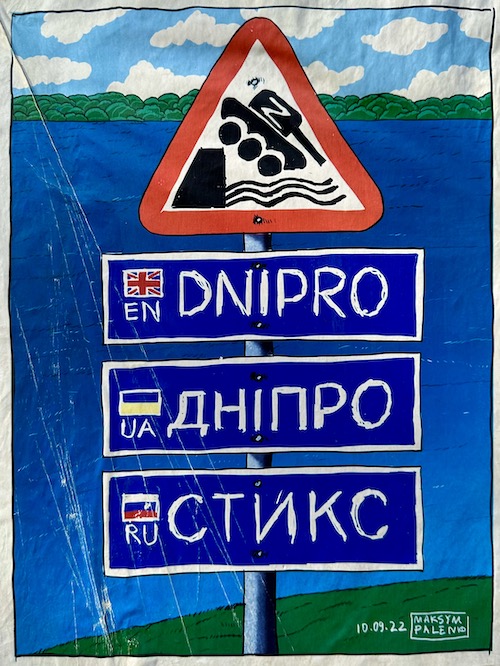
Jacob turned his gaze back toward the passing fields. He thought he had his fixer pretty well pegged now. A little spoiled, overeducated to the point that his natural instincts for right and wrong had been neutered. Then the younger man surprised him.
“You maybe know from the news last year, the Russians destroyed Yavoriv with cruise missiles. I went to help that day. My office was there. My body armor, my helmet, were there. It was all gone. Everything was craters and smoke. The missiles landed before light, most hit the cafeteria and the barracks. Some of our soldiers died in their sleep. Same with international volunteers, the ones who got here early.
“It was the first time I saw bodies like that. It was the first time I carried the dead.” He paused and jutted out his chin, his lips searching the recycled air in the rental for something beyond words. “It was—I don’t know.”
Petro stopped and squinted into the road. Jacob didn’t press the memory, though he found himself curious about it. Just a kid, he reminded himself. The stink of fruity vape drifted through the car. They maintained the exact speed limit southbound on the highway. A hollow dusk loomed at their flanks.
*
“You should have paid for the SUV, Mister Hale. All roads in Ukraine off the highway are bad. Not like this, this is stupid bad, but still. Bad.”
Petro was navigating their rental through an access road so littered with craters it might as well have been the moon. Jacob couldn’t stop worrying about the car’s suspension—and had yelled at the fixer a few times about it—but there was no way around some potholes, just through them. Jacob held his breath as they crunched over a particularly deep rut.
Dull sun kept trying to peek through low woods. Through an open window they could smell and hear a river even as they couldn’t see it. Petro mumbled something low to himself about needing a vape. Jacob ignored it.
Google Maps had them forty miles outside of Dnipro, headed toward a village with a name Jacob found unpronounceable. In the city, a journalist at the Reporters Without Borders office had directed them to a popular Thai restaurant. The hostess there pointed them across the street to an empty park. The security guard in it had claimed ignorance until Jacob played, yet again, the father card. The guard pantomimed a phone next to an ear, then stepped away. During the wait, Jacob studied a makeshift memorial dedicated to neighborhood civilians killed in Russian strikes. The faces were mostly women and mostly old, and there was a kid too, a toddler. Jacob avoided really looking at that photograph until he didn’t. Fifteen minutes later, the guard returned and gave them the address of an area farm they should be at the following morning.
This was that following morning, though Jacob wished the security guard had given them some kind of warning for the route. Not that it would’ve changed anything. Countryside like this, he knew, had only one way in and one way out, whatever part of the world. It reminded him somewhat of a long, lonely strip of asphalt near a canal. Where had that been? Kandahar, he thought. Freshly paved and pristine, contracted out through a local warlord, paid for by the faraway American taxpayer. No, he thought again, it was that same year but a different country, Taji, among the strange batch of rice fields right before you hit the Anbar desert. No, no, that’s not it, he thought, I’m thinking of the wrong trip, there were those design samples in my old leather briefcase of surveillance drones, which meant it must’ve been—
“We are there.”
Jacob followed Petro’s words to a low-roofed building in the near distance. It was modern, made of clean softwood and large, outsized windows, the kind of design Jacob would expect to find in a wealthy exurb of Silicon Valley. The surrounding field burst with wild overgrowth; no crops had grown here, Jacob observed, for at least a season or two. The craters of the access road soon smoothed out into a long gravel driveway. In it were parked three pickup trucks lacquered in green metal spray paint, and one sleek, gloss black, extended-length Range Rover. All the vehicles sparkled with carwash clean.
“That is what I am talking about!” Petro’s voice sounded in a timbre just beyond irony. “They paid the SUV price.”
They idled behind the last truck. They’d been told to wait. Three, four, seven minutes later, the front door of the softwood house opened. Out stepped two burly, bearded men with wraparound sunglasses and pistols holstered on their hips, then a diminutive woman. The men stayed on the porch. The woman walked to the gravel. She wore a corduroy trucker jacket and basic Nike sneakers. Her hair was gray and her face angular. Jacob figured her to be about his age.
“Please stay in your vehicle, Mister Hale,” she said, as Jacob unrolled his window. She stopped an awkward distance away, ten feet or so.
Jacob asked her name. She ignored the question.
“I’d invite you in. But.”
But what, she never said.
“I’m looking for Joey. I’ve been told he was with you all for a few months. I’m just here to take him home.”
The woman pursed her lips in deliberation. “You look like him,” she said.
“Yes,” he said.
“He spoke of you.” She didn’t look or sound Ukrainian, Jacob thought, though her accent was so slight and measured he couldn’t place her. She could be anyone, from anywhere, a woman of the world. “You work in contracting, yes?”
Jacob gave a hint of a nod.
“He was good. Natural feel for the business. We deal in transportation, so it’s not quite the same, but I thought you would like to know. He would talk of going to work with you someday. In the future, after the war.”
This surprised Jacob. He’d tried to get Joey involved with his company after the second DUI, but his son thought it was beneath him and wouldn’t listen. He never listened, always had to do things his way which, invariably, proved the harder way.
As for this, defense procurement and gunrunning may’ve operated in the same realm, but no, they were not the same. Jacob doubted very much anyone at this farmhouse had taken a government compliance course. Black was black and gray was gray. He tried to maintain a blank face. It wasn’t enough.
“You do not think we are similar?”
Jacob said nothing.
The woman sniffed through the brittle air, causing the trench lines in her forehead to crease. “No saints or devils here, Mister Hale, and that includes you.”
People like her, Jacob thought, always said stuff like this. Yet black remained black and gray remained gray. A debate for another time.
“I’m here for Joey,” he said again.
It was the woman’s turn for a slight nod. “Your son has a habit,” she said, “one that costs money, one that caused him to make a poor choice with funds that did not belong to him. There are no second chances in this work, you know this. It was good for him, being a guest here, being a guest from America.” The woman sneered, not so much at Jacob as at an unspoken memory. “I believe he went on to Odesa. A tax attorney who has helped Joseph before. Perhaps he is again.”
“Much obliged,” Jacob said. “I appreciate it.”
The woman then gave him a look, a curious look, he thought, one that seemed to be wondering why he’d thanked her. But all she said was “Business.”
Returning the way they came, Jacob and Petro sat in silence as their rental crunched along the access road. The day was opening up. A marble sky blinked down from above. Jacob’s bad shoulder began aching, which didn’t make sense. He hadn’t lifted anything hefty.
He knew that the woman had suggested they would’ve killed Joey if he hadn’t been American. She’d wanted Jacob to know that, too.
They would’ve killed him, he thought again.
As they reached the end of the ruts, Petro grunted, almost like a pig, as if he’d realized something. He hadn’t spoken since they’d arrived at the farmhouse.
“Though I do not know your son, I think maybe I understand him,” he said. Jacob shifted his posture so he could see the fixer, square. “I told you before that I am between P1 and P2.”
“You did.”
“Your son, maybe he is between the charity people and those ones.” Petro nodded to himself. “Which is where most of us are, I think.”
Blacks and grays, Jacob thought yet again. He shifted back toward his window. Just then something with a rocket engine flew over them, far above the rental car. It sounded like a small plane but faster, louder. His eyes went wide and his body went taut and then the sky cleared out.
“The hell was that?”
The noise of nothingness returned.
A missile, the two men decided. A fucking missile. They used their phones later at a gas station to try and figure out the target. A nearby base? A power plant? A hotel in Dnipro?
No strike anywhere had been reported.
*
Jacob had never let his pogue status get to him during his own years in the green machine. If the infantry grunts and cav scouts and artillerymen needed to put down others to validate their own expendability, so be it. But in the innermost chambers of his heart, deep in a place he dared not often venture because of what it revealed about himself to himself, he knew he’d never felt more unnecessary than he had at Joey’s graduation from Ranger School.
It hadn’t been the ceremony; he was used to parade and pomp. Nor had it been Joey asking his mom to pin on the hyper-coveted black and yellow Ranger tab instead of him, even though she’d only ever been a dirty, regular civilian. Nor had it been the macho peacocking atmosphere that had zero appreciation for the logisticians that allowed most everyone there to play at Rambo. Nor had it been Joey’s snide remark about support soldiers at lunch after at the nearby Outback Steakhouse, nor even had it been the presence of his ex-wife’s new husband, a smiley man who had the audacity to want to be Jacob’s friend.
It’d been something else.
In Odesa, Jacob recalled that day and the lunch at its center, plain as could be. Memory being the strange faculty that it was, something about the tax attorney—his bearing, his loudness, the pervasive sense of entitlement—brought Jacob back to those hours he’d spent amongst the Rangers, feeling awkward and dismissed.
“He. Is. A. Thief!” Sergiy the tax attorney was thundering away on his back porch while Petro nodded in commiseration and Jacob studied the swirling foam that capped the espresso that’d been thrust in front of him upon their arrival at the attorney’s home. The smell of sea was in the wind, and even Jacob, grumpy as he was, found himself admiring the hillside view of the restless water beneath them. It contrasted mightily with the tenor of the conversation. “Joey Hale is an insane liar!”
Jacob had understood his boy had issues, that his boy needed help. “A habit,” the lady gunrunner had termed it, just before she’d insinuated at murder. He hadn’t come to Ukraine to hear stories about Joey the altruist, or Joey the hero. Still. There were only so many times someone could get away with calling his only child, his pride and joy, his better-than-he-ever-could-be-or-ever-dreamed-of-being clone, a piece of shit.
“Is it my son’s fault,” Jacob hadn’t remembered rising from the table but there he was, upright and hostile, wagging around a plump index finger, “that you couldn’t tell the difference between real night-vision goggles and an eBay toy?”
Sergiy the tax attorney had kept a catalogue of grievances for all things Joey. They’d met by chance months before, in an elevator of an upscale Odesa hotel. (“By chance.” Sure, Jacob thought. The guy didn’t even know how much of a mark he was.) Joey had put Sergiy and some pals through a mini boot camp, of sorts, in case the Russian ground invasion reached Odesa, tailored around the attendees’ ages and dinner plans, of course. As a thank-you gift, before Joey departed for the international legion, the attorney had purchased him a $13,000 van, decked out and combat-ready, complete with a stealth mode for night missions.
The van never made it to the front in Kherson, or Donbas, or Kharkiv. Joey had totaled it ten days after getting the keys in some party district of Kyiv. By then, the attorney had met some other Westerners milling about who knew what genuine, high-tech, and high-priced white phosphor night-vision goggles were, and what a sixty-dollar knockoff set looked like. When Joey had returned to Odesa the month prior with a vague notion of standing up a volunteer battalion in Sergiy’s name, the attorney had turned him away cold.
“He did not look good,” the attorney kept repeating. “Big pupils. Speaking super-fast. Needed a shower.”
There were other equipment complaints as well, a wish list of ballistic helmets and headsets and rifle scopes that had been placed through Joey but never delivered. On the porch, Jacob sat back down, waving it all away.
“Just tell me how much he owes. Other than the van. You said yourself that was a gift.”
“Seventeen thousand, five hundred. American.” The tax attorney spat out the figure in precise English. “Not that I need it. It is the principle.”
“Yeah, yeah.” This was small-time nonsense, Jacob thought. A half-assed scheme of fake and bootlegged gear. Though part of him did admire the boldness of the operation. “Natural feel for the business,” the lady gunrunner had said. If he could ever get Joey clean, maybe …
“He is troubled from Afghanistan. It is evident.” On his own back porch, Sergiy sounded more like a judge than a lawyer. “He must go home.”
“That’s why I’m here.” Jacob rubbed at his bad shoulder again. It was getting worse, and the muscle cream he’d found at a pharmacy only did so much. Must’ve slept on it wrong, he thought. Life was funny. Survive a random missile then get injured like that.
“Sons should not have to pay for the sins of the parent,” the tax attorney said, gesturing down toward the Black Sea for whatever reason. Silly name, Jacob thought. It looked blue as could be to him. He’d heard they’d mined the beaches. “But we fathers do not get the same luxury.”
“That’s not what the Bible says.” Both older men shifted toward Petro, bafflement splaying across their faces. The younger man blew out a puff of fruity vape from the side of his mouth before continuing.
“‘The son shall not bear the iniquity of the father, neither shall the father bear the iniquity of the son: the righteousness of the righteous shall be upon him, and the wickedness of the wicked shall be upon him.’”
No one said anything until Petro shrugged. “Used to be religious,” he said. “I studied it all the way to university.”
“Do not do this strange smoke on my porch,” the tax attorney replied.
Jacob ignored them both. He’d settle his boy’s debt in short order. But only a sucker paid off liabilities without getting something in return.
“So you don’t know where he is now.” The attorney shook his head. “And you couldn’t even guess where.” The attorney shook his head again. “If you needed to, though, could you get ahold of him? Or get ahold of someone who could?”
At that, the Odesa tax attorney finally nodded.
*
They found him in a crack house in Mykolaiv, a shipping city farther east along the coast, close enough to the southern front that the fixer requested a hazard-pay bonus. His son was disoriented but alive, exactly where another legion washout had relayed they’d locate him. And the tax attorney proved to not be such a bad guy, after all, putting them up in a vacant apartment he owned while Jacob figured out their next steps. Which was nice, considering.
Jacob carried the top half of his inert son, Petro the legs, and his bad shoulder did him the courtesy of not giving out until they completed the task. Petro asked for the evening off to see a friend who lived in the area. Jacob consented, then popped an expired Vicodin he found at the bottom of his pill box.
It was a sad, demoralizing night, listening to his son purge himself over the toilet, sometimes drooling out apologies, other times babbling with demands, still other times making no coherent sense whatsoever. Jacob thought about a lot of things during those empty hours, from how Joey’s first instinct after the legion had been to volunteer for a medical charity, to prim hipster Petro’s fallen ideals and dead religion. He thought about how much he dreaded the call to come to his ex-wife, and also about the vast business of war.
Mostly though, he thought about a little string of a memory from when Joey had been a young boy, six or so, and he’d been a man who sometimes still woke up feeling new. They’d gone to a minor-league baseball game in central Pennsylvania when he’d been stationed at a depot in New Cumberland. It’d been the Fourth of July holiday weekend.
No, he corrected himself. Memorial Day. The gateway to summer.
It’d been just the two of them, both an escape from most everything and a reprieve from anything else. The PA announcer kept insisting the crowd rise and clap for all the military veterans in attendance, and while Jacob had wanted to point out that Memorial Day was not supposed to be for the breathing, he’d also liked being acknowledged. After the game, there’d been fireworks accompanied by an array of gung-ho country songs. It was rather cheap, Jacob knew, transactional patriotism at its most flimsy, but in both the moment and the memory, something real still glowed through.
Because during the fireworks, the son had grabbed the father’s arm and pulled it across his own shoulder. For a few minutes, against a bright evening sky, they’d understood one another.
Between midnight and dawn in the apartment in Ukraine, Joey crawled out of the bathroom on his hands and knees. Jacob asked if he remembered that baseball game with the fireworks. He didn’t seem to, though he was in the midst of a comedown and desperate for, pleading for, anything stronger than water and bread. When Jacob told him no, that wasn’t happening, his son called him an asshole, a bastard, a motherfucking pogue, besides.
“That’s okay,” Jacob said. “You’ll always be my son.”
Still. Being called names hurt. He stepped out on the apartment’s balcony to get some air. He left the door cracked open, in case.
The night was black and cool. The Vicodin had blunted his senses some; he felt removed, even as his arm hung from him like a crooked root.
He had no idea how he’d get them home. But that’s tomorrow’s problem, he thought.
Just then something with a rocket engine flew over, not too far above the building. It sounded like a small plane but was faster and louder and Jacob knew what it was even before it landed upon a distant hill. It struck like a great clap of thunder, and while he couldn’t make out what the missile had destroyed, it must’ve been something, because flames soon began licking up at the dark. He stared out at it, transfixed, watching the blaze swell and burn and rise until it encompassed much of the hillside. It was terrible, he thought, listening to the witch wail of sirens head toward the strike, seeing flashing strobe lights do the same. Terrible, he thought, but also beautiful, in its way, with its mass and smoke and heat and redness, something he knew he could think from the safe confines of the balcony, but nonetheless he still thought it.
“Joey, come out here,” he said, but his son did not hear him, or did not want to.
And though Jacob was used to being alone, had mostly never minded it, he became overwhelmed on the balcony by a crushing feeling of loneliness. He knew he couldn’t help the people on the hill, they were too far away, his place was here, but he also couldn’t help his son, not really. All he could do, he realized, same as ever, was watch and try to listen, and maybe say things were going to be okay even as they would never be so.
Matt Gallagher
Matt Gallagher is the author of four books, including the novels Daybreak and Youngblood, a finalist for the Dayton Literary Peace Prize. His work has appeared in Esquire, ESPN, The Paris Review, and Arrowsmith Journal, among other places. He is the Writer-in-Residence of the Institute for Future Conflict at the US Air Force Academy, and a US Army veteran of the Iraq war. Matt lives in Colorado with his family.