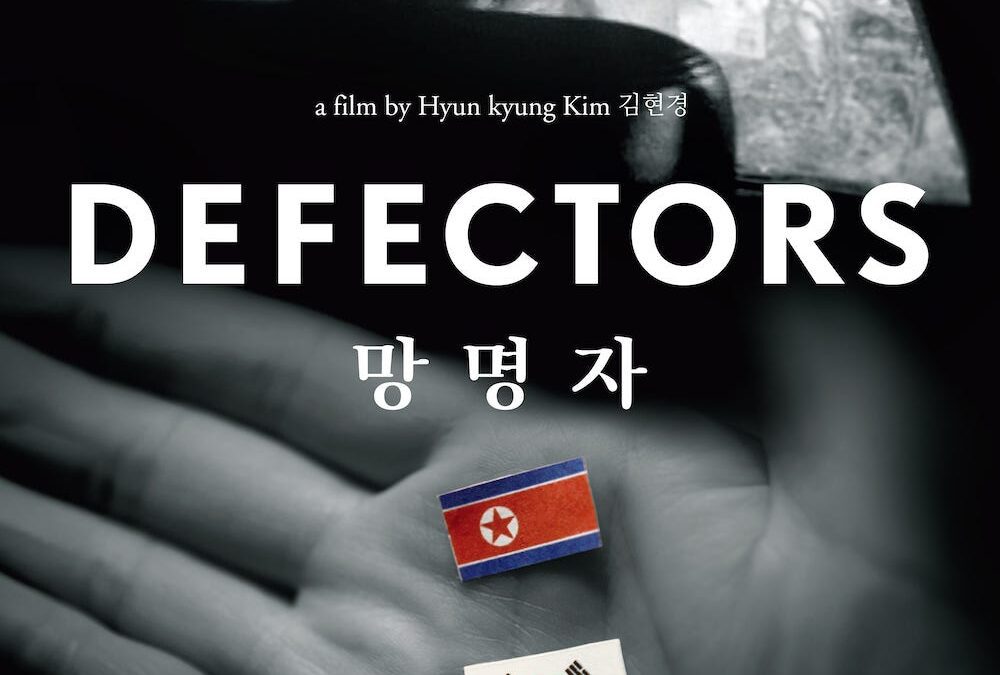
Director: Hyun kyung Kim
Released: April 26, 2023 (Visions du Réel Film Festival, premiere)
YouTube Trailer
In the preamble to the documentary film, Defectors, directed by Hyun kyung Kim, a montage made with a map and scissors illustrates how the history of modern Korea is one of separations. The Japanese occupation in 1910 separated the Koreans from their language and culture. Political governance was divided at the thirty-eighth parallel by foreign powers in 1945. North and South Korea were established in 1948 and the Korean War ignited in 1950, resulting in a complete separation of land, country, and people in 1953, when the armistice was signed, irrevocably tearing apart many families. As a Korean adoptee permanently separated from her mother when sent overseas to become a part of an American family in 1968, the film deeply resonated with me in its depiction of the calamitous, and yet hidden, trauma of family separation.
It is the reverberations of these family separations that Kim examines in Defectors. Using decades of footage of her parents, as well as interviews with a North Korean defector that span three years, Kim powerfully and intimately demonstrates how Korea remains a country at war.
Kim recalls a childhood filled with anxiety about a North Korean invasion. In bed at night, she listened for North Korean soldiers tunneling under her family’s home in Seoul. She was entranced by a popular children’s TV cartoon that characterized North Koreans as malevolent wolves in slavish service to a monster tyrant, and it wasn’t until later that she understood North Koreans were human beings. To this day, fireworks and airplanes make her nervous.
Narrating in Korean, Kim says, “The heavy smell of the Korean War has always lingered in every corner of our house.” Twenty years old when the war broke out, her father was attached to the US 10th Battalion and lost sight in one eye during the war. He wears a pin commemorating the war’s fiftieth anniversary and keeps a chart on the wall of his study to record year by year the comparative statistics between North and South Korea. His shelves are filled with books on the war. Kim remembers how her childhood toys were a training grenade and a teddy bear with military buttons for eyes.
Kim asks her father several times how he feels about the June twenty-fifth anniversary of the war’s beginning. His answer is the same: his generation sacrificed to make armistice possible, but nothing has changed since the armistice was signed. The anniversary makes him sad.
Kim’s mother, however, devastatingly manifests the war’s trauma. Her father, a university teacher in Seoul who also owned a mining business in what would become North Korea, had promised to keep her in school even though she was a girl, an unusual practice at the time, encouraging her to become a scientist. But when the war broke out, “he vanished like smoke,” rumored to have fled to the North, leaving behind a wife and nine children.
As the oldest daughter, Kim’s mother had to leave school to support her family. Without a man as the head of the household, the family suffered deeply, and Kim’s mother scavenged the rubble-strewn streets to keep her family alive. After her oldest daughter, Kim’s sister, died of Parkinson’s in 2012, Kim’s mother became a hoarder, filling their house in Seoul with junk left out on the street for garbage pick-up, and obsessively collecting disposable items such as take-out chopsticks, food containers, paper cups, and even used tissues.
When Kim marries an American and leaves her family home, where she and her deceased sister had lived even as adults, her parents say goodbye to her with no expectation of seeing her again. In the US, Kim communicates with her parents through video calls, but the guilt she feels for not being able to take care of them in their old age is a palpable emotional current throughout the film.
Thinking of her maternal grandfather’s disappearance to the North, her curiosity is roused about those who voluntarily leave their homes and families for good. Wondering about North Korean defectors who don’t have the luxury of video calls, emails, or any form of communication with those they left behind in the highly restrictive state, she decides to seek some out and learn about their experiences.
Kim encounters Dr. Kwon in Washington, DC, at a conference on human rights in North Korea. A high-level diplomat posted to Vietnam, Kwon had defected after getting into trouble for selling his government-issued car for profit. Terrified that he would be executed, he managed to escape to South Korea.
Three years after their initial meeting, Kim catches up with Kwon in the United Kingdom. He had been unable to adjust to life in South Korea, he explains, as the linguistic, cultural, and political differences were too vast. Feeling like a second-class citizen and wanting to live where nobody knew him, he inquired of other North Korean defectors about the US, but they said that it would be too difficult, so he applied for a refugee visa in the UK. Though he left behind a wife and son in North Korea, he married a woman in South Korea who had a daughter the same age as his son.
Life is not easy for them in the UK. They sometimes live separately as Kwon searches for employment. Since he has no visa, he must work odd jobs. His expression is often vacant, his health is bad, and he spends much of his time crouched by a wooden fence in his backyard, smoking. Though he has escaped the gulag, he is clearly a prisoner of his own mind. He explains to Kim that his wife in North Korea would likely have been required to marry someone else, while his son would remain with Kwon’s mother and forever be marked by his father’s defection, preventing him from attending college or having any chance of a good career.
His new wife also thinks about his family back in Pyongyang, and the prospect of reunification between North and South Korea for her is complicated by her husband’s two families, and the awkward situation that would arise were they to meet again. In hushed tones, she relates the challenges of their relationship, how her husband has been unable to adapt to South Korea or the United Kingdom, finding everything hard to navigate. She compares their existence to life in a war zone and says his heart has never left North Korea. Though she claims his training as a diplomat means he is capable of taking care of many things for their newly formed family, she also hints at his temper and laments that he’s a difficult person to live with.
When Kim asks Kwon about reunification, he hesitates, smoking constantly as he discusses the huge challenges. He concludes that his generation would not be able to adjust to South Korean language, politics, culture, and customs.
Using footage from a train ride Kim filmed decades earlier, traveling with her parents from Seoul to the station closest to North Korea, she lingers on the ruined pylons of a bridge that had been destroyed during the war and never repaired. It was that bridge, she narrates, that made her begin to feel the implications of the Korean War for the first time. At the station near the border, in interviews with South Koreans she meets there, none of them believe reunification is possible.
Kim also uses old footage to document the deterioration of her mother’s mental health. Before the death of Kim’s sister, the house was clean, bright, with ample space to move around. Two decades later, the only free spaces are narrow pathways through accumulated clutter, the chair where Kim’s mother sits to watch television, and the bed in which her deceased daughter used to sleep. Other than Kim’s father’s study, every inch of the house is crammed with stuff; even the shower is used as storage for salvaged office chairs in various states of disrepair.
Admitting that she was ashamed to bring people to the family home, Kim films her husband, the American documentarian Ross McElwee, meeting her parents for the first time. She has faith that as a filmmaker known for using his own family and past as a lens through which to study the long shadow of history, he will be sensitive to her parents’ behavior. Indeed, McElwee, filming with his phone as Kim films him, asks her to compliment her mother on her interior decorating. She refuses, saying she doesn’t want to encourage her mother’s behavior.
Allowing glimpses of herself as the person behind the camera, Kim reveals that much of her footage is shot on her digital camera or phone. Many of her contemplative takes are elegantly framed: Mr. Kwon smokes with his back to the camera, viewed through a window which is perfectly centered between dark, heavy drapes. Her mother is reflected in the glass door of a microwave as she eats. The Kwon family cat snoozes in the sun. A woman—presumably the director herself—stares out a window as snow falls. A shot of plastic red flowers at Kim’s sister’s grave is followed by a shot of similar flowers in the Seoul family home, scavenged by their mother, who favors collecting fake flowers, stuffed toys, wine bottles, glasses, and cups. These lingering shots provide glimmers of beauty even among the wreckage of separation and its sorrow.
As the house becomes more cramped, bags stuffed with junk must be secretly removed from the house while Kim’s mother is out. In a film suffused with grief and pain, the most emotional clip shows Kim’s mother crying and throwing up her hands in defense of the state of her home, shrieking that if people don’t like it, they can go somewhere else. Panning some of the carefully arranged dolls and stuffed animals, Kim muses that in another life, her mother could have been an installation artist.
Due to his wife’s hoarding, Kim’s father has moved into his study, where he and the director chat about the war. He shows her his will and reads a poem about aging that expresses his readiness for death. Kim muses on the community of sadness that is her family, from which she is also a type of defector. Much like Mr. Kwon, she is riddled with guilt for abandoning her family. She contemplates the fate of her grandfather who made the opposite journey of Kwon, defecting from South to North. Did he also have a second family? Did he think about the family he left behind? With a pair of scissors, she cuts him from a family photograph, where he leaves an empty silhouette, the missing puzzle piece to her mother’s mental decline.
The film closes with the final defection, the death of Kim’s father. Though she does not give the year—indeed, the chronology is confusing throughout, as her footage spans decades and she does not always note the dates—the funeral ceremony appears to be during COVID, as everyone is masked and seated several feet apart.
Cemeteries bookend the documentary. The film opens at Kim’s sister’s grave and closes at the Seoul National Cemetery, presumably Kim’s father’s final resting place. Panning the Chungseong Fountain statues of fighters who sacrificed their lives to the Korean War, Kim ends the film by saying, “The Korean War still isn’t over.” This is literally true, as no peace treaty has been signed. As Defectors effectively conveys, it is also metaphorically true, as the trauma of family separation reverberates through the generations, embedded in the psyche of all Koreans, even those—like the director, Mr. Kwon’s stepdaughter, and this reviewer—who are now the diaspora.
Alice Stephens
Author of the novel Famous Adopted People (Unnamed Press, 2018), Alice Stephens is also a book reviewer, essayist, and short story writer. Her work has appeared in LitHub, the Los Angeles Review of Books, The Margins, The Korea Times, The Washington Post, and other publications, and has been anthologized in Volume IX of the DC Women Writers’ Grace & Gravity series, Furious Gravity (2020) and Writing the Virus (Outpost19, 2020). She was featured in the 2024 Frontline documentary South Korea’s Adoption Reckoning. Her historical novel of Imperial Japan, The Twain, is forthcoming from Regal House Publishing in 2027.