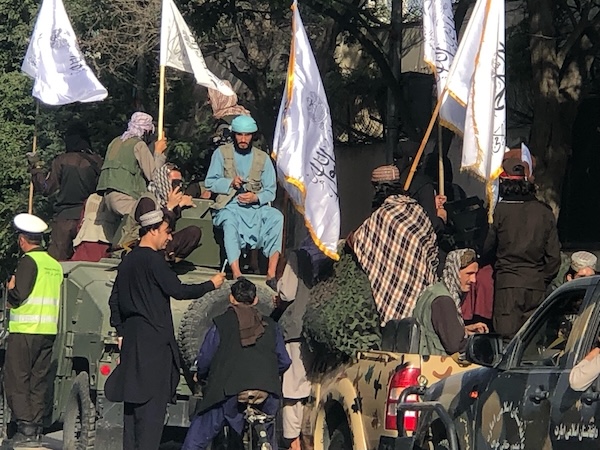
Taliban fighters crowd onto military vehicles, white flags raised high as they move through the street.
Photo: Ziaullah Ibrahimkhil
I am a woman who loves life and the act of living.
Why? Perhaps because death has always been close to me—not the quiet kind that comes in old age, but brutal deaths, the kind where over two hundred people vanish in a single explosion. Maybe it’s these mass deaths that push me to live—truly live. You might not fully understand what I mean. But here in Afghanistan, “living a normal life” means something else entirely.
Once, I was frying potatoes in the kitchen when a suicide bombing erupted outside. The blast shook the house. Windows nearly shattered. Even the oil pot trembled. I turned off the gas and went to the rooftop. From there, I saw a plume of black smoke rising. Objects were scattered on the ground. As I squinted to see better, they twitched—people. Blood everywhere. Bits of flesh clung to the branches of the elm tree beside our house. The smell of burnt meat fused with smoke. The wind came from the north, but it wasn’t strong enough to carry away the stench of burned human bodies. Cars were burning, crushed. The smell of death thickened. Sirens wailed. I watched, unable to move. I wanted to take a deep breath, but couldn’t—smoke, blood, flesh, all smothered the breath in my chest. Shortly after, the ambulances arrived. I returned to the kitchen. Turned the gas back on. Fried the potatoes.
On nights after such a bombing, I cry in bed until morning. Then I rise and live again. I adore being alive. In the midst of all the bombs and killings, breathing feels like the greatest gift. As a reward for loving life, I tend flowers. About twenty pots hang from our balcony, splashes of color in a dark world. I especially love geraniums—with pink, orange, and mostly bright red blooms. Every day, I pluck away the yellowing leaves and make sure they get enough sun. That’s why my home always smells of geraniums. Outside, the air reeks of burnt flesh. Inside, the scent of red flowers lingers.
Another day, I was slicing cheese in the kitchen when I heard that the Taliban had arrived. Instinctively, I tied up my short hair. Then I secured every lock on the door. The most terrifying part wasn’t the news itself, but knowing exactly what would follow.
For the past three years, my world has shrunk to the few steps between my room and the kitchen. I cook; I return. That’s all. Outside, I wear what the Taliban mandate—long black garments, always with a male chaperone.
I cannot even publish my writings. I pour my thoughts into notebooks and hide them, afraid they might search our home one day. I’ve torn up and burned my writings many times. Yet I always write again. And this piece made it into print, even as the Taliban patrol outside our door. Maybe you are reading this somewhere peaceful. I wrote it just after returning from the market . . .
The night before, the TV announced that women must wear long, loose black garments; otherwise, the Vice and Virtue police would arrest and imprison them. The next morning, I went to buy the Taliban-approved clothing.
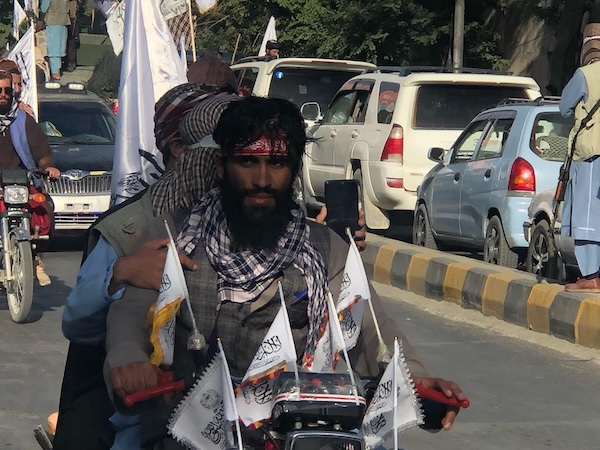 A group of Taliban fighters ride a motorcycle decorated with white Taliban flags as they move
through a crowded street. Behind them, cars and other fighters on motorbikes fill the road.
Photo: Ziaullah Ibrahimkhil
A green pickup truck was parked in the middle of the road. Inside were Taliban men in white turbans and traditional clothes, along with two women completely covered in black, their faces veiled. They stood under the scorching sun, scanning the crowd, searching for women who disobeyed—not only those in colorful clothes but even those whose faces weren’t fully covered. I watched them from behind the glass of a shop.
Amid the chaos, I heard women arguing with them. I couldn’t make out the words, but their gestures told the story. They were talking about clothing. My new dress was folded inside a plastic bag. I paid for it and kept glancing outside. Then, out of the blue, I saw the Taliban dragging women into the truck. Their voices rose in protest. Shopkeepers and bystanders just watched.
I stepped back from the door. Opened the bag. Right there in the shop, I pulled on the black veil and covered my face with a mask. The truck drove away. And so did I.
When I returned home, I hung the black clothes in the closet. Who knows when I’ll go out again—dressed like a crow.
 In a black veil and face mask, Tamana Aria takes a selfie beside a group of schoolchildren.
When I say the Taliban have returned, I don’t mean a mere political shift. I mean girls beyond sixth grade can no longer go to school. I mean the gates of knowledge slam shut, and the key is tossed into the well of oblivion. I mean women expelled from universities—freshmen and seniors alike—like birds with their wings clipped. I mean parks, gyms, every place where women once breathed a small freedom—now forbidden. I mean women may leave the house only out of necessity, dressed in Taliban-approved black, fully covered, accompanied by a male guardian. I mean driving is banned. Freedom is chained.
The women who disobeyed?
Many were killed. Some were dumped in trash heaps—unshrouded, unburied. Does anyone truly understand this pain? Can anyone fathom that, in the twenty-first century, while children across the world study AI, we are forced to live in the Dark Ages? Here, women are stoned with their dreams.
*
[Original text: Persian]
Tamana Aria
Tamana Aria is an Afghan writer currently living in Pakistan. She writes about life under Taliban rule, the effects of war, and the survival and resistance of Afghan women.
Ziaullah Ibrahimkhil is a photographer from Kabul, Afghanistan.