
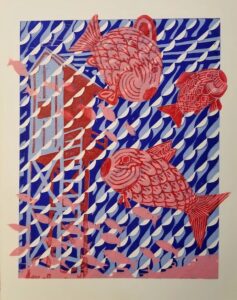
Brian Russell Roberts, American Aquatic; or, Topaz Prison Camp Flooded by a Resurgent Lake Bonneville, 2022. Linocut. Courtesy of the artist.
It was mid-January 1944 in the central Utah prison camp of Topaz. Tori and I were walking away from the mess hall, and we saw the person who had taught us about drawing lines. Tori called out, “Where are you going?” and the line-drawer stopped.
“Tori! My bird-girl. I’m getting ready to go away from Camp.”
“Lucky! You’re going back to California.”
“I am going to New York.”
“Oh no!” Tori was six years old and honest about many things.
The line-drawer smiled. “I will draw for a big magazine. A glossy.” Tori huffed, and the line-drawer conceded. “New York City. Sure, it’s no San Francisco. Look, I’ll tell your story when I get there. I’ll tell everyone’s story.”
“You just draw pictures,” said Tori.
The line-drawer laughed. “Pictures are stories. What about the funnies? Or maybe those hippos you drew?”
“Okay.”
The artist squatted, eyes level with Tori’s, and spoke like she was telling a secret: “Advice from your art teacher before I get on the bus tomorrow. Use the whole sheet of paper!”
Tori was a reciprocal secret-teller: “An advice to you, Teacher. Tell it like a magpie on someone’s shoulder. The stories about us here in Topaz.”
The line-drawer laughed and pointed at me: “Tell it how he sees it, huh?”
“Yes.”
I was perched on Tori’s shoulder, wearing a little red sweater. Tori became my caretaker because I got separated from my flock and lost my feathers a few months earlier. The sweater? It was my virtual plumage while the real stuff grew back. January in the Sevier Desert is very cold.
Suddenly, the line-drawer grabbed me, relocated me bodily to her shoulder. After planting me there, she strained her neck and crossed her eyes, better to see how I looked while I took in my perspective on the world. But I wasn’t looking at the world. I was squawking and jabbing hard at the swath of human flesh that spanned ear to nose and collar to forehead.
“He doesn’t like it—give him back!”
“Take him, take him!” said the line-drawer, who emitted a high-pitched laugh and walked quickly away, waving goodbye while Tori waved, too.
Due to her employability as an artist, Teacher had been granted an early release from prison. I didn’t like being manhandled—taken up as a bird in the hand, plopped on her shoulder. But I could attest to her skills as a line-drawer and subtracter.
§
Back in April, when I could fly, I had witnessed a murder: one human (a guard who climbed down from a tower) shot another human (a prisoner who walked near the barbed wire). A week later, I learned that humans, like magpies, hold funerals for their dead. Always a keen inspector of carcasses and their environs, I did a fly-by while a flock of two thousand humans converged around the dead prisoner. That was my first time seeing the line-drawer, and her drawings struck me, dimensionally speaking.
Most humans I had observed were dimension-adders, and dimension-adding was on full display at the funeral. Wooden boards of two dimensions were assembled into a box of three dimensions, in which the carcass was stowed. The humans had taken other boards and set up a platform of three dimensions, upon which to place the stowing-box. Further, as I saw when I scanned the human flock, uncounted sheets of flat paper had been folded into flowers of three dimensions. The paper flowers were everywhere, attached to wires, placed in vases on the platform, pinned into human hair and lapels. Each human stood decorated with a flourish of dimensional adding.
But among all these adders was the line-drawer, a dimension-subtracter. Like other humans, she was beholding the funeral in four dimensions (the three human spatial dimensions plus the one human temporal dimension). But from these four, she was subtracting two, freezing the event in time and pressing it down spatially into lines on paper. I hovered and swooped near the line-drawer. In the full-dimensioned world of the crowd, I saw two humans-of-flesh sharing a handkerchief at the funeral. But compressed and subtracted onto her paper? Two humans-of-lines, also sharing a handkerchief, flattened from four to two.
It was all just novelty back then. I didn’t know I would ever live in the prison, which my flock called The Cage: a square of forty-two blocks bristling with tarpaper barracks, brimming with nine thousand captive humans, subdivided by bisecting dirt and gravel foot- and wheel-ways, all circumscribed by vast unspoolings of wire enspined rhythmically in barbs and guard towers. Mostly, I had only ever viewed the prison from above. Upon coming to live in The Cage, I didn’t know what I was in for.
Once I lost my feathers and Tori became my caretaker, I saw the line-drawer regularly. She gave weekly instruction to juvenile humans on drawing lines. Tori was a pupil. She was learning how to take a thing that exists in the round bubble of the world and subtract it down, pressed onto paper. I was intrigued, mainly by the feelings of dimensional dissatisfaction that must actuate humans in these dimensional manipulations. Generally, magpies are dimensionally content—neither adders nor subtracters but peaceable perceivers of things in four spatial dimensions, four temporal dimensions, and four magnetic dimensions. A round dozen, as we say.
But I was not a general magpie. I was a dimensionally discontented magpie. Without regular access to flight, our perception comes unmoored from all four magnetic dimensions and three temporal dimensions, nearly bringing us down to dimensional par with humans. I was living through a terrible era of dimensional subtraction, so I was disturbed to see humans giving other humans lessons on the topic.
It was during these subtraction lessons that Tori and the line-drawer began their conflict, though I don’t think either was in the wrong. In class, Teacher would give each pupil a square sheet of paper and tell them to draw lines.
Draw the potbellied stove in your barrack as it dries your clothes and warms your tea. Draw the water tower—use crosshatching for crossbeams. Or, in the foreground, draw an Indian arrowhead in your palm—with the barbed wire in the midground and the Drum Mountains hazy in the background. Draw the sun in the sky—but no smiley faces because the Sevier Desert sun cracks faces at us all day long but never smiles. Draw a map to your second and third best hiding place when the dust storms come—but never, ever give away your first best. Draw yourself with your favorite stray dog or cat, and trade faces with it.
Draw what Topaz was like when it was underwater during the ice age, when old Lake Bonneville covered Utah six hundred feet higher than the Mormon Temple. Draw the waves—the way your hand waves, the way Bonneville would wave if it could wave—the day you say good-bye to a friend leaving Topaz for good.
Make everything big—fill the page!
Tori and the line-drawer’s conflict: Tori would never fill the whole page. She would make a line down the middle and then draw only on the right side. Or, if the line-drawer said, “Draw on the left side too!”, Tori would flip her sheet over and draw only on the left half. One week, the line-drawer walked by and said, “The whole paper, Tori. Next time I will give you only half the sheet.”
Next time she indeed gave Tori half a sheet. Tori drew a long line down the middle of this tall rectangle, then drew only on half of the half. Teacher walked back by: “But Tori, your drawings are very good. Fill the whole paper. Why do it like this? The paper is expensive.”
“I draw what the magpie sees,” said Tori.
“What?”
“What the magpie sees fills only half. He sits on my shoulder—my head blocks the other half.”
True, I thought, and more true than she knew. Yes, she was right that her head blocked half my view, but more than that, as a flightless magpie, I was missing out on over half of my dimensional perception. Tori wasn’t really drawing what I saw, but how I saw.
Teacher smiled and laughed a nice laugh. “What a story you’re telling—then have him sit on top of your head!” Then she was serious: “We can’t leave it half blank.”
But Tori did not relocate me. And the line-drawer, with the mien of one well-practiced in her art, would not relent about the paper. So, meeting by meeting, the line-drawer gave Tori only half of what she had given the previous week. As halves were halved, Tori’s papers became narrow rectangles, and then narrower still. One day I watched her draw a long line down a thin ribbon of paper, confining herself to just half a ribbon’s-worth. Hardly enough turf for the evening’s prompt, which, when issued by the line-drawer, seemed vindictive: Draw the broad-backed hippopotamus!
Stubborn subtracters, both of them. Sure, Tori’s neck and head blocked half my view, and sure, I appreciated Tori’s attempt at perspectival solidarity with me. And I did like the idea of perching on Tori’s head instead of her shoulder. But I didn’t ask to be in the middle of this.
§
When the prisoners held their December art show, things got worse for the two subtracters. Tori’s series of progressively narrower drawings got entered under the line-drawer’s name. That didn’t work out well, but the mix-up was understandable. My understanding is that it happened because the children’s displays (which were organized by class) needed to be submitted under their teachers’ names. Nothing nefarious. Someone had just been hasty, misread the teacher’s name as the student’s.
At the show, Tori and I wandered through the exhibition hall. Her head and neck blotched out half my view, but there was still a lot to see. Cedar branches selected for their resemblance to horny toads and mustangs. Tiny clam shells from ancient Lake Bonneville, glued into the shape of anthropomorphic nonhuman animals, including a duck in a blue sailor’s shirt and cap. (Glad Tori didn’t make me wear a cap!) There were flat stones with writing carved into them. And ikebana—but flowers of paper and cellophane, coat-hanger stems. Above all: the rustling walls, papered and canvassed with paintings and woodblock prints and line drawings.
When we got to the drawings by Tori’s class, hers were missing. We weren’t surprised—Tori had not ended well with the line-drawer. Then we wandered into the adult section and saw a ribbon pinned next to Tori’s series. I nearly lost my grip on her shoulder as we ran, weaving among the gangling human patrons, toward her dimensional subtractions, best-in-show for line drawings.
“I won!” She jumped up and down in front of her drawings, which drew attention from several adult humans, including the line-drawer herself, red-faced, and the judges she was confabulating with.
“Here she is! Tori—with her magpie as always. You see, I ripped the papers into thinner and thinner strips—a magpie’s perspective and all. She did the drawings.”
“Ah-ha,” said the judges, and the line-drawer went on: “See—that’s her stack of one hundred tiny hippopotamuses, standing on each other’s heads, on the very last pinched ribbon of paper. Hippopotamuses all the way up!”
The judges bent over laughing and called the line-drawer a true caper-cutter—ingenious, as always. Like that time she plastered a whooping cough sign on her door to keep the Caucasian guards away. And back before Camp, how at the Treasure Island World’s Fair the line-drawer had told the spectators, when they asked where she was from, that she was Diego Rivera’s daughter. Of his third or fourth marriage, was it? It served those spectators right.
The line-drawer was beaming and asked how they heard about that. They laughed again.
Now she really got going, feigning a furtive glance over at some senior humans, Issei I’d heard them called, who were chirruping amongst themselves and not looking her way at all.
The line-drawer pretended to stifle a laugh she wasn’t about to suppress.
“Beaucoup, beaucoup—we need to stop.” She thumbed a mirthful tear from each eye and pointed quickly at the senior humans. “They’ll start in again on our Nisei problems, say we’re not Japanese enough. Hell we aren’t. And not American enough, too? With everybody, it’s where you from? Where you from?” Her hands were flapping fit to fly. The line-drawer and her judges all laughed until the Issei really did glance over at us.
Finally, one of the judges squared his shoulders and got po-faced and said it was good the drawings did not belong to the child, because there was no prize money for the children’s section, and all the ribbons were already distributed in that section.
The line-drawer’s face switched from ruddy to pale. She thanked the judges, bowed slightly, and pulled us through the milling patrons, right out the exhibition hall door and into the cold. The line-drawer squatted and whispered, “You heard what he said. Better if I take the prize money in my name and give it to you and your auntie.”
“Why is it better?”
“Because you won’t win anything if they put you back in the children’s section. A child cannot win the adult prize.”
“Mine won already.”
“Yes. But let me take the prize in my name and I will give it to you. You can buy something for your mother, in that other Camp they put her in. Send a nice Christmas present.”
“Okay.”
After the last day of school before Christmas, Tori’s auntie said the line-drawer had stopped by with some money from a contest and told her it was for Tori, for being “a good pupil and a sport.” Tori said Teacher had not won it but that she herself had won the contest. And what could we buy at the co-op and send to Mama at the other cage she was kept in? Auntie said they could not send packages, only letters. Tori said, “Then tell her to take the money and give me the blue ribbon!” I don’t think Auntie understood what Tori was saying. Auntie said it was generous of the line-drawer, and that Auntie had not usually celebrated Christmas, but Tori would have a Christmas present with the money.
After Christmas, we came back from playing in the snow, running through the grid of prison blocks and paths lighted by glinting icicles that spiked down from barrack roofs. When we stepped inside, Tori took me out of her coat pocket, where she had kept me for the snowball fight. Auntie said, “Tori, Tori! You are in the Camp paper!”
“Like Eleanor Roosevelt!” said Tori, and Auntie read to us while Tori sat with her on the cot. A judge had interviewed the adult winners. Auntie skipped to the line-drawing category: “It was Tori’s inspiration that put the wind in the project. I learn so much from my little students. A magpie’s perspective!” Then, the judge said, “Modern life is so complicated. We can learn very much from the simplicity of children. They’re the most elemental.”
I felt like I had been stolen from. Auntie could have said, Tori, you and your magpie are in the Camp paper! Tori could have said, My magpie is there, too! Tucking me in her pocket for a snowball fight made sense, but this felt like being tucked away for permanent. Then there was the line-drawer, in the paper, saying she learned so much from Tori, about a magpie’s perspective. And just who did Tori learn about a magpie’s perspective from?
We had never been inside the line-drawer’s barrack but knew where it was, near the Art School, south of Military Police with their rifles propped over their human shoulders and east of Internal Security with their rifles clutched close across their human chests. We “marched over like we were drafted,” destination: Teacher’s barrack. Some of the prisoners had been drafted to fight and die for the United States. And some of the undrafted prisoners used this saying whenever they walked briskly inside the prison that the United States had set up for them as punishment for living in California with the wrong kind of human plumage. I was fuming, feeling very brisk.
“Do you think I wanted it this way?” the line-drawer was saying to Tori. “The camp paper? It’s what I said, sure, but taken out of context. Anyway, I have won many contests and had one-man shows. I was trying to save us both the embarrassment. And to get you something for your penny bank.”
Still a juvenile human, Tori was not equipped to argue her points very well. I was even worse off. I understood the language about as well as Tori but lacked the active vocabulary to convey my grievances. At a few points in their lopsided argument, I would interject a human word or phrase I had learned during my months in The Cage. I did this in the pique of the moment and not because I thought my vocabulary corresponded to the flow.
“Give me the prize,” Tori said.
“I gave it to you already. The money. I gave it to your auntie.”
“No, the ribbon.”
“Take it, take it.”
“Okay.”
There was a lull. I screeched, “Funeral!” and Tori started back in: “Tell them it was my drawings!”
Sure, Tori’s drawings, but my perspective, wasn’t it? I hissed, “Relocation,” but the line-drawer talked over me: “I told them already, twice, and they didn’t believe. I can tell them again. Do you want me to march-like-I-was-drafted over to the judges right now?”
The line-drawer stood up from her cot, put on her coat, scarf, gloves, boots. She looked around as if she were hoping to add more layers, delaying. The delayer made to open the door but turned and said, “If they do believe, they will need to take away the ribbon. And the Christmas ice skates, I guess.”
Tori started to say something but stopped. I cawed, “Ikebana!”
This was a real talons-out fight, wherein the talons were words and clothing articles and ribbons and gifts, and the torn flesh was the very seat of human emotive life. At first, I was surprised a fully-fledged human would take a fledgling human so seriously. But I knew how it would be among magpies, if, for instance, I had an offspring who, before attaining one year, was bigger than I was. Even if the offspring didn’t know it yet, I would know that he would soon be taking the largest portion of our flock’s carcasses for himself. No doubt I would show the tender love of a magpie father to offspring from any given clutch. But to an offspring who was outcompeting me at such a young age? Grave danger. My real attachment was to my caretaker, but I decided the line-drawer was justified in feeling threatened.
Finally, it seemed like a draw. Tori just stood there. I just stood on her shoulder. The line-drawer just sat down at her desk and said, “Go ahead and just stand there with your bird.” She started working on a line drawing, and I cawed, “Army surplus coat!”
The line-drawer looked up as if it was the first thing she had heard me say in the entire fight. Then she straightened her face and looked back down. Not a minute later, she looked up again.
“Look what you and that bird made me do!” She was upset, but then laughed in a sputter. “Oh, this is a keeper.”
Tori stood next to Teacher and looked at what she and I made the line-drawer do. Teacher had been working on an auto-subtraction, a two-dimensionalization of her own self. In this drawing, she was standing in an ill-fitting coat, and Teacher had mistakenly drawn her own two-dimensional legs so they were backwards on her own two-dimensional body.
“That’s it, what it’s like,” said Teacher. “Torn up, put back together wrong.”
Tori nodded. And I realized that all this—Tori just standing in the barrack and me just standing on her shoulder—had been an extension of the fight, and that during this extension, Tori had won. I knew this because of what the line-drawer said next.
“You win, Miss Tori.”
“I do?”
“Yes. I shouldn’t have let it go like this. I shouldn’t have taken the prize in my name. I should have insisted they give it in your name.”
“But you said they wouldn’t.”
“They are my friends. They would have listened. I’ll take care of it.”
“I win!”
“Yes, you win. And maybe someday, after Camp, you will be my teacher.”
“Okay,” said Tori.
“How did your magpie know I was working on a drawing about a coat?”
Tori didn’t answer. She said, “Give me my drawings, please.”
The line-drawer went through a stack of papers. She found a large envelope. On our way out, both subtracters said thank you to each other. I was glad my caretaker won but surprised the fully-fledged human backed down. It all told me that once Tori got her wings as a line-drawer, she would be uncommonly powerful, a subtracter to be reckoned with.
§
The day the line-drawer rode the bus out of Topaz, Tori tacked her first-place drawings on our barrack walls. And by the end of January, my plumage had grown out enough to remove the sweater. Feathers were tangling in the wool, itching. Worse, when I extended my wings, the woolen loops would nearly dislodge my new primaries and secondaries from their follicles. Tori needed to take up scissors against the knit-job, cutting and unpeeling the wool, gentle as she went. My desweatered feathers weren’t yet thick enough to keep me aloft. But by the end of February, I was flitting around the barrack, aiming for soft landings on cots and blankets and coats. Conducting practice sorties more reliant on leap than lift.
I was spending less time on Tori’s shoulder these days. But I guess I’d gotten so used to seeing the world half-blocked-out by her head that I liked looking at her half-blank line drawings on the wall. I even used the drawings to orient and challenge myself during my self-administered flitting lessons. For example, as I leaped from my favorite perch on the clothesline that hung near the potbellied stove, I would tell myself: Aim for the hippopotamus standing highest in the sky—you won’t make it, but at least you’ll land on the cot!
Soft as they were, my landings flushed vague puffs of human history from these army surplus items—inklings of spent firepower, stubborn clingings of sulfuric breath. Waftings from another time, a prior human war. And from this war? The desperate scent of winter mites rallying thick on human skin-flecks ahead of the March thaw.
It took until mid-April before, one day as we walked away from the first grade, I leaped from Tori’s shoulder and flapped my way up into the Sevier Desert’s cloudless sky. A year since I first saw the line-drawer at the funeral, a half-year since Tori became my caretaker.
As I rose, I saw my flock, which had overwintered on the prison water tower, rise reciprocally to meet me. They were engaging in a welcome-plummet, flying fast toward me.
§
But I wasn’t plummeting toward them. I was engaging in rigorous and elated aerial tumblings. Rigorous, because it is thus that our magnetic dimensional sense, and concomitantly our temporal dimensional sense, gets recalibrated. And elated, because I, a magpie of half-year dimensional discontentedness, was tumbling amid the restoration of the round dozen, with the world and everything bubbling: bubbles within bubbles turning to foam, foams inside foams turning to froth, and froths enveloping froths enveloping froths. Inside the froths: a sky and earth and horizon of ten thousand mise-en-abymes nested within ten thousand mise-en-abymes. In those fleeting tumbles, I believed there would be no end to abymes.
I was recouping the round dozen. I was an adder!
I blinked—it was too much to take in so suddenly. And for a dozenth of a second I saw Tori’s drawings, her dimensional subtractions, as they had hung in the exhibition hall and as I had memorized them on the barrack walls. I chased them, flapping bubble to bubble, foam to foam, froth to froth, abyme to abyme.
Finally, in a far corner of what I believed was everything, we were careening and tumbling through a bubble that was a center and round dozen of dimensions unto itself. Then, they—the drawings!—stopped beating their wings and turned to meet me, eye to eye, magpie perspective to magpie perspective. And I saw.
When Tori claimed to draw how the magpie sees, she hadn’t just meant she was filling half the page in solidarity with my half-eclipsed view from her shoulder. No. I don’t know how she managed to see beyond humankind’s frail four dimensions, but somehow her subtractions had always been reductions of the standard magpie’s round dozen—she’d been pressing all twelve magpious dimensions flat onto the papers she got from Teacher. And now, through the foam, these first-place subtractions were hovering before me, meeting me eye to eye. They were dawning like suns cracking faces, restored to a full-dozen roundness of times, spaces, and magnetisms. They inflated into twelve-dimensional tableaux.
I saw them all at once and can only reproduce them here in subtracted form as a half-dozen tiny stories: answers, oblique and scatter-shot through time, to Teacher’s drawing prompt about how to stand frozen on the bed of a desiccated ice-age lake and wave goodbye to a friend, or how the lake itself would wave goodbye.
§
In January 1944, the line-drawer boarded a bus to freedom. Beginning that day, and for the rest of that year, hail and rain pounded the earth, bringing highwater. Which precipitated the line-drawer’s celebrity, since from 1944 to 1969, she painted many paintings of the floods that were set free the same day she was. Her fellow humans looked at the paintings, then looked at their new inland seas. They said, “And how! The floods are all we see around here!”
After her release, and ever-after, some humans thought she didn’t look like the right kind of human. They would ask, “Where you from?”
“I’ve been living in a prison,” she’d say.
“Where you really from?”
“The prison’s name was Topaz.”
“You know what I mean.”
“It was on a dried-out lakebed. Lake’s name was Bonneville, which the floods have since refilled.” She was born in Riverside, California. They wanted her to confess, I’m from Japan!
One afternoon, the line-drawer rowed a boat directly to the forty-second story of a building on Manhattan Island (which had formerly been an island), where in the early 1960s she tutored an aspiring folksinger. She instructed: “Whenever you write a song, imagine the song’s narrator, and then do not sing it from that perspective. Sing your songs as if rendered by a speechifying magpie sitting on the shoulder of the one who should have been the narrator.” The singer nodded and then immediately broke with his teacher, ever-after writing all songs as if sung by a parrot perched on the shoulder of what would have been his human narrator. Toward the end of his life, as his extensive oeuvre received its due reassessment, these silenced human narrators became known as the thousand-narrators-who-might’ve-been.
Back in Utah, when the floods sloshed over the spires of their temple, the Saints (formerly known as the Mormons) undertook their long-foretold trek. They boarded jet-planes to lay claim to the city of Independence in the state of Missourah (formerly known as Missouri). They mildly accepted their gratis peanut pouches and Diet Cokes. As for the Saints’ fate in Missourah, which by then would have been a shallow sea? I hear they’re taken up to Jesus by now. And the flooded world just kept foaming, frothing.
Centuries ago at a one-woman show at New York City’s prestigious Mortimer Levitt Gallery (housed just above the waterline, which at that time lapped at the twenty-third floor), the line-drawer exhibited a painting of the prison guard tower, the official perch of the guard who murdered the prisoner. Barbed wire festooned itself like dead Christmas lights. The painting thrilled the critics, the critics told the papers, and the papers convinced President Harry S. Truman to have her to the White House, where she spit in his soup.
But the painting! The tower-top stood two hundred feet below the surface of Bonneville, the ice-age lake that evaporated down to the Great Salt Lake and then, with the post-1944 floods, resurged. Above the tower, schools of fish glinted iridescent like tumbling magpies. Below, octopods tight-roped across the barbed wire. Reverently, a critic pronounced the painting cephalopoetic. But to the end of her long life, the line-drawer denied this. The onliest description she ever endorsed: American Aquatic, the painting’s original title in 1952.
The day the line-drawer rode the bus out of Topaz, the sky stormed for two thousand years. The waters rose high enough to submerge a towering stack of hypothetical hippos. The floods gushed to drown Utah’s mountain ranges, turning processions of peaks into archipelagoes. And there I was, in Tori’s drawings, circumambulating the foaming beach that circumscribed Drum Island, highest peak of the former Drum Mountains. Somehow, she’d drawn me narrating—singing—each of the tableaux. I was the ghost of a magpie who in the 1940s nested on Topaz’s water tower. Who once perched on the line-drawer’s shoulder and squawked in anger. Who, twenty centuries later, wished—or wishes—he could have carried healing in his deplumed and woolen wings.
§
All that in a dozenth of a second. The tableaux had been subtracted flat into Tori’s line drawings, but now in the foam they were a swooping, tumbling, soaring pageant above the earth’s blank carapace.
Before they disappeared into the froth, the line drawings asked, “When are you from?” I hesitated. Then they said, “When are you really from?” I couldn’t have said. Was I truly dimensionally recalibrated yet? But even if I was… After everything Tori’s drawings had just shown me, and after doing time down in The Cage, I doubted I’d ever really know when I was from again. My every when felt torn up, put back together again wrong.
I unblinked. It was still April 1944. My wings became circumspect, expecting rain, torrents, floods, froths. But Tori was standing down on the dry desert dirt next to her school, flapping a human hand at me while trilling up into the clear blue sky in full-throated magpie, like she had never in her life needed me for her magpie’s perspective.
My flock was still plummeting toward me, their squawks greeting me back into a firmament I no longer knew how to share with them.
❊ ❊ ❊
Q&A with Author Brian Russell Roberts
Fiction editor Elizabeth Lukács Chesla has an email Q&A with “American Aquatic” author Brian Russell Roberts.
Elizabeth Lukács Chesla: You’ve spent more than a decade researching and writing about the World War II-era Topaz prison camp in Utah, which is the setting of your novel-in-progress, Topaz Magpies. What drew you to this particular time and place in American history?
Brian Russell Roberts: When I moved to Utah in 2008, my next-door neighbor asked if I was “a mountain person” or “a desert person.” At that point I didn’t know enough about myself, or enough about Utah’s two main landscapes, to choose. He said it didn’t matter anyway because “Utah is infinite.”
I spent the next decade in the mountains and deserts, testing that infinity. One Saturday, I think in 2017, we were driving through the Sevier Desert in Millard County and we hit the town of Delta, where we saw the newly opened Topaz Museum. I’d already heard of Topaz. I’d assigned the prison camp’s arts and literature journal, Trek, in an American literature course. So I’d seen Trek’s article on Lake Bonneville, a lake that covered a lot of Utah during the ice age. I’d had a chance to talk with my students about the prisoners’ interest in deep time.
At the museum in 2017, I saw a stone carving with a couple fossilized trilobites in it. Next to one of the trilobites, the artist, Shigematsu Ishizaki, had carved 480,000,000 in Arabic and kanji numerals. I realized that during his unconstitutional imprisonment by the US government during World War II, he was thinking about what this place—the future Utah—was like a half billion years ago when the trilobites scuttled in the Cambrian ocean! After that visit, I started teaching courses focused on the literature and art of Topaz at my university. I was also researching my book Borderwaters: Amid the Archipelagic States of America (2021), and I wrote chapter 4 on the Topaz prisoners’ contemplations of their imprisonment in relation to two ancient bodies of water, Lake Bonneville and the far older Cambrian ocean.
The novel began with those experiences teaching, researching, and writing, along with several trips around that same time to the mining town of Eureka in Utah’s Tintic Mountains. Eureka is the novel’s other main geography, about sixty miles north of the old Topaz prison site.
So, mountain or desert? Give me another decade to decide. In the meantime, I’ll be inching through Mark Danielewski’s 2025 novel Tom’s Crossing, which begins in my own infinite neighborhood, the Tree Streets, at the base of the Wasatch Mountains and devotes over twelve hundred pages to the canyon and mountains above my house.
ELC: Our fall reading period includes a special call for work that documents, illustrates, or addresses geopolitical violence in the United States. We recognize that geopolitical violence has always been a part of the country, and that in many ways, it is as prevalent now as it has always been. How have current events impacted this story and your novel?
BRR: In December 2015, a US presidential candidate said he wanted to temporarily ban all Muslims who weren’t US citizens from entering the United States. He said, “What I’m doing is no different than FDR.” After the bombing of Pearl Harbor, FDR in December 1941 issued three presidential proclamations restricting the rights of Japanese, German, and Italian nationals, and in February 1942 he issued Executive Order 9066, which helped imprison some 120,000 people of Japanese descent living in the United States. Two-thirds were US citizens.
In 2018, that former candidate—now president—used Executive Order 13780 to institute a revised version of his ban on Muslims entering the United States. The Supreme Court ruled EO 13780 constitutional but in so doing felt the need to deny any analogy between EO 9066 and EO 13780: “The forcible relocation of U.S. citizens to concentration camps, solely and explicitly on the basis of race, is objectively unlawful and outside the scope of Presidential authority.” Chief Justice John Roberts said the court’s WWII-era decision on the Japanese American incarceration “was gravely wrong the day it was decided, has been overruled in the court of history, and—to be clear—‘has no place in law under the Constitution.’”
Since 2015, the WWII incarceration has been present—not a ghost but actually present as a template and touchstone—for a new era of US travel and immigration policy and enforcement. One semester when I was teaching my Topaz course, several students drew analogies between the WWII incarceration and the images they were seeing of children in cages, which were front-and-center in the news at the time.
As with several chapters in the larger novel, “American Aquatic” takes up this question of cages. The narrator and his flock refer to Topaz as “The Cage.”
ELC: Speaking of your narrator, why a magpie’s perspective?
BRR: Thoreau famously went to jail for a night for refusing to pay his poll tax. Reflecting on that experience, he wrote that the people on the outside of the stone wall were in prison while he, inside, was free. Thoreau: a human who was thinking himself out of a cage, turning the cage inside out—easier since he spent just one night in jail.
But when humans have looked to describe the horrors of captivity and other unfreedoms, birds have been powerful metaphors, especially birds paired with cages. Take for instance Paul Laurence Dunbar’s poem “Sympathy” or Maya Angelou’s poem “Caged Bird” or her memoir I Know Why the Caged Bird Sings.
In Topaz Magpies, the birds are experts at thinking topologically, experts at turning things inside-out like Thoreau. But the birds find, to their horror, that they can’t think themselves out of cages—cages aren’t inside-out-able.
ELC: The main action in “American Aquatic” is the conflict between two line-drawers, six-year-old Tori and her art teacher. You are also an artist, making extraordinary linocut prints such as the one that accompanies this story. How has your work as an artist informed your work as a writer?
BRR: Thanks to Consequence for pairing my story “American Aquatic” with my linocut “American Aquatic; or, Topaz Prison Camp Flooded by a Resurgent Lake Bonneville.” The print is inspired in part by the art of by Miné Okubo, the UC-Berkeley–educated artist who was imprisoned in Topaz and went on to publish the prison memoir Citizen 13660 in 1946. I created the linocut about a year before drafting the story, and linocutting the scene was a kind of prewriting exercise ahead of the story, though it wasn’t as linear as it sounds.
Writing and linocutting are two things I do. I often take similar subject matter for both, without intending to have them feed on each other, even though they usually do. This happened when my linocut “From the Center of Spiral Jetty” turned out to be the right fit for the cover of my book Borderwaters. Or again when my story “Time’s Medusa” paired well with my linocut of a mining gallows in Eureka.
In terms of form and process, the medium of reduction linocut relies on repetition, and accumulation through repetition, to build up an image. That’s how the narrators of Topaz Magpies tell their stories.
Readers can see some of my linocutting process on Instagram: @brian.blockprinting.
Brian Russell Roberts is Professor of English at Brigham Young University, where he directs the English MA and Creative Writing MFA programs. For nearly a decade he has taught courses for the English Department and American Studies Program on the literature and culture of Topaz, one of the United States’ unconstitutional World War II–era prison camps. His academic book Borderwaters: Amid the Archipelagic States of America (Duke University Press 2021) features a chapter on Topaz, focusing on the prisoners’ engagements with geologic deep time through art and literature. “American Aquatic” is drawn from the manuscript of his in-progress novel Topaz Magpies: A Novel in Stories and Objects. Four previous stories from Topaz Magpies have appeared in the Notre Dame Review, Joyland, and Phoebe, with a fifth named finalist forCutBank’s Montana Fiction Prize. Roberts is also a literary translator (Indonesian to English) and has most recently published an English translation of Pramoedya Ananta Toer’s Larasati (Lontar 2025; co-translator Keith Foulcher), a novel centering on the Indonesian War of Independence.