
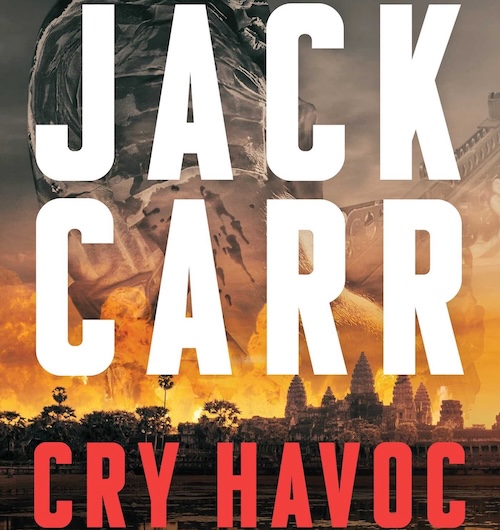
Cry Havoc
By Jack Carr
Simon & Schuster, 2025. 560 pp.
I am a pacifist, opposed to war across the board, and it is as a pacifist that I am reviewing Jack Carr’s Cry Havoc, a book that celebrates military skills and values and includes among its epigraphs the “unofficial Vietnam-era SEAL creed,” which is: “I shall inflict so much personal pain and grief, suffering and outrage, that as a person you shall have but two choices: SURRENDER OR DIE.” For a pacifist to review such a book may seem a strange thing. But it is a necessary exercise for pacifists, living as we do in a non-pacifist world, where what the military historian Joanna Bourke calls “deep violence,” is pretty much everywhere, in toys and statues and parades and holidays and metaphors and novels like Carr’s. A pacifism that looks away from such things is ignoring too much. (A militarism that looks away from pacifist critiques is also ignoring too much.)
Not all of the book does the work of celebration, I should note; a fair amount of it is a second-rate spy novel. Early in the book, we read of a clueless spy named Allister Desmond, an avid reader of spy novels, that “Le Carré just depressed and confused him, though he suffered through the stories all the same.” Maybe Carr shares Desmond’s views, maybe not. In either case, evoking Le Carré invites a comparison, and in that comparison, Carr comes out the loser—as would most writers, to be fair, and in most genres. Le Carré offered an extraordinary intricacy of plot, an acuteness of psychological and political perception, a dazzling variety of voices, each precisely heard and notated, in several languages. Carr’s novel has nothing resembling that; the characters are for the most part speaking in the same voice, neutral, over-expository, lacking what Robert Frost calls “sentence sound.” The honey traps—to use Le Carré’s term for spy work involving sexual seduction—are predictable, the ensnaring women all beautiful and efficient. The double and triple agent plotlines are familiar and unsurprising. The attempts at cultural sophistication that so many spy novelists love are labored and over-explained. (It is maybe significant that Henri Barbusse’s great antiwar novel Le Feu, a copy of which is used by a Communist spy to transmit secrets, is consistently called Le Fue.)
If the spy novel were the whole of the book, I would not be reviewing it; spy novels are not challenges to pacifists.
But war novels are, and Cry Havoc is principally a war novel. By “war novel” here I mean not simply a novel that is about war—antiwar novels are about war, after all, from All Quiet on the Western Front to Slaughterhouse Five—but a novel that celebrates war, or at any rate that celebrates violent military action conducted in war.
Carr’s book does that very well, in several different ways. It refrains, for the most part, from presenting enemy soldiers as monsters. They are enemies—the goal of protagonist Tom Reece in his particular role in the Vietnam War is to kill them in order to keep them from killing him—but they are not rats or vermin or the Yellow Peril, not like the Bugs in Robert Heinlein’s Starship Troopers. In Carr’s accounts of Reece’s actions, all questions other than the question of who will win are excluded. As I read about these actions, I am not asking questions about war, that “crime against humanity” as the War Resisters League defines it; I am not even asking questions about the justice of the Vietnam War in particular, unjust and murderous as it was. There are Tom Reece and his comrades, there are their North Vietnamese and Viet Cong and Pathet Lao antagonists. One group will win this particular battle, one group will lose, and even those of us who think the North Vietnamese were in the right will be drawn to root for the people we know, that is, Tom Reece and his comrades.
Reece is the protagonist. We do not see things from the perspective of his several comrades (nor from that of his North Vietnamese antagonists). But Reece is working hard to protect these comrades in action, to get the wounded to safety, to rescue his comrades in captivity. And there are no better motives for military action, no motives a pacifist needs to honor more. They are simple, compelling, human and are powerful even in antiwar fictions; one of the most moving passages in All Quiet on the Western Front recounts the narrator Paul Bäumer’s steadfast, loving attempt to carry his wounded comrade Kat to safety. He fails, Kat is dead by the time Paul arrives with him at camp, but Bäumer is heroic. And so is Tom Reece in his attempt to rescue his captive comrades.
But Reece goes too murderously far in his commitment to these principles, too murderously and with too great an indifference to consequences. He learns that the Soviet Union has transferred six American POWS, captured in Vietnam, to Siberia. He wants to get them back. How? “We go to war if we need to. . . . We owe it to them and to their families to do whatever it takes to get them home” (emphasis added). War with the Soviet Union, nuclear weapons blowing up the planet? Most principles have their limits of usefulness, Reece’s fantasy goes beyond those limits.
The third compelling aspect of Carr’s war passages has to do with weapons. Carr is a virtuoso in depicting them, the weapons themselves and their efficient, courageous, deadly use by the men who carry them, as good in some ways as William Volmann in Rising Up and Rising Down. There are long lists of weapons, like those in Tim O’Brien’s The Things They Carried. There are accounts of the use of weapons, vivid in their precision: “Tom let the RPD [a lightweight machine gun] hang on its leather sling, transitioned to the cut-down M79, broke open the action, switched the flechette for a high-explosive round, closed the action, thumbed the safety forward, aimed, and depressed the trigger.” Much of the book’s appendix glosses the weapons the book depicts, showing how this or that weapon was available, or might have been available, at the moment when the book shows it as being used.
What does a pacifist do with such passages? One possibility is to denounce them all as tributes to the destruction of human lives, each life a universe, as the Talmud teaches. I keep thinking of the Devil’s comments in George Bernard Shaw’s Don Juan in Hell:
I tell you that in the arts of life man invents nothing; but in the arts of death he outdoes Nature herself . . . When he goes out to slay, he carries a marvel of mechanism that lets loose at the touch of his finger all the hidden molecular energies, and leaves the javelin, the arrow, the blowpipe of his fathers far behind. In the arts of peace Man is a bungler . . . I know his clumsy typewriters and bungling locomotives and tedious bicycles: they are toys compared to the Maxim gun, the submarine torpedo boat. There is nothing in Man’s industrial machinery but his greed and sloth: his heart is in his weapons.
But the weapons passages are also compelling, saturated with detail, animated. They have some of the same powers that hospital emergency room shows have: speed, jargon, high competence and devotion, sophisticated gear. The doctors and nurses are trying to save lives, Carr’s soldiers are trying to destroy them, but the two narratives have things in common.
They also have in common that, while reading or viewing, one is free of moral scruples or larger considerations. Why are American soldiers in Vietnam in the first place? Does the war meet Augustine’s—or for that matter Michael Walzer’s—standards for a just war? Why are there so many people coming to emergency rooms? Why are the rooms so crowded?
Here, the heart of the matter is the competences and the machines. Reece sees a Pathet Lao soldier with an AK:
There was no time to throw a grenade and sink back into the protection of the thick brush. It was time to go to the gun. The RPD had two settings—safe and fire—and was designed so a shooter’s finger could sweep seamlessly from the selector to the trigger, which was what Tom Reece did. The man swung his AK toward the American. He never made it. Tom’s five-round burst stitched him up from his pelvis to his heart. Another five rounds tore through what was left of his chest. As he crumpled to the ground his head caught in the Y of a teak tree, which arrested his fall, leaving his soulless body upright; a human scarecrow hung in effigy.
There are occasional moments, even in Carr’s novel and in, say, HBO’s The Pitt, for a passing reflection on such matters. Sometimes Noah Wyle’s Dr. Robby rightly tells administrators that the emergency rooms are so crowded because the hospital isn’t hiring enough staff (or paying prospective staff enough) to attend the non-emergency rooms and beds. Sometimes Tom Reece and his comrades reflect critically on the war. One night in a hotel, for example, Reece “pondered how many more years of his youth he was going to a sacrifice to a country called Vietnam and to the policymakers in Washington who were keeping them all chained to the deck of a sinking ship.”
But those critiques do not affect any of these soldiers’ behavior, do not suggest to any of them that if the nature of the war is to do more harm than good, then it is their moral responsibility not to wage it. The late Daniel Ellsberg turns up in Carr’s book (and Carr in the appendices establishes the fact that Ellsberg was in Vietnam at the time the book puts him there). Ellsberg was an analyst for the RAND Corporation when, in 1969, he heard a talk by the late Randy Kehler, a draft resister on his way to prison. Ellsberg was moved by Kehler’s talk to break other laws and, in 1971, to release the Pentagon Papers. In Carr’s book, talk about the war as unjust, as doing more harm than good, is just talk; Reece and his comrades just go on doing what they have been doing, with the same high degree of mostly amoral competence.
As the book ends, Reece is apparently about to go to work in the Phoenix Program. Carr glosses it as follows: “A CIA-run covert operation in Vietnam focused on neutralizing Viet Cong infrastructure. That’s a civilized way of saying the program targeted Viet Cong leadership for assassination.” There’s an apparent frankness in that, a soldierly disdain for euphemism. But the frankness is also a means of concealing. In fact, the program targeted not only Viet Cong leaders but also civilians; it subjected its targets not only to assassination but also to torture. That, it seems, is what Tom Reece is going to be doing. At one point he rejects a tactic that “would kill innocent fishermen . . . That was not an option.” But he has also been shown to be capable of torture. In revenge, he tortures the man who has tortured and murdered one of his friends. Now, under the aegis of the Phoenix Program, it seems, he will be torturing people for what he will perceive as strategic ends justifying the means and thereby committing war crimes in an unjust war.
Which leaves us where? The book at its best offers compelling accounts of violent action with little dehumanization of enemies and a minimum of clash-of-civilizations rhetoric. Its focus is on survival and local victory, on high competence in destruction, on the instruments this competence makes use of and on caring for one’s comrades even when such caring means risking one’s life. Every pacifist needs to recognize the power of these accounts.
But a pacifist will also recognize two things that the book does not do. The first is to consider the justice of war in general, or a particular war, how it affects the choices an individual makes. Terrence Malick’s luminous film, A Hidden Life, tells the story of the Austrian conscientious objector, Franz Jägerstätter, who was beheaded for refusing to swear allegiance to Hitler. At one point in the film, Jägerstätter is discussing his choice with people who are urging him to capitulate. He asks, “Does it matter if the war is just?” It does to him; finding the war unjust, he refuses to swear allegiance and is executed. It mattered to Kehler and Ellsberg, too. But not to Carr’s soldiers. If the war is doing more harm than good, as Reece acknowledges in one conversation, maybe the right thing to do is not fight it? But Carr’s soldiers soldier on.
Moreover, and despite its air of unsparing realism, the book does not offer a full account of what appalling energies war can unleash. “Cry havoc, and let slip the dogs of war,” the Shakespearian source of the book’s title, is Marc Antony’s frank recognition and exaltation of what happens when havoc is cried: “Blood and destruction shall be so in use,/And dreadful objects so familiar,/That mothers shall but smile when they behold/Their infants quartered with the hands of war,/All pity choked with custom of fell deeds.” The result, in Vietnam, was what the journalist and historian Nick Turse calls “a My Lai a month.” It is the job of the pacifist to be concrete, as the American pacifist Kathy Kelly likes to say, a concreteness that the book seems to be promising but avoids, and which the pacifist needs all the more to attend to.
Lawrence is Anne Pierce Rogers Professor of English Emeritus at Wellesley College, where he taught from 1980 till 2022. He has written abundantly about diaries, words and music, translation theory, and nonviolence; he has also published translations from French, German, Italian, Latin, and Yiddish, and written and performed some fifty verse narratives for early opera and early music theater more generally. His current large project is Portrait of a Pacifist Critic, an exploration of the relations between pacifism and literary criticism, in support of which he was awarded a Guggenheim Fellowship in 2020.