
This is the fairytale you inherit. Told at kitchen tables, retold in sighs and sorrowful silences. The details are few, but the shape of the story remains. You fill in the rest with the whispering ghosts in your head, reaching for closure on their behalf.
The house where the family lived before the war did not belong to your great-grandparents Egisto and Marina. It was subsidized housing for employees of the Magona, one of the benefits of working at the steel plant. But your mother, Anna, remembers that top-floor apartment without electricity as a stately and elegant home because it was improbably furnished with precious antiques.
Those antiques were the remnants of a long-gone past of blue blood and privilege. Marina’s mother, Donna Rosa, was a noblewoman, the last heir of a French title that could not be passed down matrilineally. The riches that came with that title were lost to the husband’s gambling habits and his addiction to wine and women.
Donna Rosa gave her husband seven children. He repaid her with the slow, humiliating erosion of her family’s fortune: the horses, the gold coins bearing Napoleon’s face, the jewels, the lands and stables, and finally, the mansion, all of it surrendered to the debt collectors, year after year. Her legacy shrunk to nothing. He then took up with a cabaret dancer.
He was gone most nights, a relief for his children. On the rare nights he stumbled home, reeking of wine, wobbling and blustering, he would exercise the one privilege he could not pawn for cash—his life and death power over his household, the right to discipline his wife however he saw fit. In those days, it was exercised with impunity by men throughout Italy. Thus, her small, fragile frame bore his rage, the muscle-force violence of his self-pitying.
Until the oldest of the seven had enough. Hitching a wagon to the two remaining mules, loading it with all that was left of their possessions, he begged his mother to leave the man she desperately loved, the Suvereto countryside she had never lived without, and all the illusions of her vanished youth. She resisted, at first, still in love. Until her son clarified her options:
“Mother, if you don’t come, I’ll have no choice but to kill him.”
For years after, she mourned him. She sighed after the man who had ruined her, and begged her sons to take her to the ramshackle house where he now lived, just to see him again, even if just from a distance.
So they did.
One day, they brought her as close as they dared, to the edge of a wide field where he now labored as a sharecropper. She gazed at the bent, diminished figure and wept: “But look how handsome he is!” forgetting, already, the bruises he left on her body, the fortune he drank into dust.
The sons had heard that in Piombino, there was always demand for iron and steel laborers. The town boasted two plants and a port. The brothers had nothing but a handful of gold coins squirreled away from their father before he could gamble them away. They insisted that those would be saved for their sisters’ dowries.
So even Marina, the youngest daughter, at age twelve, had to find work. She took a job at the Magona. Six days per week, ten hours per day, she collected and sorted ores near the blast furnace area. That’s where, years later, she met Egisto.
She was engaged, by then, to a young man from a well-off family, the son of an influential attorney. Perhaps she dreamed of regaining the wealth her mother had once enjoyed, though she was born too late to know anything but the iron and clay taste of poverty. She would have felt as if she remembered. She may have thought that comfort and luxury were her birthright, unjustly denied.
So she resisted Egisto and the feeling his long glances provoked, the burning in her throat that could not be quenched with water or wine when he came near. She ignored how his eyes followed her, how the blue of his irises imprinted behind her eyelids, haunting her during sleep. When he came near, she turned up her nose and chin, pretending immunity to his winsome smile, tightened her lips at his jokes even as laughter welled up, shaking her belly. And when he declared himself to her, she said no.
Instead, she accepted an invitation to her wealthy fiancé’s mother and kept her head bowed and her hands laced together above the table where her future mother-in-law could see them. She blushed often, averted her eyes, and spoke in a quiet voice of domestic matters. She took care to conceal her fierce, strong-headedness sharpened over the years at the factory, where to fend off men’s advances, she learned to snap sharp-witted put-downs, and to shift her hips out of reach of a grasping hand.
What happened next is unclear. Your grandmother, Liliana, claims there was another young woman after Egisto, and there was bad blood between her and Marina even before the blue-eyed little man got caught in their spat. A muttered snark triggered an epic shouting match and hair-pulling that drew other women from their tasks to bear witness.
Marina had the last word: “You think you won? Wait and see. I will steal that beautiful boyfriend of yours right from under your nose.”
Your mother, Anna, remembers a different story. It was Egisto who put his foot down. When Marina finished her shift at the factory, walking home one night, Egisto stepped in front of her, refusing to be ignored.
“I know you’re in love with me,” he said. “You only agreed to marry that man because of his money. But you love me.”
Marina’s tongue had always been quick, but she stood with her back to the gray smokestacks, the iron gates, that curious man standing in front of her, only a little taller than herself. He was lean, delicate, but his strength emanated from the steel in his eyes. He was a stalk of bamboo, impervious to storms, unbendable, yet graceful. She wondered how he had swept all the clever retorts from her head.
She used the only word she had left: “Yes.”
Who knows which story is true. Perhaps neither. Perhaps both. But you know how the story ends.
On the surface, it unfolds like a storybook. Marina marries Egisto. She quits the factory, and he is promoted. They have two children, both girls, first Liliana, then Livonia. The oldest takes after Marina, dark and curvy, fearless and stubborn. The other takes after Egisto, petite and fair, quiet but armed with steely resolve. The children grow into girls, then into young women. Liliana marries first, then Livonia. There will be grandchildren, too: first a girl, Anna, your mother, then, years later, from Livonia, a boy.
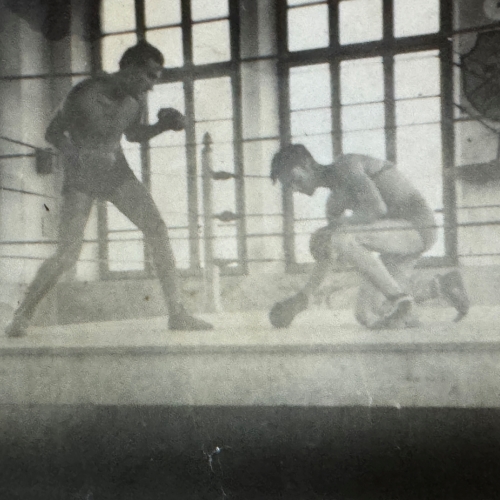
In fairytales, there are heroes and monsters, and so it is with this story. The princess is now a young Liliana, just turned seventeen. She doesn’t know the spell she’s about to cast, so powerful that it cannot be undone by Bible verse or holy water. The handsome prince is Nello, the talk of the town. He trains as a welterweight boxer, but is known for his handsome Greek profile. His trainer is frustrated by Nello’s mild character, the lack of the raw, hungry aggression that makes a champion. He scoffs at the vanity of the young boxer, the measures he takes to safeguard his nose in a fight. Nello’s fame is fueled by his elegant looks, but his mean uppercut earns him a regional championship belt, despite all skepticism, all disbelief.
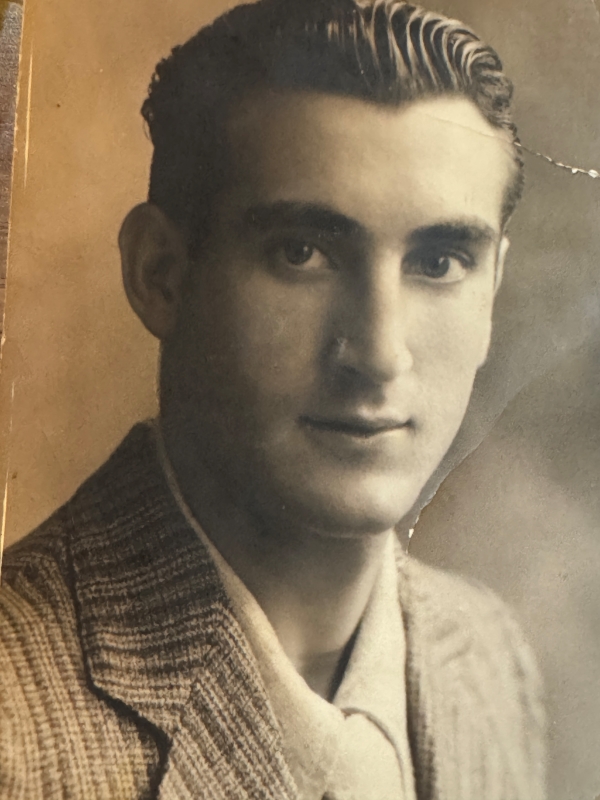 Nello
Nello
Liliana is seventeen when she first sees her handsome prince, strolling that same cobbled avenue in the historic part of town that leads to the piazza overlooking the port. Nello hangs outside the training gym with the boys. It’s just around the corner from Corso Italia and its coffee shops, its glimmering window displays.
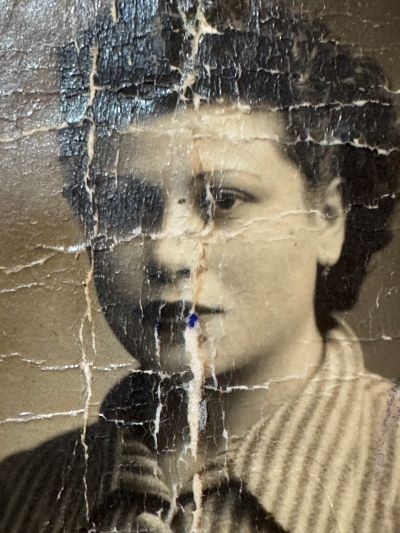 Liliana
Nello sees Liliana walking with friends, her rich curly hair bouncing with her steps, her curvy shape flattered by a hip-hugging pastel dress. What strikes him foremost is her laugh, so much abandon, such fearless joy. It’s her spell.
Nello’s catcalls, “Bella!” and for days, maybe weeks, he’s everywhere, at the grocer’s, at the market, strolling casually, hands in his pants pockets, along Piazza Bovio. One day, Liliana steps out of a store to collect his deep-throated “Bella!” close to her ear. She turns on her heels to face him and says, “So are you!”
Soon after that, they’re engaged.
But this is Italy. It’s the 1930s. Blackshirts patrol the streets and beat random passersby with sticks and tire irons, just to establish their apex status. Mussolini covets Libya, Albania, and Greece. There are plenty of monsters. Pick one. Pick four or four thousand.
One day, Nello tells Liliana that he is a Communist.
“Does it bother you?”
She shakes her head no, makes a joke, laughs, a beautiful fountain of sunshine.
She doesn’t tell him the truth: she has no idea what he means. She’s seventeen, a “Daughter of Maria” educated by nuns, and marching obediently with the Balilla Youth Group. She’s oblivious to fascist grooming. She doesn’t know Communism is illegal. She can’t even imagine what it might be.
At home, during dinner, Liliana tells her parents about the handsome pugilist who walks her home: “He says he’s a Communist. What does that mean?”
Egisto looks up from his plate. He thinks, It means believing in safe working conditions; it means opposing the Blackshirts and war and everything Mussolini stands for. He mulls it a moment in silence, then says only, “Don’t worry about it. I know what it means.” He nods and keeps eating, and no one ever brings it up again.
It’s hard to appreciate the recklessness of Nello’s admission at a distance of decades. Was he offering Liliana an out? Warning her of the risk she was taking by associating with him? The OVRA, Mussolini’s secret police, is so efficient at planting informers that even Hitler’s Gestapo demands training in their methods. Mussolini has eyes and ears in every factory and shop, in every schoolyard and playground. He even has eyes on the Pope.
If an informant had heard Nello’s admission, if Liliana had told the wrong person—if Egisto, a steel-mill worker, hadn’t been sympathetic to Communist goals—Nello would have been seized by the Blackshirts, beaten and tortured, thrown into jail, and, if not killed, exiled indefinitely to a detainment camp. That’s what happened to Nello’s brother, when an informant told fascist police about how the barber was printing communist fliers in the back of the shop. They locked him up for weeks, beat him, and tortured him until they forced a confession, and all the while Nello, locked in a cell next door, is there to witness. Claudio loses his hair, first, then (the family whispers) his manhood. Claudio is sent to a detainment camp, but the Blackshirts release Nello, a minor, accused of nothing. They tell him they hope he’s learned a lesson. Nello nods, says he has, and as soon as he’s free, he signs up for a Communist party card of his own. It will save his life in Ukraine, a few years into his future, but right then, all he knows is that Fascism kills hopes, that it murders the soul of a brother, even as the body keeps living.
But Nello isn’t found out. Instead, he’s pulled from his promising boxing career, from any future championships that might have cemented his dreams, and drafted a year before he’s of age into Mussolini’s army. Because he’d worked in his brother’s barbershop, he’s trained as a medic: he could handle a razor, bloodlet, maybe even extract a tooth.
Nello (standing) boxing
The hospital unit to which he’s assigned is with the Alpini, an elite infantry mountain division, and before WWII officially becomes Italy’s war, Nello finds himself in Albania, trying to outrun bullets while pulling a gurney, dodging bombs and machine gun bursts to rescue the wounded. Honorably discharged four years later, he has just enough time to marry Liliana, enjoy a brief honeymoon, and get his wife pregnant before he’s called back. To Russia this time. He is one of only three hundred who will get to go home, on his shoulders, the weight of the eleven thousand ghosts in his unit. He will hide under a tank to avoid Soviet capture, and flashing his Communist Party card to Ukrainian civilians, he will be saved not just from Soviet gulags, but from starvation and exposure as well.
 Nello in uniform
The first time Anna meets her father, she is three years old. It’s 1943. Everyone is still living under the same roof: Liliana, Anna, Livonia, and Marina, all four dependent on Egisto, the roof above their heads, courtesy of his job at the steel plant.
One day, Anna hears the roar of a truck’s engine, its tire crunching gravel as it pulls up to the apartment block. She hears clicking at the front door, things turning, maybe hinges or locks, then boots climbing stairs. Clutching the railings, she watches a man climb up the steps, reaching one landing, then the next. He looks up, and his eyes land on her.
“Anna?”
She takes him in, this tall man, the thick, overgrown beard, the somber blue eyes, the uniform, the hat with the black plume, the dust on his hair and eyebrows, the filth on him, the smell, the deep, scary voice . . .
She pivots and runs inside, screaming, “Soldier! Soldier, Mamma, a soldier!”
She’s already learned that soldiers mean guns, stolen food, broken furniture, blood. When soldiers appear, the adult women shout, telling the children to run, go hide. So she runs.
And she hides. But the women call out from the kitchen, from the back of the house, from behind doors: “A soldier? Is it Nello? Could it be Nello?”
Anna detects the emotion in those trembling voices, but if it’s fear, it’s not the one she knows. The women rush to the door but hesitate just as they’re about to see for themselves, their breath caught in their throats.
“It’s Nello! My God, it’s really him!”
Liliana throws her arms around this ghost of a man, choking with sobs as she pulls him to her. Anna detects the emotion, but if it’s sadness, it’s not the sadness she knows.
All the women press around the ghost-man and hug him. That terrifying soldier, tall and skeletal, so filthy and hairy. All of them reach for him, their faces wet, their eyes swollen.
And the war rages on, no longer in distant countries, but right there in their land. And afterward, jobs are scarce and hunger rampant. Nello is lucky and finds work at the steel plant, but Livonia’s husband, Dorino, finds no permanent work, radioactive even to the most desperate to hire because of his ties with a syndicate for agricultural laborers. Livonia takes work as a seamstress to make ends meet, Dorino as a stone cutter when he can get jobs at the cemetery, and the couple lives under the same roof with Egisto and Marina.
Nello is promoted to blast furnace operator. He and Liliana move into their own factory-subsidized apartment, and for a while, there’s a future, there’s hope. There’s a burgeoning political career to replace the opportunities Nello lost with boxing: He is elected PCI section leader, then proposed as a candidate for the mayoral election only a few years later.
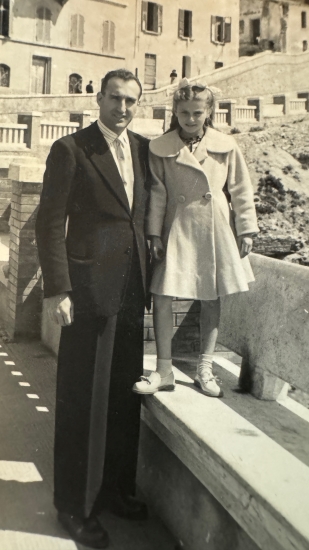 Nello with his daughter Anna
But Nello dies before his ambitions are realized. Coming back from a party meeting one night. A roadblock, a motorcycle, a banal traffic accident.
Some say it was negligence; others whisper it might have been murder.
This is what the women are told: a stone pierced the skull at the back of his head when he fell. A sharp, pointed stone, like a bullet.
This is the part of the story that doesn’t add up, the hole in the plot that’s never explained. A roadblock in the middle of a well-trafficked highway; no one else crashed into it until that late Sunday night. The delays: five hours for the police to show up at the accident site, five days before the body is buried, unshaved, head bandaged so thickly it looks like the skull had fallen apart, yet the face shows no bruises at all.
 Nello’s funeral #1
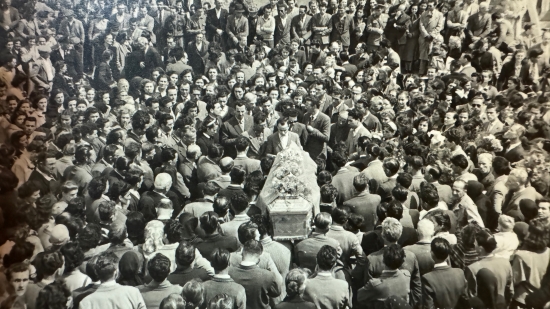 Nello’s funeral #2
Nearly seventy years later, you find a clue. A secret surveillance file depicts the prince of your grandmother’s tale as dangerous, violent, “perfectly capable of persuading the crowds to commit acts of rebellion.” A Communist, a partisan who trained with the most elite military division—exactly the kind of man the CIA finds most dangerous. It’s the Korean war. It’s the dawn of McCarthyism.
There was never an autopsy. You will never know why. You will never recover the police report—lost to the negligence of poorly managed archives, or else, simply destroyed. But the chief of police who signs the last memo on Nello is known for his abuse of Communists, famous for putting in jail former resistance fighters without regard for evidence, due process, or verdicts. First, the accused serve jail time. Years or even decades later, if found innocent by the overwhelmed courts, they are released. In the meantime, many are tortured and lose their lives. This chief of police’s name pops up in one parliament hearing after another, a palette of alleged abuses coloring his creative interpretations of law and order. He leaves his mark on this story: Carmelo Marzano, the end of a trail crumb at the doorsteps of a witch’s house.
What did you expect? This Italy, scarred by war, a pawn in a chess game between Russia and the US. Such a beautiful country. So much blood in its soil.
With Nello deceased, the factory-subsidized apartment is forfeited. Liliana has to provide for her daughter. She will take up a job at the co-op, washing wine caskets, taking warehouse inventory. She’ll move back with Egisto and Marina, and her sister and husband. For years, she will wake up before dawn every Wednesday, the day when cadavers are buried. She will spy the undertakers from a distance for a glimpse of the soul she has trouble believing may escape that cold, gray prison of flesh and bones. For the rest of her life, she will sigh, like Donna Rosa, for how handsome her husband once was.
And that’s how her story ends. The princess became a store clerk; the prince turned into a ghost. And the monsters? They’re still there, without scales or jagged teeth, without fire-breath or claws. They shed their uniforms for suits, disappearing in recondite offices, into the basements of government and corporate buildings, nameless and silent, always watching, always waiting, concealed by wires and screens.
The rest is denouement. Egisto grew old and retired. The women worked, cooked, raised children, prayed for their ghosts in candlelit churches, and buried their hearts under a marble slab. They crocheted the stories in cotton, stitched them with silence, with what they forgot, and what they could not. Then Anna married a man who took her far, far away to America. There’s none of the glamor of Donna Rosa’s noble wealth, but in some ways, Anna is wealthier, safer, at least. That’s what reassures the women, makes it worth the yearly visits that dwindle to the occasional long-distance phone call. That’s what you tell yourself when, one by one, they pass on, alone.
And you? You inherit their story. You plant that seed in this foreign soil, feed it with the sunshine of your gratitude, water it with the tears of their ancient losses. Until the monsters that wait in the shadows emerge, here too, where maybe they’ve always been. They are everywhere around you, surfing the vast ocean of digital waves and surveillance cameras. They sometimes wear uniforms, sometimes behind the wheel of unmarked vans, masked and armed with guns and terror. They spirit away storybook heroes—and also brave children, mothers, wives—and lock them away in camps not unlike the one where your great uncle gave up his youth. It’s an irony too bitter to ponder, but irony is at the heart of every good story.
And it’s yours to pass on, now, this story. Not a fairytale. Just a history. Write it down: there are no storybook endings, no happily ever afters. But there is the memory of those who were brave enough to fight the monsters, and those who chose to survive them for love. For the ones still here. For the ones whose storybook ending has yet to be written. And that’s its own kind of magic. Perhaps the most powerful magic of all.
Laura Valeri is the author of four award-winning and nominated books, most recently, After Life as a Human, a collection of essays about climate change and its effects on Dog Island, Florida. She teaches creative writing courses in the undergraduate English Department at Georgia Southern University. She lives in Savannah, GA.