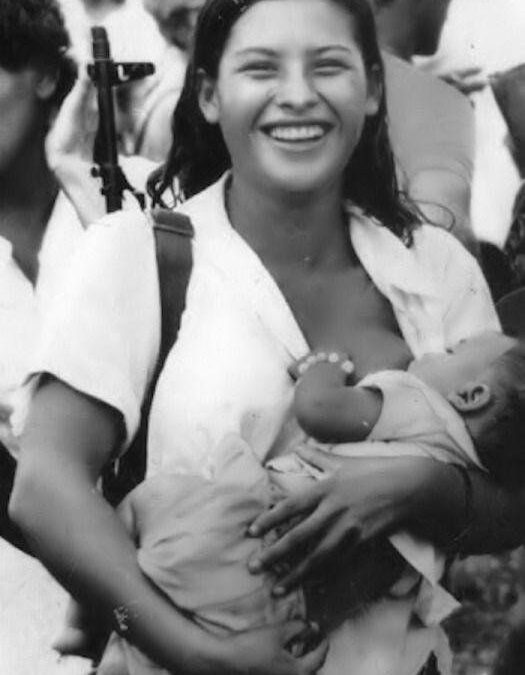
La miliciana de Waswalito (The Militiawoman from Waswalito)
taken by photojournalist Orlando Valenzuela, 1984
A talk about the real-life context that helped inspire “Since Estánil”
~
He said, You’re different from all the gringas. I know I am. Sometimes I sleep but sometimes I lay with my stomach gurgling and think about it: The difference between me and a gringa is that I’ll work all my life. This would be the case even if the revolution had lasted, which I am supposed to say it did, gloriously, but everyone knows Daniel and his wife killed it. A gringa doesn’t work until she’s grown up, and she can go to school. I know because Estánli told me there are free colleges in Washington like we tried here, but here it didn’t last. Then when she is old the gringa will stop working and be taken care of. I have five children, but they will not be able to take care of me. And the government would rather see me dead.
Estánli told me I’m different but he was talking about the difference in girlfriends, Nicaraguan vs. gringa. I was his girlfriend, and he said I was easier to be with than gringas, more accepting of him. You accept what’s perfect, I said. He said that women in Washington where he came from could be very sharp, but that even with all I’ve been through, I was never sharp, not with the kids, not with my loca Tia Cuca, not with the shop down the street that never gave credit. The more I think about this difference, the truer it seems. He helped me realize things. We talked and talked. I have been quieter since Estánli left. Also I am sharp now. Now I work in the gum factory. I’ve worked there thirty-two years. I count chicles into boxes: two, four, six, eight. They make a certain rattle when there are eight, so I can shake any box of chicle and tell you whether there are seven inside or four or eight. The big problem is when they catch you talking or when you’ve put in nine. I learned the rattle of nine right away so they’ve never caught me doing that, but last week they fired a girl up the line. She talked, and she must have put in nine. I would rather work somewhere else. Chicles are sticky and small; we can chew all we like, but we can’t swallow them and have a meal. We are hungry, we Nicaraguans, and we, my family. Marisa is a skeleton. I wish I worked at the hospital still, but it closed. Now you get any job and you’re grateful.
He said he wanted to pay me for practicing Spanish with him. He was studying Spanish at the language school. For years, until things changed and they closed it, the Escuela Nicaragüense was in our neighborhood and North Americans came to study Spanish and experience the revolution. They stayed with families. The neighborhood committee never approved our house; Tia Cuca was too crazy. Señora Castillo, whose son died alongside my husband Gustavo during the Insurrection, said they could not take the chance. I understood. But Ana next door, whose rooster crows all night, had students, and we talked to them. Estánli was the nicest. He’d stop and ask me medical words because I worked at a hospital. He also asked about guardabarranco and culebrí; I could tell he was listening to our music because we have a song about Sandinistas hiding in the jungle with those animals. And I explained, because I lived in the country as a girl and I know about guardabarranco nests and culebrí bites. So we talked more and more. I said I could never take money for talking to a friend. He was very handsome, with a wide mouth shaped like a pulled-out heart. Later when we kissed his mouth trembled back and forth. He went home to Washington but he left me a bracelet of tortoise shell. And then several months later Ana came over all agitated and said he was visiting again for five weeks and needed a room, and she had two students with her already, so could Estánli stay with me? It wasn’t official through the school; it was just a favor. He took the children’s bed, and they slept with me, at first anyway. He paid for the room. I didn’t ask. It was a privilege to have him. But my Tia said she would rob him if he didn’t pay. She was crazy. I said I’d tell the police. Anyway, he paid; he insisted.
He said, Luisa, your kids should eat more fruit. He brought beans every evening, or rice, or fruit because he said children need fruit. And he brought a whole box of toilet paper; it was years since we’d used anything but newspaper. He was very generous. The bus home from the institute where he was working on tuberculosis research went right by Roberto Huembes, the newest market. Estánli got off there every night and walked home, and it is a long way. He said walking is good too for children. He is the kind of doctor who heals people’s lungs. We were the same age. We were both twenty-seven. I liked weekends best because every weekend he took us with him somewhere. We went to the beach. He’d already been there with Escuela Nicaragüense, and imagine that I am pure Nicaraguan and he was only visiting, and I never had been. And my children never had been. During the dictatorship no one could go anywhere, and with the revolution we were too busy. I brought a towel and tortillas and cheese, and when we got there in the institute car, which they let him borrow on weekends, he bought us red soda and mamay and peanuts. The children were scared at first but Estánli was patient. He took their hands and showed them the water and pretty soon they were splashing and running. He showed them how to build things from sand. I wish I could build a sand house and live there. Some men got drunk and tried to swim and it was very funny, but Estanli said it was not something he could laugh at.
The beach is where Estánli took sixteen fotos that I have, so I remember it more than I remember the weekend we went to the volcano, or the weekend we went to Masaya, or even the last weekend when the children stayed with Tia Cuca and he took me to the forest to the Selva Negra, the first time I had stayed in a hotel or been north. I liked it very much and I remember it every day, but the fotos are on my wall and they are beautiful, and so I remember the beach several times a day. The children have their underwear on and they are wet and happy, shouting and laughing. He took three fotos of me, two standing at the water so it washed my feet and one sitting feeding Angelina on the sand. But I only have one of Estánli, the last foto we took, because the person taking the fotos can’t be in them, and too late I thought I would want some of him. It is not clear, like the others; when he sent the fotos he wrote that maybe I moved the camera. But he is standing with his long legs and his jeans cut ragged above his knees, smiling with the sea behind his chest. He is light and hairy as a mango seed, and tall. This was the only foto I had until he sent the other one.
But I have fotos in my mind of Estánli at the market, and on the bus, and walking in with a big heavy pineapple. And the night fotos, more like a film because they are dim and I feel him move against my skin. Since Estánli left we tried to eat more fruit, but now we can’t afford any, not even banana.
You are pretty and smart, he said.
I love Nicaragua, he said. The United States must be a cruel place. Children are left alone day and night while the parents work, as he was. Tia Cuca was crazy, but she helped look after the children and never let them run in front of cars or play with matches. Estánli said his parents drank too much, and in the United States it is no problem to afford liquor, so probably they are drinking too much still. Dona Carmencita went to a different part of the United States, and she said there are some good people there in Florida but terrible crimes. It’s that way now in Managua, and the worst criminals are government people. I come straight home after work and still sometimes I see robberies on the bus but no one can say anything or the robbers will find them and slit open their hands as punishment and take the bones out. We have gangs in Managua. Young people are hungry, and they were raised Sandinista and then everything changed. My kids are angry. I’m angry, also, because we made the revolution so we would not have to work like slaves at places like the chicle factory. Before he left home, my son Gustavito was in a gang. I don’t know what he’s in now. Maybe dirt. Anyway, Doña Carmencita is very proud of her son and he sends her money and packages from Florida. With the money she bought six rocking chairs for her friends to sit on, and we go over when we are not too tired, on the evenings when there is water to clean up with because we don’t want to dirty her good chairs, and we rock and talk. The packages all have boxes of her famous pancake mix. One time I asked her what it was that she liked so much about her pancakes because she will only eat those pancakes, nothing else, and she said she’d show me, and the next night she called me over and gave me one to taste, and it’s true, it was delicious. When I think of them my stomach cries out. Her son told her to come to Florida, but she says she’s too old now to leave Nicaragua.
Estánli’s mother never cooked for him. He ate box food all his life. It made him happy that I cooked typical Nicaraguan foods. Ana cooked, too, but mostly gallo pinto and eggs. I made him things I ate as a child: chayote stew, and squash with cheese, and fried tongue, and ropa vieja, and empanadas, and even nacatamales, which take a day to prepare and which he liked very much. I could be a cook, he said. With his rent money, I bought the meat and eggs. Tia said to save some, and I did, but some I spent on good food for Estánli, and then the children were able to taste some of the foods of their homeland. They liked the rellenos and the pio quinto best, but pio quinto is very expensive because you need cinnamon, rum, and sugar, even raisins. I only made that once because Estánli did not like it because he said the rum smelled like his mother. But that night was the first night I moved to the children’s room where Estánli was waiting for me. I remember because before he could enjoy kissing me I had to use his toothpaste which was very rich mint so I would not smell of rum. Making love with Estánli was beautiful.
He even said, Luisa, what do you like? He is the only man who asked what I liked. I felt embarrassed. I was raised that sex is for the man. So he laughed and said he would have to experiment and find out what I liked, and he tried some things that were very nice, and a few that made me laugh, and pretty soon every night he would ask what I liked and then I could tell him something.
He said, I love you. He said it the last night we had together, in the beautiful hotel. I thought I’d never be hungry or unhappy again. I thought so twice over: because of the revolution, which was giving us enough to eat and medicine and schooling, even during the war, and because Estánli told me not to worry, that he would help. But the revolution failed, and although I voted Sandinista and I see how the CIA and Reagan cheated us out of our election and our country, I’m in the minority now of people who are true Sandinistas. Being true Sandinista does not help you get a job now, or feed your children. You’re better off pretending you agree with Daniel, even though he is a weak old man relying on his half-ass wife. If Estánli had stayed, Daniel might have made him leave. And I might have gone with him.
I don’t want to go back to the US, he said. I said he should stay, that doctors are scarce in our revolution.
There is no one in the United States like you, he said. He said he’d write and send me things, to tell him what I needed. He said he would come back when he had a vacation.
Then he said, You’ll find someone else. I said no, there was no one else I could love now I had been with him.
He’s the one who found someone else. In the first years, he wrote four times and sent money twice. Then he wrote one last time to say he was married, and he sent a foto, with him in a beautiful suit and a woman, a bride, at his side. She was not pretty, but she looked happy, and her hair was that light blond of corn. I showed the foto to Ana and to Doña Carmencita, and even Tia Cuca before she died, and they all agreed she was not pretty. That was so many years ago I don’t count. Estánli has grown children by now, probably. Some days I hurt. Some days I’m too hungry to hurt.
He said, I could not forget you, Luisa, any more than I could forget Nicaragua. He sang the song to me, “Nicaragua, Nicaragüita.” Since he left that is my favorite song, and I sing it even though Ana listens through the wall and disagrees with me and reports people who criticize Daniel.
He said no. He wore two condoms every time like gloves on one big finger, and he said there could be no child. On the last night, I cried and said I wanted one and I could care for it.
He said he would not be able to care for it. I wanted to kill him, but there have been so many deaths. I killed people during the insurrection, and I did not want more blood in my nose because once it gets in there you breathe it all your life. Besides, I could not kill someone I love. At the hotel I said that when a person loves another person, it does not just end. It goes on and on, and will always be, wherever the two people are in the world. And when one person gives her word that she will do something, the other person can believe her. I said, this one time please God let a Nicaraguan decide for herself something without an American saying no or yes or maybe so. I said the child would be beautiful and would be my favorite, and I would care for it as devotedly as I always have cared for my children. He said it was true that I was devoted. I said that it would not be right to deny someone he loved something that she wanted very much, and that I was able every day to see the face of my first husband in my oldest boy, Gustavito, and feel gratitude to God for a child as a gift when God took my husband. I said my children’s faces help me keep hope in my heart. And that I would remember Estánli just the same without a child, but with a child I would have evidence that he remembered me, too.
I knew that if I had his child, he would send money and we would all eat. I knew it, and so did he. I said that he promised to visit and maybe he would, and I knew he would write, as he said, but still I needed this to remember him because who knew what would happen, and it was not so much because I didn’t believe him as because I believed every word, but that the world is very hard. I said children soften it.
Still he said no.
*
Editor’s Note: The author offers these resources for learning more about the role of women in the Nicaraguan Revolution: “Women in Nicaragua: The Revolution on Hold,” “Women With Guns Helped Win the Nicaraguan Revolution,” “Subversion Diaries: Revolutionary Women,” “‘We are the revolution:’ The Nicaraguan Women’s Movement Taking Charge,” as well as this article about the ongoing human rights violations in Nicaragua: “New UN report details Nicaragua’s ongoing human rights crisis.”
Leah Halper
Leah Halper grew up in the US and Latin America. She is a teacher, activist, and writer.