
By Abby E. Murray
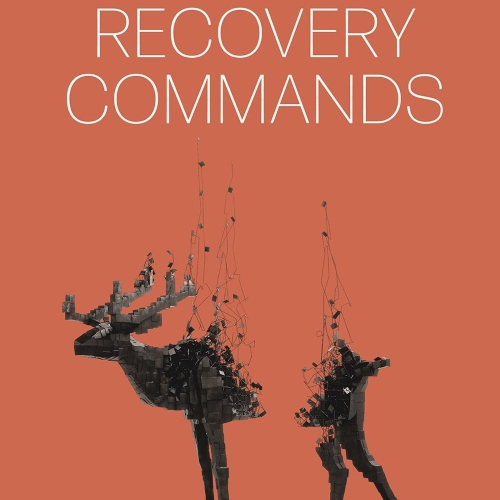
Recovery Commands
Ex Ophidia Press (2025), 95 pp
There is a familiar predicament that many of us can recognize at once: We’re in an environment, not of our making, with which we’re not in tune. This might be a short, endurable misery, like a bad party, but sometimes it’s a much more serious situation with no end in sight. What can we do? Do we change (or disguise) ourselves to fit the prevailing tenor? Do we protest? (If we do, where will that get us?) Do we search for like-minded people and try to create a covert community within the larger one?
No one easily fits in everywhere. In our society some differences are easily accommodated: restaurants include vegetarian dishes on the menu, parking lots reserve spaces for the handicapped, baseball pitchers throw to both right-handed and left-handed hitters. But the misalignment that stems from deeply felt moral dissent has no easy solution. At the start of World War II, Robert Lowell spent time in jail over his refusal to fight. Anthony Hecht joined the army but refrained from shooting enemy soldiers and came home wracked by PTSD for the rest of his life.
Abby Murray, a committed pacifist, is an army wife who loves their soldier-husband and lives with him in an environment imbued with military culture and structured by military hierarchies. Their poems indicate that they are too wise to confront this ethos head-on; instead, their running protest takes the form of the poems, by turns acid and bitterly comic, that comprise this book.
It’s not easy to write, or compile, a book of poems on a single theme. Murray accomplishes it by employing a variety of styles and by sneaking up on their central concern through a series of indirect assaults, suggested by some of her titles:
“Buying Paint on the Brink of War”
”At the Wives’ Coffee”
”What It’s Like to Wonder Whose Country It Was First”
”Self Portrait as a Starfish”
”The Traditional 20th Anniversary Gift is China”
They consider their predicament from many points of view, through many figures of speech, often laced with irony:
The army spouse
has no known
natural predators.
Of what should
I be afraid?
Besides metaphor.
[from “Drone Song”]
Midway through the book we come to a bald statement of the issue, phrased as a question in plain language:
Is there a way to tell
the commander’s wife
you’re a pacifist
and it’s possible
to trust your spouse
but mourn his work
because the death
he’s delivered
through the cracks
of thatched rooftops
is more than a fracture
beneath his skin . . .
[from “Asking for a Friend”]
The answer is clearly Not in so many words. And so we have this book, where poems on a range of subjects treat aspects of the insuperable problem in many ways, from many perspectives.
As to the styles, almost all the poems are in the first person. Even if the poem mentions you often, or makes a series of third-person statements, eventually an I pops up to reveal the poet themself, commenting and directing things from behind the scene. Many of the poems, usually unmetered, almost always unrhymed, have the rhythm and pacing of a stand-up routine:
If you ask me
where I’m from
I have to think about it.
Strike one.
My hometown
is a blood tree I keep
blooming in my ribcage.
Strike two.
And I know that,
eventually, my body
will betray me because
it cannot love me
the way I love it.
There is nowhere else
I could live that might
convince me I belong there
because I don’t.
[from “In the Next House”]
Behind the wisecracks looms the impossible reality: The writer loves their husband and child and implicitly pledges, in the words of the biblical Ruth, “Wherever you go, I will go, and wherever you live I will live.” They do not, however, take Ruth’s next step and add, “And your God [or belief system] shall be my God.” Because of that crucial reservation, they are tormented, and the reader—at least any empathic reader with similar moral reservations—feels their anguish.
The question is how to make an entire book out of that single overwhelming interior conflict. Murray’s strategy is to depict in the poems the myriad situations in which the conflict manifests itself. So we find them, for example, dropping their husband off for his first day at the Pentagon; recounting the objectives of the Survival, Evasion, Resistance, and Escape school (a military training program); buying paint to touch up their military housing unit; encountering suspicious neighbors who “prefer chatting / with my husband over me”; attending a coffee party for army wives (where “there is no coffee”); welcoming the incoming major’s wife to their husband’s battalion; and bringing their daughter (against their husband’s wishes) to a protest march.
The poems are best seen as parts of a running monologue. I find no single poem that stands as a well-formed definitive statement, moving, beautiful, and complete in itself. The writer’s aim is not to impart a vision but to protest and persuade. Or at least, if they must follow their husband, as they have chosen to do, into a career and an environment about which they have deep moral reservations, not to go quietly but to leave this indelible record of their protest.
Curiously, almost nothing is said about the husband’s perspective: his reasons for choosing this career over his wife’s deeply felt moral objections, his own belief system, whether based on family traditions, moral justifications, or something else. The book will disappoint anyone hoping to find a reasoned dialogue between two political principles or two moral philosophies. As far as this collection is concerned, the belief systems of both sides are beyond debate. We’re dealing here with the psychological fallout.
The poems recounting this fallout (I choose the word deliberately) are full of comments:
. . . you remember the army wife
who told you that’s why you can only trust
your battle buddy, by which she meant
other army spouses, by which she meant
us, not them, as if human kindness
is a code to be broken rather than
a language we all speak by choosing
to speak it . . .
The reader understands that in this artificial world both the outsiders and the insiders are trapped, manipulated, and helpless, though not all are equally aware.
The book needs to be taken as a composite—a collection of protests and lamentations, none of which is a finished, beautiful object in itself, but which in their various tones and attitudes have a cumulative force and urgency from which no perceptive reader can turn away.
Read in this way, the writer’s lines, sometimes verging on prose, now and then achieve a kind of informal eloquence that cannot be dismissed:
There are so many brutal reasons
to give up on us. Our hatred has prisons
beneath its deepest basements. But someone
is on the corner of 21st and Pacific playing a violin,
carving with distinctly human tenderness
the most delicate partita from wooden ribs
and the vibration of thin metal strings, things
more easily broken and discarded
than they are made to sing.
[from “If Humans Are Hopeless”]
The book’s title, Recovery Commands, refers to messages sent by mission control to a martian rover on the point of failing because its solar batteries are losing their charge. The commands try to reorient the rover, putting it in the path of the sun. It’s a desperate, last-ditch maneuver with a low chance of success. “I’m not proud,” the poet says, “but this is how I love, / as if it is my nature / to receive an answer.” The last lines of the title poem might be addressed to the poet’s husband, or to the military establishment, or to the country at large:
Wake up. Can you hear me?
Turn toward the light.
Jan Schreiber was Poet Laureate of Brookline, Massachusetts from 2015 to 2017. His poetry books include Digressions (1970), Wily Apparitions (1992), Bell Buoys (1998), Peccadilloes (2014), and Bay Leaves (2019). His translation of The Poems of Paul Valéry came out in 2021. A collection of his criticism, Sparring with the Sun, was published in 2014 and a new one, Breath Lines, appeared in 2025. An advisory editor of Think journal, he teaches in the BOLLI program at Brandeis University and runs The Critical Path, an annual symposium on poetry criticism.