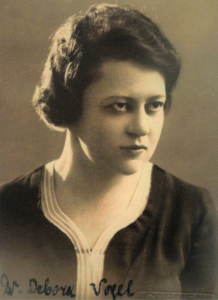
Debora Vogel
Editor’s Note: To celebrate the launch this month of Anastasiya Lyubas’s Blooming Spaces: The Collected Poetry, Prose, Critical Writing, and Letters of Debora Vogel, Consequence Forum commissioned new translations of Vogel’s writing about war which we proudly publish as “Fragments.”
✣
A Fragment
(Gentlemen in Bowler Hats)
At the end of March, spring comes unnoticed: as if it has been waiting for a while. It arrives with the baggage of greenery, light as a sigh. The greenery hides the pristine blue of midday in an unexpected way; it comes with an inherent anticipation of life.
On all the streets in the world gray uniforms march at the same time. They are of two different kinds.
The ones in the foreground represent, as it were, the greatest certainty and magnitude in life. They belong to people to whom a single role has been allotted. This role is to demonstrate the enduring way of the world where certitude is purchased with the coveted red metal and pale silver and where gold defines the fate of things.
In the background—still hazy and covered with tiny drops of leaves and certainty of the foregrounded uniforms—figures are being sketched out: decidedly different, they are waiting for their turn. These figures in military uniforms, gray like life and tin, bend under a suppressed longing, “the yearning of raw materials that wish to play their part in history.” They are heavy from waiting and glassy grayness.
It is the end of March, a warm spring.
The world is getting ready for war.
The ministers of foreign affairs of both countries wait for one another at the train stations. They are not in their official top hats, instead, they are wearing ordinary elliptical black stiff bowler hats.[1]
And all the telegraphic agencies, reporters, and newspaper correspondents emphasize in every way this seemingly inconsequential fact.
“A bowler hat,” the newspapers write, “introduces a cordial and an unofficial tone into the greeting.” There must be some truth to the statement, because the men in bowler hats give repeated assurances that one should not expect much from these visits, that they serve informal and purely informational purposes….
Such an important detail and in no way accidental—these common bowler hats instead of the formal top hats.
Meanwhile, armored ships with soldiers, tanks and ammunition are leaving Naples for Africa.
Mussolini has had no intention of missing out on the six months of the dry season in Africa which is about to commence in October.
Time is of essence: one needs to act quickly before the next season’s rainy days arrive in order to be in a position to declare political gains for Italy soon.
Debora Vogel, “a montazh kapitl.” In Zikh 18 (1937), no. 33, p. 90-91. The subtitle is found in the following manuscript: Debora Vogel, “fun der serie: pasirungen banale (a montazsh-kapitl)” (From the series “Banal happenings” (A montage chapter)”. Ms in YIVO Archives, New York: RG 108, Box 64, F. 63.5; 5 pages. Debora Vogel explains the etymology of the Polish name for “bowler hats” in the following sentence which has not been translated: “these hats are called ‘meloniki’ because they are similar to the pot-bellied and elliptical melons.”
~
A Fragment
Ammunition is converted into life.
And Europe behaves like a disgruntled and tormented person in those ill-fated moments when everything seems thwarted and could have been otherwise.
In these moments, passion engulfs us to account for life in terms of other possibilities. Never mind that in the course of such calculation one is assailed by sadness, a regular companion of lost things.
Such abnormal anguish has now overwhelmed Europe:
On April 3rd, 1935 the dailies published a table prepared by the Institute for Economic Research. “Statistics you should pay attention to” reads the headline of the short article.
It appears from this table that during the previous year the export of military goods increased from 224 million guilder in 1933 to 251 million in 1934. This means that the export of ammunition rose by twenty percent at the same time as the global trade shrank by four percent.
The second column of numbers in the table speaks its own language. From this column, it follows that in 1935 Europe will need twice as much ammunition as in the great year of war—1913.
At this point, the pathological passion for recalculation mentioned above gets expressed again. The amount of 30 million guilder by which the war industry needs to expand in 1935 is much higher than the sum of the annual import to Europe of raw materials, semi-finished products, and goods which are able to give life itself.
This much can be said for the newspaper report.
Life’s commentary on it is as follows: an insipid and expressionless mood befalls us at the sight of large arsenals and ammunition warehouses. We find ourselves in a similar mood after catching a glimpse of the large kitchen floors scrubbed with yellow lye with a strong odor.
Debora Vogel, “Fragment,” In zikh 18 (1937), no. 36, p. 181.
~
Military Parade
(A Montage Chapter)
These events happen at the end of the expressionless Lyczakowska street where it becomes a circular Bernardynski square on one of the last days in February 1937.
It is one of the first spring days. Women sport clothes in bright colors, light as porcelain. The first sadness runs over the body—the sadness is elastic despite the fact that the trees are still black and withered. Memories intermingle with the fear of a squandered life and everything is self-evident.
Out of the clear and delicate blue, out of the very heart of the first spring blue, soldiers and tanks emerge. They are self-evident, like everything that happens on that day.
The tank-houses approach, flat like meadows. The leather of helmets and coats is like iron, smooth and shiny, free from whimsical wrinkles. People dressed in leather coats and helmets are the same—without the slightest quirk.
Through the gray sidewalks and their dusty square tiles, you can sense how the soft slow grass and shiny pink worms are crushed and lumped together with dirt.
Suddenly and quite pointlessly a bizarre blue atmosphere rises above the sidewalks. It is ludicrous and sad at the same time, like a thin and helpless smile of the gentleman in a bright coat which is premeditated for the lady in elastic blue who speaks about the first drawn-out sadness.
“….The army is our pride
The army is the essence of people’s life.
That’s why all citizens cherish the army
All revere the army…”
(This is the sound of a fragment from the government manifesto shouted three times a day through all megaphones. It is shouted once again the next day and printed three times over in all newspapers and on five million billboards hung all over Poland or some other country.)
That same day, it rains in the evening. Everything is washed away with the rain’s grayness. Then a flashy white and red billboard appears with a smiling face of a soldier and a caption announcing “Military Newsreel” in Pan cinema.
A mechanical ballet dances on the screen—the ballet of grayness compressed into figures and surfaces. The grayness is without any hint of dusk, without any drop of subtlety and melancholy. It is infinite and lifeless like the cold North Sea in autumnal fog.
The high and tragic pathos of the navy-blue mountains—cut out from the purple paper of the sky—is projected from the screen. As is the pathos of the nights with dark skies.
“…Men’s destiny is to die under the tank…
….Women’s purpose is to give life…”
The delicate complexion of children’s cheeks is soft like velvet and cool like the fragrant flowers. Men’s life climbs along the sad, hard, and stiff lines. It is ready to be grated by the iron teeth of the tanks. Blind women who carry inside themselves sad and stiff men pass by the tanks. Everything is forever the same.
Late at night, a newspaper page lies open in a room. A red headline reads, “Europe in flames.” A banal statement.
“…The cost of tin rose and the price of lead increased as well…Zinc can be replaced by the artificially manufactured metal…”
One of the first spring days passes. It is tender and elastic and full of foreboding and anticipation. You await banal things like the fresh greenery which suddenly and unexpectedly floods the sidewalks. You also anticipate the gray porcelain of the sidewalks being warmed up by the light of the lanterns aglow with the dim yellow honey-like light (the light in Claude Lorrain’s paintings).
Trees and bodies prepare “for life.” As if nothing else were as important as this strange thing called “life.”
Debora Vogel, “militer-parad (a montazsh-kapitl),” In Zikh 19 (1938), 47, p. 154