
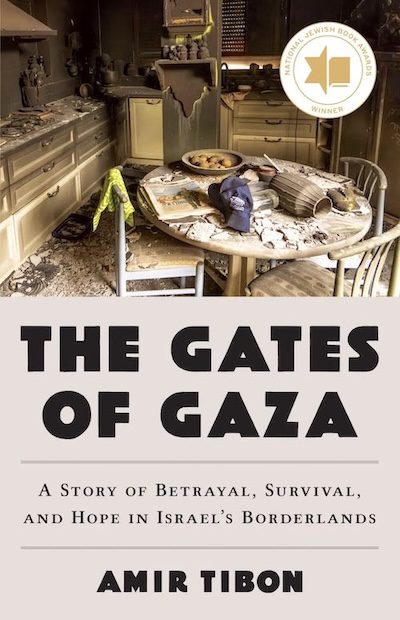
The Gates of Gaza: A Story of Betrayal, Survival and Hope in Israel’s Borderlands
By Amir Tibon
Little, Brown and Company, 2024; 352 pp
One the most chilling scenes in all of Western literature occurs in Book 21 of Homer’s Iliad. Maddened by rage at the killing of his closest friend Patroklos by the Trojan warrior Hektor, Achilles is on a murderous rampage of revenge when he happens upon a poor sod named Lykaon. A while back, Achilles had captured this young man, son of the Trojan king Priam, but chose to spare his life and sell him into bondage instead. Lykaon was eventually released, but after enjoying only eleven days at home, he re-entered the battle against the Greeks and once again fell into Achilles’ rough hands. Having thrown down his armor and spear, and utterly exhausted, Lykaon begs for mercy, and offers Achilles a huge ransom in return. Achilles’ response:
Young fool, don’t talk to me of what you’ll barter.
In days past, before Patroklos died
I had a mind to spare Trojans, took them
alive in shoals, and shipped them out abroad.
But now there’s not a chance—no man that heaven
puts in my hands will get away from death
here before Ilion–least of all a son
of Priam. Come, friend, face your death, you too.
And why are you so piteous about it?
Patroklos died, and he was a finer man
by far than you. You see, don’t you, how large
I am, how well-made? My father is noble,
a goddess bore me. Yet death waits for me,
for me as well, in all the power of fate.(115-125, Fitzgerald translation)
Hearing this, Lykaon’s knees fail, he sinks down and opens his arms wide in supplication. In response, Achilles cuts his throat and slings his bloody corpse into the river.
The astonishing word in this passage is “friend” (philos). While it is possible Achilles uttered it with a sadistic smirk, I don’t think he did. Instead, I take it to express a genuine recognition of a profound likeness between two warriors. You and I, Achilles is saying to Lykaon, share the same fate. We Greeks attacked your city. Of course you want to kill me. As it happens, though, I am stronger and so I will kill you first, but have no doubt that, like you, I too will be slain on the battlefield.(1) The two of us are consumed and defined by a deadly war from which we cannot escape, so stop crying and open your eyes to the cold hard truth that neither of us will ever return home.
A story Amir Tibon tells early in The Gates of Gaza: A Story of Betrayal, Survival and Hope in Israel’s Borderlands is what brought this passage from the Iliad to mind. Tibon, a journalist with the Israeli newspaper Haaretz, and his family, lived on Kibbutz Nahal Oz, which is roughly a half mile from the Gaza Strip and was one of the numerous Israeli communities attacked by Hamas on October 7, 2023. Some twelve hundred Israelis (and foreign workers) were murdered—three hundred at a musical festival—and over two hundred were kidnapped. The chapters of The Gates of Gaza alternate between a harrowing hour-by-hour chronicle of that day—during which Tibon and his family took shelter in their safe room (which every house in Nahal Oz was required to have)—and a historical account of the role Gaza has played in the long struggle between Israelis and Palestinians. It concludes with a scathing critique of Israel’s leaders, Benjamin Netanyahu in particular, for having failed to provide adequate security for their fellow citizens.
Tibon, whose grandparents survived the Holocaust, describes himself as a “liberal left-leaning Israeli Jew” who believes in making peace with the Palestinians. Kibbutz Nahal Oz was filled with people like him, which, perhaps, makes the murder of thirteen of them all the more heart-rending to recall. At the same time, Tibon is a Zionist who is convinced that “without secure borders the world’s one and only Jewish country would be unsafe and the dark past of our people could perhaps repeat itself” (p. 9). This conviction is one reason he and his wife decided to move to Nahal Oz in 2014. At first, the prospect of living there seemed preposterous. The most recent war between Israel and Hamas had just ended that summer and the borderlands were still dangerous. Why would two successful young professionals leave the safe, sophisticated city of Tel Aviv for a remote community next door to the Gaza Strip? Tibon explains: they were motivated by “patriotism and defiance of Hamas” (p. 9), as well as a “desire for community, for a slower lifestyle and for proximity to nature” (p. 212).
The story begins in 1953, when a group of about sixty Israeli soldiers was sent to what became Nahal Oz in order to establish a kibbutz, a collective farm. At that time the Gaza Strip was controlled by Egypt and was “a city of refugees” (p. 22). Much of its population consisted of Palestinians displaced from their homes during the 1948 Arab-Israeli War. Israel’s strategy, formulated by the Zionist Moshe Dayan, Israel’s most influential military general, and David Ben-Gurion, its first prime minister, was two-pronged: to maintain a military presence on the border with Gaza but also to build civilian communities. Their purpose was “to detect and deter attacks and to convince the Arabs that the [. . .] recently founded State of Israel was there to stay” (p. 16). Witnessing the arrival of the Israeli Jews was excruciating for the Palestinian refugees in Gaza, some of whom could actually see their old homes and fields from their camps. When any of them tried to return, even just to retrieve their possessions, “they were turned away by Israeli soldiers often with violence” (p. 22).
Eight years after the 1948 war, April 29, 1956, was supposed to be a festive day on Kibbutz Nahal Oz. The community was growing and a communal celebration of four weddings had been planned. Moshe Dayan himself accepted an invitation to attend the party. The high spirits of the kibbutzniks crashed that morning when Roi Rutberg, Nahal Oz’s chief of security, was ambushed and killed by Palestinians. The weddings were canceled and Roi’s funeral was scheduled for April 30. Dayan came anyway, this time to deliver a funeral oration. Its opening is astonishing:
Early yesterday morning, Roi was murdered. The quiet of the spring morning dazzled him, and he did not see those waiting in ambush at the edge of the furrow.
Let us not cast the blame on the murderers. Why should we question their burning hatred for us? For eight years they have been in the refugee camps in Gaza, and before their eyes, we have been transforming the lands and the villages, where they and their fathers dwelt, into our estate.
“Dayan’s words,” Tibon explains, “represented a rare recognition by an Israeli leader of the Palestinian Nakba, or ‘catastrophe’—the mass displacement of civilians during the 1948 Arab-Israeli war, when approximately seven hundred thousand Palestinians had become refugees” (p. 27).(2) However empathetic he may have been—after all, European Jews had suffered their own catastrophe not long ago—Dayan’s response was fierce and uncompromising:
Beyond the furrow of the border, a sea of hatred and desire for revenge is swelling, awaiting the day when serenity will dull our path. . . . This is the fate of our generation. . . . to be prepared and armed, strong and determined, lest the sword be stricken from our fist and our lives cut down (p. 27).
Of course they hate us, Dayan told the hundreds of people attending Roi’s funeral, for we have stolen their land and homes. Of course, they want revenge. Do not blame them, for were our positions reversed we would want the same.
Despite his admonition not to cast the blame on the murderers, Dayan was anything but conciliatory. Instead, he exhorted the crowd to face the fact that they must always be prepared to fight for their lives. In a passage (which Tibon does not quote) Dayan elaborated:
We are the generation of settlement; without a steel helmet and the muzzle of the cannon we will not be able to plant a tree and build a home. Our children will not have a life if we do not dig shelters, and without barbed wire and machine guns we will not be able to pave roads and dig water wells. Millions of Jews who were exterminated because they had no land are looking at us from the ashes of Israeli history and ordering us to settle and resurrect a land for our people.(3)
Dayan’s eyes were open to the fate shared by both Jews and Palestinians: they were locked in lethal combat. The Gates of Gaza is similarly open-eyed. Tibon’s description of October 7 is meticulously detailed and dispassionate. His analysis of the evolution of Israeli policy on Gaza is clear. His account of the heroism of those Israelis, like Tibon’s own parents, who fought back is stirring. Finally, although he says little about it, he is not blind to the “unimaginable destruction that Israel has unleashed on Gaza in the aftermath” (p. 289).
On the one hand, Tibon differs from Moshe Dayan. When Egypt’s president, Anwar Sadat, offered to make peace with Israel in return for its withdrawal from the territories it captured in the 1967 war, Dayan rejected his proposal proclaiming “that for Israel, keeping the occupied territories was more important than securing peace” (p. 53).(4) By contrast, for Tibon “the only way to ensure real security for Israel is to make peace with all its neighbors . . . and ensure they have a state of their own” (p. 54).
On the other hand, Tibon, like most Israelis, shares Dayan’s view that Israel is “surrounded by hostile neighbors—some of whom would have liked nothing more than to redraw the new Jewish state right out of existence.” He describes himself as a Zionist “in the most basic sense,” which for him means that in order for Jews to be safe they must have their own country whose borders are secure. For Tibon, until a stable peace with the Palestinians is finally reached, “communities like Nahal Oz have a vital role to play” in making a “safe world for the Jewish people” (p. 10).
Tibon seems to share something else with Moshe Dayan. What endangers Israel most, Dayan warned, is complacency, for that is when Israelis will let their guard drop and become vulnerable. He even seemed to suggest, shockingly, it was just this that killed Roi Rutberg:
The young Roi who left Tel Aviv to build his home at the gates of Gaza, to be a wall for us, was blinded by the light in his heart and he did not see the flash of the sword. The yearning for peace deafened his ears and he did not hear the voice of murder waiting in the ambush. The gates of Gaza weighed too heavily on his shoulders and overcame him (p. 28).(5)
Serenity had dulled Roi Rutberg, a lapse that proved to be fatal. Dayan exhorts the crowd never again to let their guard down.
Tibon himself learned this lesson in 2018. On November 11, an Israeli intelligence unit inside the Gaza Strip was exposed. A battle ensued and the next morning Hamas launched a rocket attack on southern Israel. The residents of Nahal Oz were instructed to stay at home and remain close to their safe rooms. Since there had been numerous such alerts, this was a familiar and not particularly alarming routine for the kibbutzniks. After a long day of confinement, one family, who were Tibon’s neighbors and friends, decided to venture outside. The children wanted pizza and as the parents were putting them into their car seats they heard the sirens. Since they were too far from home to return to their safe rooms, they ran to a small bomb shelter nearby. “The girls cried as a powerful rocket exploded right outside the shelter,” but fortunately the family was unharmed. From his friends’ experience Tibon realized that “complacency—or even a simple desire for normalcy—could kill” (p. 219).
This principle is central to Tibon’s critique of the Netanyahu government. Having built an enormous underground barrier that prevented the Palestinians from leaving Gaza through their many tunnels, and erecting a fence and a high-tech surveillance system around the Strip, the Israeli military was confident Hamas had been successfully contained. “Hamas is deterred and afraid of us” (p. 236), Netanyahu bragged to members of his Likud party. The military command was so confident in its efficacy that, weeks before October 7, it dismissed warnings that came from its own “spotters”—female soldiers who monitored Israel’s vast network of cameras along the border—that Hamas was planning a major attack.
What makes the failure of the Israeli military all the more galling to Tibon is that it was, he argues, a byproduct of Netanyahu’s political maneuvering. For several complicated reasons, which Tibon carefully documents, it was to Netanyahu’s advantage to keep Gaza calm and to claim credit for doing so. In retrospect, the way he chose to do this was repulsive: He allowed the oil-rich country of Qatar to fund, and thereby strengthen, Hamas. While a sizable portion of the millions of dollars the Qataris sent to the Gaza Strip was used for its stated purpose—to build neighborhoods, schools, and hospitals—much of it was siphoned off to purchase weapons. Israel publicly criticized Qatar but did nothing to stop the flow of cash. Tibon claims the reason why was simple: “Netanyahu needed quiet, and Hamas needed money” (p. 225) and so, even after the 2014 war, “Qatar once again flooded Gaza with cash, with the tacit support of the Israeli government” (p. 212). Even after Yahya Sinwar, the leader of Hamas, publicly declared a massive attack was coming from inside Gaza, Netanyahu minimized the threat. As a result, the Israeli army was woefully unprepared to defend borderland communities like Nahal Oz when the invasion Sinwar had promised was launched and more than a thousand Jews were slaughtered.
In the Epilogue of The Gates of Gaza, Amir Tibon drops his journalist mantle and becomes reflective:
As an Israeli citizen, I supported the war effort, at least in the early months of the fighting. I was angry over what Hamas had done and scared of how Israeli weakness in the face of that attack would be perceived by other adversaries. But as a human being, I find it extremely difficult to countenance the level of destruction caused by my own country inside Gaza. And as a resident of Nahal Oz who still holds out hope that my family will one day be able to return, I have to ask myself what will result from all this violence—peace and quiet, or more violence? (p. 289).
He concludes by turning again to Moshe Dayan’s 1956 speech. “Gaza’s gates still weigh on our country, as heavily as if Dayan had delivered his speech only yesterday.” But they “don’t just weigh on our shoulders . . . in the years and decades to come they will weigh even more heavily on our souls” (p. 290).
It is not clear what he means. What does Tibon think will weigh so heavily on Israeli souls? The recognition that prior to October 7 Israel, dulled by its prosperity and technological prowess, let down its guard, and must never do so again? Or is it that Israel has been transformed it into a heartless killing machine? Tibon finds it “extremely difficult to countenance” the fact that in retaliation for the October 7 attack, Israel, by its own admission, has killed over seventy thousand Palestinians, of whom 83 percent were civilians. Is this what makes his soul shudder? Is he appalled by Benjamin Netanyahu’s description of Israel as a “super-Sparta,” a Greek city-state whose entire culture was devoted to military readiness and which subjugated vast numbers of foreigners so that Spartan men could train for war?(6)
Whatever the answer, one thing is clear: Amir Tibon loves his country. Israel offered a desperately needed haven for Jews like his grandparents and thereby made his own existence possible. Without it, he fears, the dark past of the Jewish people could repeat itself. At the same time, he has profound misgivings about its present government. In short, he is a Zionist critic of Israel. For some of Israel’s most trenchant American critics this phrase is self-contradictory. For them, Israel’s destruction of Gaza and its horrifying indifference to Palestinian suffering are the inevitable conclusion of the Zionist logic Moshe Dayan articulated at Roi Rutberg’s funeral: because we took their land they hate and will try to kill us, and so we must be ready to kill them first.
The Gates of Gaza thus raises a painful question whose answer is anything but obvious: should Zionism itself be held fundamentally responsible for the actions of the Israeli government since October 7, 2023? Or was it the complacency of the Netanyahu government and the Israel Defense Forces who deserve the blame for this horrific new cycle of violence?
❊
End Notes
Bk 9 Achilles is told by his goddess mother that he will die if he avenges the killing of Patroklos.
Tibon notes that the government sanctioned “broadcast version [of this speech] omitted the first, explosive paragraph recognizing the Nakba and the tragedy of the Palestinian refugees” (p. 28).
The full text of the speech, translated by Jean-Pierre Filiu, can be found in the Wikipedia entry, “Moshe Dayan’s Eulogy for Roi Rothberg.”
According to Nir Eisikovits, Dayan “came around” by the late 70’s and, after Sadat visited Jerusalem, supported making peace with Egypt.
“In Judges Book 16.3, Samson tears loose “the gates of Gaza” and lifts them to his shoulders.
On the death toll in Gaza see The Guardian, January 30, 2026. Netanyahu’s “super-Sparta-speech” was reported in the Times of Israel on September 29, 2025.
After teaching Ancient Greek Philosophy for forty years, and having written seven books and more than forty articles, David Roochnik retired from Boston University in 2020. He is now devoting most of his considerable energy to what used to be his hobby: writing fiction.