
Pravy Jha reads “Kasheer, After”
Editor’s Note: Kasheer is the Kashmiri name for Kashmir, a Himalayan region held by India and long claimed by Pakistan. Its Hindu minority, the Kashmiri Pandits, had lived in the Valley for centuries. In January 1990, as an armed insurgency rose against Indian rule, targeted killings and threats drove almost the entire Pandit community out of the Valley within weeks. Most fled to camps in Jammu; decades later, many have never returned. Among the killings that defined that winter was that of Girija Tickoo, a young Pandit woman abducted and murdered after attempting to collect her salary. This essay moves through the Pandit exodus of Kashmir, and through what could not be left behind.
Author’s Note: This essay is not a record of my own leaving. I did not live through the exodus of the Kashmiri Pandits; I came to it slowly, through reading, through interviews and first-person accounts, through community archives, and through conversations with people who carry the memory themselves. Much of what is here was given to me: the green trunk and the folded winter clothes by a friend whose family left Habba Kadal, other details by voices I found in testimony and reporting. I have tried to hold what was shared with me without claiming it as mine.
❊ ❊
He did not begin with the night.
When I asked him about leaving, he went instead to the trunk under his bed, as though that was the only part that had stayed intact enough to touch without it coming apart. It was iron, painted a green that had dulled into something closer to ash along the edges, the paint worn thin where hands had met it over years. His mother kept winter things in it. Pherans folded thick, shawls layered one over the other, camphor tucked into the corners so the smell would hold through the damp months.
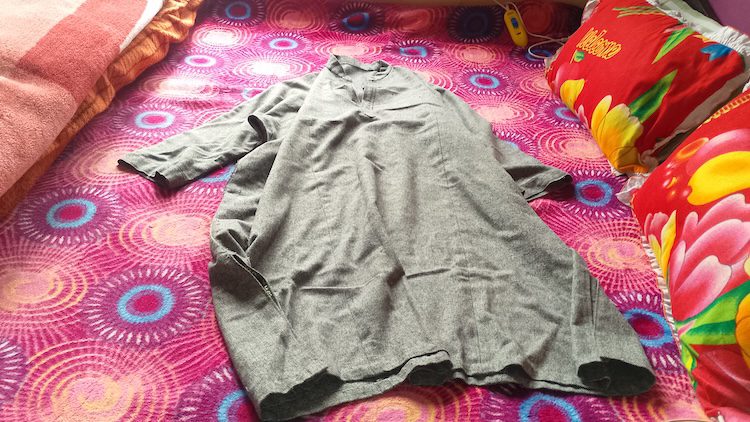
A Kashmiri Pheran
She opened it that morning and did not reach in immediately. He said she stood there longer than she needed to, looking without touching, as if the act of choosing anything at all would make the moment hold. Then she took out one sweater, only one, and closed the trunk.
After that she began to speak the same sentence, over and over. Her voice wasn’t loud or urgent, but its steadiness made it difficult to interrupt. They would be back before the real cold set in. It did not make sense to carry everything for a few days. Her repeated sentence felt the same each time. No one corrected her. They did not entirely believe her. But there are moments when contradiction becomes a kind of violence. It was easier to let the words stand than to break them.
The departure does not loom large in his mind. Neither does the road, nor the checkpoints, nor the crowding of bodies carrying what could be lifted in one attempt. What remains is that room, the trunk still half full, the sense that nothing had been properly concluded, that the act of leaving had begun before anyone had agreed to it.
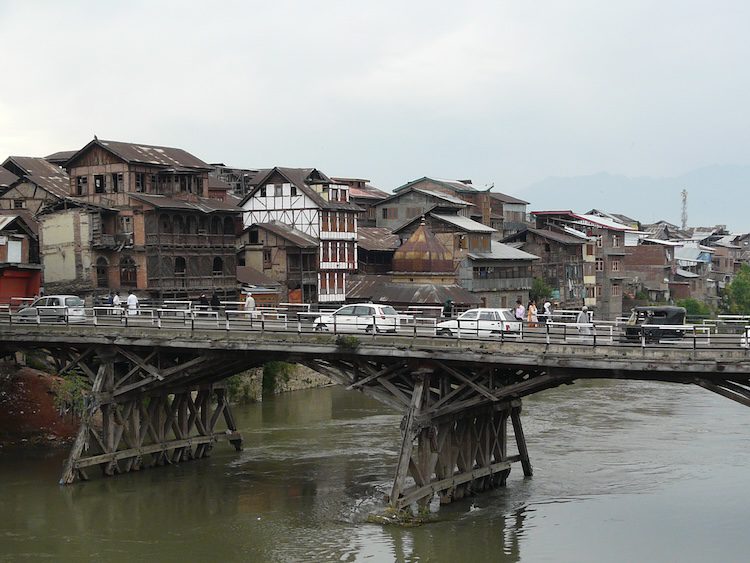
Habba Kadal Bridge
In Habba Kadal, sound does not stay where it is made. It travels, crosses walls, settles into other rooms. You learn early to recognize what does not belong to your own house. That winter, the difference became harder to ignore. There were sounds that did not resolve into anything familiar. A voice raised and then cut off mid-breath. Movement in a lane that should have been empty at that hour. Footsteps that did not slow at a doorway but continued past it, too quickly.
By morning, something would have attached itself to the night, but never fully. A name would circulate. A place would be mentioned once, then not again. A body would be found somewhere it did not belong. Rainawari. Sopore. Anantnag.
Conversation began to adjust itself. People stopped finishing sentences; completion had become unnecessary. Whenever you began to say something, the other person would have already intuited the meaning.
What is written now arranges those months into sequence, but the experience resists that order. When people speak, they do not move forward so much as around. Someone begins with a neighbor who stopped meeting their eyes in the lane, and the story stays there, because that small shift contains far more than a list of events can hold. Someone else remembers a shop where they had always been known, where suddenly there was a pause before anything was handed over, then a distance that did not need to be explained. Another recalls being told not to remain outside after a certain hour, in a tone that suggested the decision had already been made elsewhere.
A woman once told me that the moment she understood what was happening did not involve violence at all. It was the day her father stopped correcting people. He had always insisted on saying Vitasta. Not Jhelum. He would repeat it until the word settled properly in the other person’s mouth. It’s not that he was stubborn. The word simply held something he refused to surrender casually. One day he quietly let it pass, and the conversation moved on. He did not return to it. She said that silence marked the point where something had already begun to give way.
Girija Tickoo
Girija Tickoo went back to collect her salary.
The fact itself disrupts the way people try to organize what followed, because it belongs to a time when routine had not yet fully acknowledged its own collapse. She went because work still existed in form, because systems take longer to fail than people do, because there is always a brief interval where everything continues as if it has not already changed.
She went for something ordinary.
She was taken, because she was a Pandit, and she did not come back. What was done to her before she was killed became one of the stories that fixed the fear in place, passed between people in fragments no one wanted to finish.
What happened after does not need to be elaborated to carry its weight. It moved through people in fragments that were sufficient. After that, even small errands acquired a different scale. The idea that you could leave a place and return the same day without consequence no longer held.
There were warnings, and people hold on to those stories carefully, because they preserve something that feels recognizable. A man in Sopore was told, quietly, that his name had appeared where it should not have. He left the same night. No preparation, no explanation beyond what was necessary. He did not need further detail. The information had already arranged itself.
There were also assurances. “You are safe here.” “Nothing will happen.”
These came from people who had been part of their lives for years. Neighbors. Colleagues. People whose presence had never needed to be questioned before. That kind of familiarity does not dissolve immediately. It stretches, holds its shape longer than it should. Some stayed because of it. They were not naive. Trust does not collapse at the same speed as threat.
What remains later is not the intention behind those words. It is the distance between what was said and what unfolded.
The leaving does not survive as a single memory. It returns in parts that do not align cleanly. A door being locked. A light left on. Food measured for another day. A voice from behind that is not answered because turning back would require a different kind of decision.
People say they locked their houses. They say it with a quiet insistence, as though that act still holds something. Locking suggests return. It preserves the idea that what is being left remains yours in some form, even when everything else has shifted.
Jammu was not an arrival in any meaningful sense. It was where people found themselves because there was no immediate alternative. Rooms meant for two held entire families. Corridors became extensions of living space. Sheets created divisions that did not prevent sound from passing through them. Everything was audible. Conversations, arguments, illness, grief that could not be entirely contained.
The heat altered things in ways that were difficult to name at first. It was not only discomfort. It felt misplaced, as though the body had been moved into a condition it did not recognize. People who had lived their entire lives in cold climates found themselves unable to adjust in ways they had not anticipated. Sleep became irregular. Appetite changed. Bodies responded unevenly.
Older people began to fail more quickly than expected. Not in dramatic ways. It was a steady decline that did not reverse itself. Heatstroke, heart conditions, illnesses that seemed to accelerate without a single clear cause. These are now recorded, analyzed, turned into patterns. But what people retain is not the pattern. It is the moment when someone who had been stable is suddenly not.
Now the language around all of this has shifted. It has been many years. Lives have been rebuilt. These sentences appear often, and they move without resistance because they do not require anyone to remain within the experience for too long.
What resists that movement are smaller things. A key kept long after it has ceased to function. A name that feels incorrect even when it has become standard. A script that is recognized but no longer easily read.
He told me once that he tried to draw the layout of his house from memory. He could recall most of it without difficulty—the entrance, the narrow passage, the window that opened onto the lane. But when he reached the trunk under the bed, he stopped. He could not remember what else had been kept inside it beyond the winter clothes. He said that was where the memory lost its precision, not disappearing, but thinning, as if it could no longer support the same level of detail.
Kasheer, after, does not exist as a place one returns to. It persists in fragments, in what has been carried forward without being fully resolved, in what has been altered through time without entirely disappearing. It does not demand attention consistently, but it does not recede either. It remains, unevenly, in ways that resist being organized into something complete.
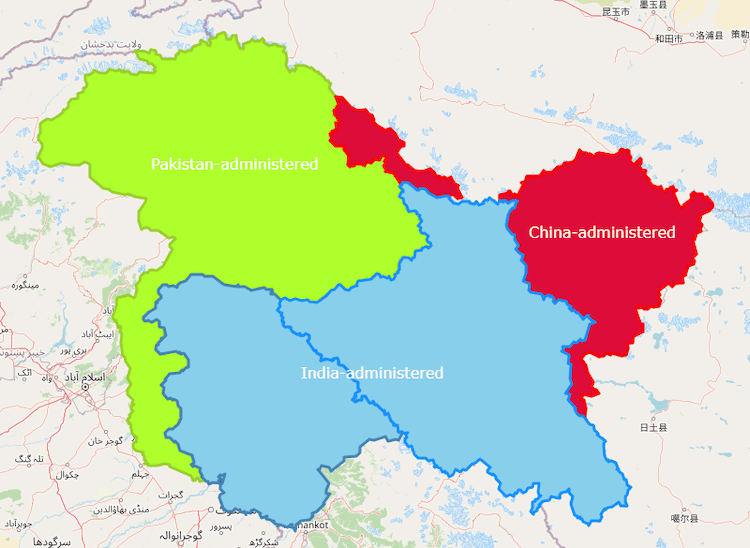
Kashmir administered regions and claims
Acknowledgment
The account of Girija Tickoo draws on documented testimonies of individual victims, including those gathered in the iKashmir archive. The detail of Vitasta and Jhelum comes from an interview with the actor Bhasha Sumbli.
Pravy Jha is a student writer from India whose work has appeared in Brilliant Flash Fiction, Blue Marble Review, and elsewhere. She won second place in Writers’ Hour Magazine’s “The Doorway” contest for her piece “The Door That Waited.”