
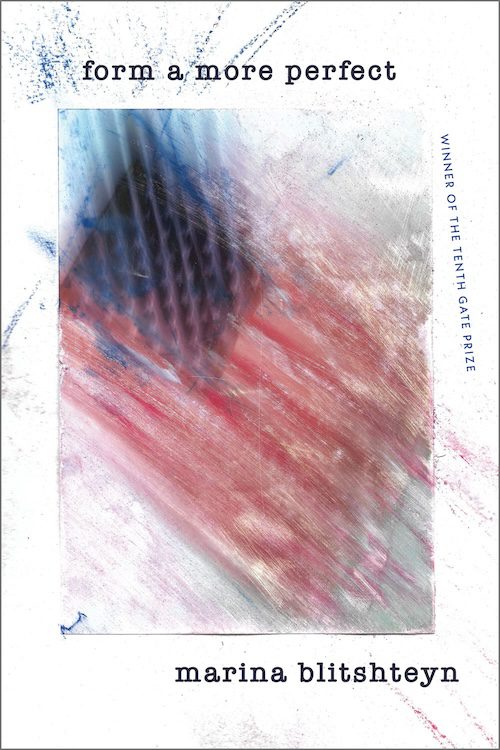
form a more perfect
Marina Blitshteyn
The Word Works, 2026. 79 pp.
Marina Blitshteyn’s poetry collection form a more perfect starts from an awkward fact: much of what we call the self has been decided before we have decided anything. A name, a language, a sex, a country, a class, a family history—these come first and speak through us. Blitshteyn was born in Soviet Moldova, into a Russian-speaking Jewish family, and came to the United States in 1991. The book treats those facts not as background but as part of the mind’s construction. Yet it does not quite say that a person is only what history has made of her. Her own hunger, grief, desire, fear, and her wish to continue remain fundamental, though these experiences too are caught in language and memory. The question running through the poems is therefore less “Who am I?” than “What in me was given, what was forced upon me, and what can I still do with it?”
The last part of that question matters most. Blitshteyn does not suppose that freedom means stepping outside language, history, class, or the body. There is no outside. Freedom lies in what one can do with the forms already there. The clearest statement comes in the poem “free”: A student suggests that one should “love the prison”—accept the limits one cannot escape and learn what can still be done within them. Another speaker in the poem calls facts “a productive limitation” and explains that “she means like a formal constraint, like verse.” The poet goes on to check her bank balance and builds “more and more cells in the room / so I can practice dancing in tight spaces.” Money, history, and poetic form all narrow her freedom; the task is to move inventively inside those limits.
form a more perfect won the 2024 Tenth Gate Prize from The Word Works. The prize is for mid-career poets writing in English who have already published at least two full-length collections. It carries publication and a cash award, and the manuscript is selected by an outside judge. The stated purpose is to honor a poet’s sustained development of a distinctive poetics. Richard Hoffman chose Blitshteyn’s manuscript, and on the prize’s own terms the choice is reasonable. As in much experimental writing, metapoetic discourse is foregrounded: several poems provide clues to the formal choices, doubts, and principles governing the rest of the book. It has a recognizable mind, a recognizable ear, and a set of formal habits that belong to one another.
The title clips a phrase from the preamble to the United States Constitution: “to form a more perfect Union.” Blitshteyn removes the object. What is to be made more perfect? A country, a language, a poem, a self, a family, a public life? The omission is useful because the book distrusts final forms. The country is unfinished. The speaker is unfinished. The sentence is unfinished. Even perfection becomes comparative, subject to improvement and therefore not perfect at all.
The collection has four sections: “landguage,” “a poet,” “the future,” and “a poethics.” They differ in method. The first is tight, measured, and largely lyric. The second is discursive and autobiographical, often approaching the artist’s statement or essay. The third is the most various, moving among love poems, political poems, elegies, visual experiments, and speculative prose, and reflections on social class. The last section gives the book’s ethics of writing, then partly erases and damages its own declarations.
“landguage” is the strongest section as a sequence. Most of its poems were first written in a strict ten-by-ten form: ten lines of ten syllables each. Blitshteyn says the sequence began with poems about friends from her youth in Buffalo, New York, and then expanded to include the city itself and questions of identity, class, and language. Her formal challenge was to fit spoken English into the syllabic pattern without making it sound stiff. As the sequence developed, she sometimes bent or abandoned the rule when a poem required it.
The form suits the subject. The speaker is always fitting herself into a room whose dimensions were established by someone else. She learns how to speak, how to pass, how to order wine, how to conceal an accent, how to explain a name, how not to explain it. The lines perform the same labor. They compress a speaking voice until it becomes slightly awkward, and the awkwardness is part of their meaning.
Several poems in this section are quite coherent. The writing is not uniformly fragmented or disjunctive. “a city” gathers memories around Hoyt Lake. “homes” moves from family habits to the racial and economic divisions of Buffalo. “tourism” tells the story of an off-season trip to Coney Island and ends with a lover saying:
Everything’s trash, the beach is trash, the sand
is trash, the people are trash, I love it.
The declaration is comic, rude, and tender. The right to hate a place freely may be one of the forms belonging takes.
The poems “Russian” and “American” make a particularly good pair. In the first, the speaker enters a Russian restaurant, speaks Russian, and feels least at home among the smoked meats and Russian manners. In the second, she pretends not to know Russian near Brighton Beach, only to discover that others can “smell the Russian” on her. These poems are honest about a feature of immigration that is often softened in poetry: the immigrant may feel ashamed not only before Americans but before other immigrants, and assimilation may involve a petty, understandable wish to feel superior to those who have not escaped as thoroughly.
The collection belongs to the tradition of American experimental writing that Charles Bernstein helped define in A Poetics. Here poetry is not treated as a transparent vessel for experience but as an inquiry into the habits, exclusions, and pressures built into language itself. Blitshteyn works within that tradition in her own way, turning its questions toward immigrant English, class codes, gender, Jewish memory, and the friction among Russian, Yiddish, and American speech. Bernstein is recalled more specifically by the puns, mangled idioms, comic etymologies, suspicion of ordinary language, and sudden shifts between argument and silliness. In “is,” received phrases chase one another through a comic syllogism: knowledge is power, ignorance is bliss, time is money, until the poem arrives at “ignorance is bills.” The joke is not merely verbal. It restores rent, debt, and wages to slogans worn smooth by repetition.
Blitshteyn’s work also belongs to a line of American poets who have treated form, voice, and historical memory as inseparable. Lyn Hejinian is recalled in the way autobiography is made through syntax, repetition, received questions, shifts of register, and later, correction of the historical record rather than simple reporting. Susan Howe is present in the broken words, erasures, and damaged pages, where historical injury appears in the surface of the poem itself. Charles Olson is a direct precursor: as Gloucester does in The Maximus Poems, Buffalo becomes a meeting place of memory, property, speech, and public conflict, though Blitshteyn compresses Olson’s civic scale into ten-line poems and puts him, as she says, “in a corset.” Where Olson claims the city, she asks what right she has to claim it and whom her account leaves out. Alice Notley is perhaps the closest affinity and is credited with this epigraph:
“He owns form,” “doesn’t he?” “The tyrant” “owns form.”
Blitshteyn shares Notley’s feminist defiance, political anger, distrust of literary authority, and willingness to alter a form once it begins to dictate the poem.
The opening poem, “sonnet: mutter,” offers the clearest early example of Blitshteyn’s ear. English and German words keep slipping into one another: bitte becomes “better,” Leben approaches “love” and Liebe, Mutter becomes “mum,” and “city” turns into citte, a nonword which rhymes with bitte. These echoes join the poem’s subjects—the mother, the abandoned city, and the grief of leaving both. Thus “Out of the rubble of my Leben, love” means more than “love emerging from the ruins of my life”: its sounds make life and love nearly inseparable, so that departure cannot free the speaker from what she has lost.
Moldova appears less often than this Moldova-raised reviewer hoped, but one passage in “the return” concentrates much of the book’s family and historical memory in the changing name of its capital:
I can’t say it, we would never say it,
cheesy-now? no, Кишинёв, Молдова,
not Kiszyniów or even Кишинів,
not Кишинэу to us, no, קעשענע,
פאגראם קעשענעװ, City of Slaughter
The text moves through several linguistic and political versions of Chișinău:
“cheesy-now?”—a comic English approximation of the modern Romanian name;
Кишинёв, Молдова (Kishinev, Moldova)—the Russian form used by the speaker’s family;
Kiszyniów—Polish;
Кишинів—Ukrainian;
Кишинэу—Chișinău written in the Soviet Moldovan Cyrillic alphabet;
קעשענעװ—Kishinev in Yiddish;
and פאגראם קעשענעװ—“Kishinev pogrom” in Yiddish.
It ends with “City of Slaughter,” recalling Hayim Nahman Bialik’s long poem about the 1903 Kishinev pogrom, written after he visited the city and collected survivors’ testimony. In this anti-Jewish massacre, forty-nine Jews were killed, hundreds were injured, and nearly two thousand Jewish homes and shops were destroyed. The succession of names in the poem places one city within rival national histories, the private language of the speaker’s parents, and the Jewish memory of massacre. The passage works especially well because the changes of language, alphabet, and sound make those layers audible and visible, while the movement from the jocular “cheesy-now?” to “City of Slaughter” carries the reader in a few lines from family speech into historical terror.
“The return” describes a family visit to Chișinău, the city of the speaker’s parents’ youth. They ride in cabs, repeat old street names, and complain about the new currency, while their daughter asks what the city was like before she knew it, turning the question over “the way a mourner / turns and returns to the loss asking why.” Moldova appears less as a fully described place than as an inheritance carried in Russian speech, Jewish memory, family graves, and the capital’s changing names. That inheritance is shadowed by the history of the Kishinev pogrom. The Moldova of the poem is Russian-speaking, Jewish, Soviet and post-Soviet, and only partly recoverable.
The collection’s second section, “a poet,” turns to prose and self-examination. In “my fate to my name,” written after the 2018 antisemitic shooting attack on the Tree of Life synagogue in Pittsburgh, in which a gunman killed eleven worshippers, Blitshteyn recalls that her sister was once forbidden to publish under the family’s Jewish surname. Returning to the former Soviet country of her birth, she finds that name on headstones in Yiddish and Russian and realizes that “it isn’t myself i’ve been hunting . . . it’s the dead.” The name printed on her book cannot restore them, but it answers the suppression of the name and helps keep it from disappearing.
“how to make it in america” returns to the speaker’s uneasy place within English. A classmate’s mother praises the young poet: “you do so well / in our language.” The insult lies in “our,” which marks English as belonging to native-born Americans and casts the child as an outsider, however well she speaks it. Blitshteyn later turns that humiliation into a motive for first mastering English and then breaking its rules.
In “olson in a corset,” Blitshteyn explains both her debt to Charles Olson and her resistance to him. She wants to enter the male-dominated tradition of American civic and experimental poetry that Olson represents, but fears being seen within it chiefly as a daughter, wife, or female subject rather than as a poet. Her ten-line poems compress Olson’s expansive civic manner into a smaller, deliberately restricted form. The “corset” names both that restriction and her attempt to reshape his example for her own purposes.
The third section, “the future,” is the book’s broadest and least uniform. It contains the paired “Identity Love Poem” and “Post-Identity Love Poem,” political poems, class poems, visual work, elegy, and speculative writing. The love poems ask whether a beloved can be seen apart from race, ethnicity, history, and the public meaning of the body. The answer is no, though the poems also resist turning love into an exercise in seeing the beloved through the approved social categories. “We are people again, ultimately,” the sequel says, before it questions even that refuge.
“Matter as Event” links Kara Walker’s monumental sugar-coated sphinx sculpture, installed in the former Domino Sugar Refinery in Brooklyn, with an unnamed 2014 protest march through Manhattan, probably one of the demonstrations against police violence that followed the deaths of Eric Garner and Michael Brown. The poem argues that history remains present in material things—in sugar, stone, bodies, luxury goods, and the labor that keeps their surfaces clean. That idea is most persuasive when Blitshteyn gives it physical form: mountains melt “like sugar cubes in tea,” the refinery reeks with acrid sweetness, and the marchers pass Gucci and Prada displays guarded by men in fine suits and polished by workers the shoppers do not see.
“who gets to write the immigrant experience?” distrusts the conversion of family history into a product. The speaker fears being found interesting for the wrong reasons, becoming a representative immigrant, turning parents into a lesson, and supplying the market with a usable story. The poem’s long sentence refuses the clean arc it fears. It keeps adding objections until the immigrant narrative begins to choke on its own packaging.
The quieter poems often carry more weight. “american with paper” remembers the grandmother learning American civic facts and English handwriting. She is taught now to write the letters by beginning at the bottom whereas, as a child, she was taught to begin the Russian letters at the top. The speaker recalls the grandmother’s hands more clearly than her eyes, and the body becomes “paper . . . thin / like any pencil tip / could puncture it.” The poem ends with naturalization: she came “all the way here / to be made / natural.” The phrase contains citizenship, mortality, and the strangeness of suggesting that an administrative act can make you natural.
“the future is exile” compresses several generations into suitcases, coats, silver, streets in the city center, departures, returns, and boxes left to rot in a basement. It may draw on Moldova, Jewish flight, the Soviet inheritance, or several histories at once. Its strength lies in refusing to sort them too neatly. War becomes something packed and carried, then left for children to unpack.
“threnody” is the book’s severe center. “No poem can save me or could save them,” it says. The dead will not read the book. The poet worries that she is stealing what her grandmother lived to preserve, that Jewish difference can become material, that mourning can become a career. The image of ashes smeared across the pages is both reverent and indecent. Blitshteyn does not resolve the accusation. She keeps writing because silence would be another form of loss.
The speculative prose poem “the old world (2023)” is one of the book’s most complete achievements. On another planet, settlers repeat the habits of the old one: they build roads through mountains, cultivate the land, damage it, and adapt to the damage. The planet’s baldness becomes the speaker’s scalp, roads become bodily maps, blood and water answer one another. The poem allows survival without declaring it innocent. Human beings live by altering what they enter. Yet the last sentence earns its small allowance of wonder: “sometimes a cactus sprouts a flower and you get / to see it.”
The fourth section, “a poethics,” states the duties of the poet. Blitshteyn asks herself to know the limits of the personal, consider the social good of the work, attend to the effects of a text rather than shelter behind intention, understand the histories of words, and leave room for what she cannot know. She compares a text to a child one must help grow into a good person.
This is an honorable position, though it is also where the book’s philosophy becomes most doubtful. A poet cannot ensure the “optimal effect” of a poem in culture. Effects change with readers and years. The wish to take responsibility can become the wish to control what cannot be controlled. At times Blitshteyn’s poems seem to question their own moral permission before they have finished speaking. Her scruple is genuine, but the imagination needs some freedom to be wrong, foolish, excessive, and unforeseen.
The poetics in form a more perfect can also grow predictable. The book knows the kind of contemporary experimental collection it means to be: multilingual, feminist, diasporic, anti-capitalist, self-interrogating, visually disrupted, suspicious of inherited speech. There are many accomplished books of this family. The literature of displacement has acquired its own stock materials—the mispronounced name, the divided alphabet, the grandmother, the suitcase, the lost language, the border, the family archive, the question of who has the right to speak. Blitshteyn often handles them well, but certain procedures announce themselves too early. “city poem” splits a long series of words around “city,” for example:
domesti city
auda city
perspica city
[…]
“sonnet: matter” breaks words into scattered pieces; a manifesto is redacted. Once these devices are grasped, the poems do not always move far beyond them.
Yet the value of form a more perfect does not depend on the unprecedented. Most poets inherit their subjects and some of their methods. Its originality lies in the way Blitshteyn joins inherited subjects and methods to her own languages, memories, and habits of thought. Blitshteyn’s Moldova is not just any immigrant homeland. It is Кишинёв and Кишинэу, Russian family speech and Yiddish catastrophe, old street names, and new money. Her America is not an emblem. It is Buffalo, Goodwill, Brighton Beach, adjunct work, bank balances, lovers, cafés, and a grandmother learning where an English letter begins. Blitshteyn has written a moving book of real intelligence, formal skill, and moral seriousness. Its finest poems find exact forms for lives divided among languages, countries, and loyalties.
Philip Nikolayev is a widely published multilingual poet, literary translator, and editor living in Boston.