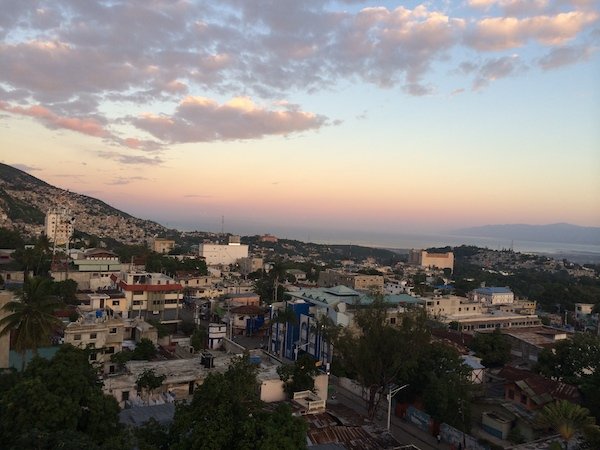
Haiti 1, Danielle Legros Georges
Translator’s Note: Jean-Claude Martineau is a poet of the underdog. Throughout a long career as a writer (as well as songwriter, composer, activist, and statesperson), Martineau has made visible the experiences of Haitians who fight on Haitian soil and in its diaspora to uphold their right to self-determination and human dignity—often against great odds, and in defiance of great powers. These combatants are the descendants of the Africans and allies who waged the thirteen-year anticolonial, anti-slavery war that created the Haitian nation and the world’s first Black republic in 1804. Martineau and many scholars of Haiti maintain that the struggle for independence has yet to be fully achieved.
The unpopular leaders of today’s Haitian state remain in power with the backing of a coalition that includes the United States government and the United Nations, entities that have supported Haitian managers often at odds with the interests of the Haitian people. Conditions in Haiti are dire, with fuel shortages, internal displacements, kidnappings, high unemployment, inflation, an intense gang presence funded by Haitian oligarchs, and Martineau notes, “the apparent indifference of the authorities in front of the crisis.” Current Haitian leaders, moreover, have called for a foreign military intervention to help them hold their grip on power.
Jean-Claude Martineau is a poet of the Haitian people, which is to say the Haitian majority, who continue to engage in the historic quest for civic inclusion in the life of the nation. Across his work, Martineau has engaged and shed light on members of that majority, and the effects of centuries-old, often undeclared campaigns against Haitian sovereignty, democracy, and families. We see the ten-year-old orphan who fends for himself while dreaming of attending school in the poem “Diver.” We identify with the narrator’s concern for this child. In “Viva El Toro,” we sympathize with the bull in a bullring who finally sees his true enemy is not the matador’s dazzling cape, but the matador himself. In “I’ll Roll Along,” we walk the night in the Haitian countryside with the cow herder who teaches us a lesson of perseverance and collaboration.
Martineau writes in the language of the Haitian people: Haitian/Kreyòl, in addition to French. His Kreyòl-language literary texts are accessible in ways French texts may not be—and make them a response to the challenges of print literacy and access to formal education so many strive for. His texts are sung, read on the radio, performed as plays, and recited by heart by Haitian schoolchildren. He has created several anthems of Haitian liberation included “Ayiti Demen (Lè la libéré Ayiti va bel)” written in 1978 against the backdrop of the almost thirty-year Duvalier dictatorship.
These poems, originally published in 1982, (Flè Dizè: Powèm, Chante; Marika Romain, New York) remind us of how much the struggle continues for Haiti, and how relevant Jean-Claude Martineau’s work remains in 2022 and as we move forward.