
The Venus of Odesa: New and Selected Poems
By Askold Melnyczuk
MadHat Press, 2025. 139 pp.
~
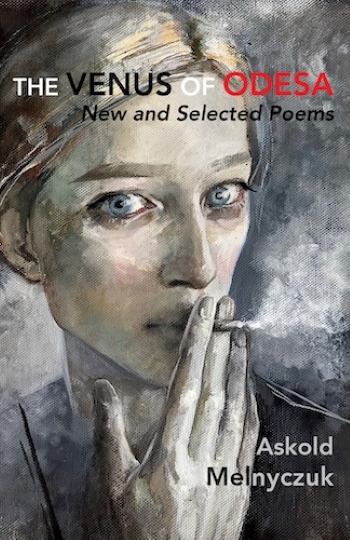
On the cover of Askold Melnyczuk’s The Venus of Odesa: New and Selected Poems, a young blond woman looks at us reproachfully: wide-eyed, pale, thin, smoking a cigarette. She looks a little like Victoria Amelina, the Ukrainian novelist and war crimes researcher killed by a Russian missile in June 2023. Here I am, she seems to say. What are you going to do about the cruelty and injustice I died documenting?
Melnyczuk, whose parents left Ukraine at the end of World War II and wound up in Irvington, New Jersey, in 1950, learned about political violence at an early age. His grandparents and parents witnessed twenty-odd years of horror in Poland and Ukraine under Stalin and Hitler—forced collectivization, mass starvation, neighbors and relatives lost to execution, Siberian exile, deportation, and mass murder. Melnyczuk’s first language was Ukrainian; his career as editor, publisher, translator, poet, and novelist has grown out of his early experiences at the family dinner table hearing his elders talk about their dead. “I don’t believe I’ve sought out this particular perspective,” he writes in “War Stays for Dinner,” an essay published in the Irish Pages Press. “It’s something I’ve inherited, like skin color and a nose.”
The Venus of Odesa is Melnyczuk’s first book of poems. While it appears at a critical moment for Ukraine, the poems within were written over the last fifty years, and its five sections differ in approach and theme. Throughout, however, an underlying question is what to do with this inherited perspective. Are we individuals, each of us defined by—and obligated to act on behalf of—a particular nationality, language, and set of beliefs? Or are we fluid and unbounded, part of some pervasive life-force? Should we identify with and defend our inherited cultural identity or (he wonders in an interview in Chytomo) do as Susan Sontag suggested in Regarding the Pain of Others: invent a pill “that will allow us to forget the past so that we can begin with a kind of clean slate”?
The book’s first section, focusing on the speaker’s family, suggests their Ukrainian past remains crucial, despite their journey to the US across what one poem, “The Voyagers,” calls the “apotropaic water.” Water voyages turn up frequently in poetry about immigration and exile—as in epics like the Odyssey—as a site of loss, death, or transformation. Apotropaic means offering protection from the evil eye. Can an ocean, by separating old world from new, protect the voyagers from suffering?
Obviously, such a voyage brings about major changes—in geography, language and culture. As the next lines announce, “Body, suffer / a sea change.” This pivotal line hints at Melnyczuk’s preoccupation throughout these poems with the physical world and with the body in particular as a site of experience. Politicians lean toward abstractions and generalities. These poems present us with the concrete repercussions of these abstractions. In “The Voyagers,” the “sea change” turns out to be quite literal:
When his dentures
dropped out,
his wife screamed:
“Part of a man
overboard.” (15)
Many of Melnyczuk’s poems break their syntax with these short lines, creating a hesitant, stuttering, disorienting quality. Combined with an insistently literal depiction of ordinary objects, the result tends toward the surreal, with a hint of humor. I thought of Gogol’s hapless protagonist who loses his nose. The new dentures are a “fair fit” but as the poem concludes, “no man willingly ever / gave up his teeth” (16). Losing a homeland here involves not just abstract losses: it results in a literal misfit.
There’s a resistance to synthesis in these poems that I admired, even as the resulting inconclusiveness made them hard to digest. Poems dart from viewpoint to viewpoint, interrupt themselves with line breaks and end punctuation. They pose questions, and rethink. “The Mouth Refuses to Translate” refers to English as a “hostile tongue,” a “Jacob’s ladder / I am testing / rung by rung” (14): the world feels unwieldy, populated by disparate objects resistant to easy lyrical resolutions.
Take, for example, “A Potato Reading Rilke.” The title alone has us juggling the ordinary with the otherworldly, and in fact the poem, as a whole, sets up an argument between Rilke and Trotsky:
Suddenly the crap has meaning:
old wallets, scarves, the radio
years in a drawer, batteries, blue
shirt, the almost new
sweaters, the scarred belts.
Apocatastasis of objects!
Apocatastasis: defined by Webster as “the doctrine of the final restoration of all sinful beings to God and to the state of blessedness.” Here restoration is reconfigured as recycling:
Someone else will one day squirm
inside the suit from Syms
your father bought you
for some funeral, or wedding. (18)
Yet there is, the speaker suggests, something deeper than that in our relation to things: the “centripetal flower, / the secret presence / planted in the heart / of our life’s decay,” the “sweetness” of “Matter dreaming.” Things need our “saying” to make them “be” in their fullest sense, Rilke suggests in his ninth Duino elegy. Trotsky, on the other hand—presented here as Rilke’s interlocutor—is more practical: “the junk in your closet / rises like Lazarus because // those on this planet have needs /you can answer” (19). Is it recycling or poetry that provides the resurrection?
Such questions are not to be resolved, but the poem as a whole seems to distrust Trotsky, “who / like all prophets, loved / the future tense too much.” Such prophets, all too often willing to sacrifice living bodies for future ideals, have been historically the source of suffering. As Timothy Snyder notes of both Nazis and Soviets in Bloodlands, “Each of them had a transformative utopia, a group to be blamed when its realization proved impossible, and then a policy of mass murder that could be proclaimed as a kind of ersatz victory” (388). Between 1929 and 1945, Snyder notes, that kind of thinking killed fifteen million people who lived in the strip of land running from the Baltic to the Black Sea, shared by Poland and Russia and including—among other countries—Ukraine.
In section II, the book’s longest section, the focus shifts from family to the speaker’s education—courtesy of books, lovers, and the streets of Boston. Melnyczuk arrived in Boston in the late 1970s, a time when the poetry scene was dominated by what he calls, in Seamus Heaney: A Celebration, a “triumvirate of ‘exiled’ poets”: Derek Walcott, Seamus Heaney, and Joseph Brodsky. All three poets were living away from their homelands (St. Lucia, Northern Ireland, Russia), which had been variously colonized, occupied, or in the case of Russia, made intolerably oppressive. All three saw the poet as a crucially steadfast voice articulating the conflicts intrinsic to his particular national identity. Melnyczuk notes that Walcott, in particular, encouraged him to see his Ukrainian heritage as worth writing about.
What resulted initially was a novel, What Is Told, published in 1994. Since then, Melnyczuk has published three more novels and a book of short stories, as well as essays and poems in various literary journals. He has also become—as professor, editor, translator, and writer—himself a major presence in the Boston-area literary world. Founding editor of Agni (1972) and Arrowsmith Press (2006), he has edited several essay collections, and through his translations and anthologies—among them From Three Worlds: New Writing from Ukraine (1996)—has played a crucial role in helping contemporary Ukrainian writers find an audience.
In his essay “The Death of a Mouse and the Fall of Rome,” he writes that, “Much of my creative life has been an attempt to convey, via stories, poems, essays, what I’ve seen of the long-term consequences of war” (Arrowsmith Journal).
The Venus of Odesa, bringing together a lifetime’s worth of poems, is part of that effort. Perhaps that’s why I kept thinking of the Odyssey as I read—another account of war’s far-flung consequences. Certainly, section II made me think of Odysseus’s “wanderings”—where the hero learns the minds of many men. There’s an array of viewpoints and allusions—street people, the Bible, Donne, Rilke, the Baltimore catechism, La Bohème, the murdered lay missionary Jean Donovan, Homer. “What happens, though, // when it gets really quiet?” asks the poem “From the Streets”: “Who / do we hear?” (39).
These unanswered questions convey a sense of urgency as the speaker explores his relation to his family, his literary ambitions, and his Boston-area milieu; so too does the recurring appearance of a head—presumably Orpheus’s—floating near the Lech Walesa Bridge in Dorchester: “balding, with gray teeth, moth / wings stapled to its eyes, // and lips about to slip / into the stream” (45). The line is typical of the tone throughout these poems: observant, precise, and deeply aware of the world’s gift for ironic juxtaposition.
The presence of Orpheus’ head—even severed and sinking—suggests a yearning toward lyricism, toward the “sweet / percussive nothingness // of faith” as “My Life Against the Berlin Wall” puts it (55); or, in “Cambridge Typewriter Is Now in Arlington,” toward a “reliable place / amid the apparent cultural incoherence” (77). This latter poem—set also in Dorchester near the Lech Walesa Bridge—dramatizes the appeal of cultural coherence through a postcard depicting the Virgin giving St. Simon Stock a scapular. “Once someone / understood that vision,” the speaker says. “. . . I sit here unable / to explain this important thing, composing instead // an a cappella to the typewriter repair man” (78). Instead of any unifying vision, we get a broken typewriter, exiled to Arlington for repair. Or, as the poem on the adjacent page ends, “no answers, just / stutters, then spring” (76).
In the two sections that follow, this questing speaker recedes—first into persona poems then, in section IV, into “versions from the Ukrainian,” including five poems by Shevchenko, the poet who, in the nineteenth century, gave voice for the first time to Ukrainian identity and history. Melnyczuk writes elsewhere of having recited Shevchenko’s poems for guests as a child. Extending the Odyssey analogy, sections III and IV suggest an Underworld, where the hero comes to terms with his ghosts. The last of Melnyczuk’s persona poems, “Swan Song,” serves as a turning point:
So what if I signed my name only
in a soft white sand
the sea would soon broom out?
My dears, I do not love destruction
but the self walking alone
is a vulnerable radiance.
It should know splendor or make its confession
to the grass, and the stars
and move on. (89)
A fluid, sibilant swan song to the “vulnerable radiance” of the self.
When Melnyczuk’s speaker returns in Part V, he is less angsty, more attuned to the natural world, less locked in a personal self. “Buddhist Diary 1954-2024” takes this sense of peace to its extreme: beyond the title, there’s only a blank page. Melnyczuk notes elsewhere he has been a Buddhist practitioner for many years; several of the poems in this section convey a Buddhistic sense of connectedness to all things. In the beautiful love poem “All Talk Is Moths,” for example, the speaker notes his inability to save a moth fallen into his coffee before telling the “You, deepening around me” that he is “happy past speech” (128).
But given a world fractured by violence, Melnyczuk isn’t one to stay put in meditative silence. “Who,” addressed to “You, dead,” mentions a current war (presumably Russia’s invasion of Ukraine) and alludes to its precursors—“Fat Boy, Dresden, Kramatorsk”—wondering, “How / split an atom / in the heart / to make the world whole?” The poem is both a moving elegy for a dead friend and a lament for humanity as a whole, at sea in its “vessel, tempest-tossed,” with “No Ithaka in sight” (121).
“No Ithaka” brings us back to poor Odysseus, wending his way home from the Trojan War. If there is no Ithaka, there is no homecoming. And what is “home” in any case? The collection’s penultimate and title poem, “The Venus of Odesa,” asks a similar question. The poem’s speaker holds in his hand a small replica of “the Polovtsian Baba”—a stone figure of a woman with exaggerated breasts and belly. There are many such babas in Ukraine—stone burial figures often ten feet tall or taller, some depicting warriors, some women. Created between the eleventh and thirteenth centuries by Turkic nomads, they are valued as uniquely Ukrainian—proof against Russian claims that the two peoples are one. In July 2025, according to The Guardian, Ukrainian soldiers were risking their lives to dig up and preserve such babas near the war’s frontlines. Such is the cultural weight this replica carries as the speaker contemplates it:
Transfixed, obedient
gray clay imperfectly glazed,
utterly sated at last:
the future of the world
once burned
under your lids. (129)
As in Rilke’s “Archaic Torso of Apollo,” the figure is a repository of time and, perhaps, a challenge to be lived up to. It is a thing, but also charged with meaning, symbolizing the nation as a whole.
Except it is also always a thing, “gray clay imperfectly glazed” that the speaker holds “at arm’s length” then touches with his thumb. As physical thing, the baba evokes the physicality of the woman it represents—the woman who, in her human flesh, was (as we are) part of a literal, physical world. “The idiocy of blood / and ideology // of bone / don’t fool / you now,” the speaker says, and concludes:
I hope
The flesh this was knew
every crevice, every rain—
and did it know
how far a man may go
to raze his father’s house,
crawl home? (130-31)
Reading that final question, I thought of Yeats’s “Leda and the Swan,” which also ends with a question about knowledge: Did this human woman raped and inseminated by Zeus share in that moment his knowledge and foresee the disastrous consequences that would follow? Here, I think, the question is even more complicated and multilayered, as it plays with the meaning of the word know, as well as with the homophone raze/raise. Did she herself know (experience) the extremities of violence conflicting notions of “home” can cause? Did she know (understand)? What are humans to make of a world where what we experience and what we understand are so incommensurate? Where we are so cut off from understanding the consequences of our actions? And what is home, once the father’s house has been destroyed?
In the wake of Russia’s invasion of Ukraine, such questions take on new urgency. So urgent, Melnyczuk asked himself in a recent essay whether he would fight to defend his home—in this case not Odesa but Medford, Massachusetts. He doesn’t provide an answer. Nor does “The Venus of Odesa,” which is followed by the book’s final poem: “Verses from Shantideva,” an eighth-century Indian philosopher. “Impossible / To control external events; / Yet if I tame my own mind, / Do I need to?”
Sontag imagines a pill that would erase collective memory and with it the violence such memory can trigger. I’m reminded yet again of the Odyssey. There Odysseus, having arrived home in Ithaka, avenges himself by killing his wife’s 108 suitors—whose family members then arrive fully armed, setting off a potentially endless cycle of revenge. Only when Athena herself appears and commands everyone to stop, is peace possible. Magic pill, or deus ex machina: without one or the other, it’s hard to imagine an end to war.
Is it possible, Sontag’s son David Rieff asks, that “the human and societal cost of the moral demand to remember is too high to be worth paying?” (In Praise of Forgetting: Historical Memory and Its Ironies, 58). For Buddhists, he points out, clinging to the past is a “forlorn illusion” (28). Collective memory, in any case, is less than exact, and always in a metaphorical relationship to history itself (116). Rieff worries briefly that poetry, with its tendency toward metaphor, might be complicit in this kind of slippage, representing the past in oversimplified terms. But then he notes that throughout the Bosnian War, which he covered as a journalist, he carried with him two poems by Wisława Szymborska—whose favorite phrase, he says, was “I don’t know” (143).
A similar, principled uncertainty underlies Melnyczuk’s work. Collectively the poems convey an attentive mind watching and wondering. The child described in “The Emerald Box” as “born all eyes,” remains so throughout—watching his refugee parents, singling out fragments of nature, thought, and history with an intense moral seriousness. The many unanswered questions, the insistently concrete diction and stuttering syntax ask the reader to be similarly attentive, and similarly resistant to premature resolutions or easily digested abstractions. Everything in the physical world, these poems suggest, deserves our care: the moth drowned in a cup of coffee, the mustard seeds sprouting, a woman shouting in the street, a small clay figurine.
As does the nonphysical world. Ultimately, it’s the way these poems juggle contraries that moves me the most, as in “My Father’s Vision,” where the speaker’s father—sick, perhaps hallucinating—sees a cathedral emerge from his yogurt. But “It wasn’t the morphine,” the speaker insists. “You saw / What you saw. // And the pigeons exploded / Into the room and roosted / Above your bed.” Perhaps the only real “father’s house” is the one we build in air.
Ruth Hoberman, professor emerita of English at Eastern Illinois University, is a writer living in Newton, Massachusetts. Since her 2015 retirement, she has published poetry and essays in various journals, among them Nixes Mate, Solstice, Salamander, RHINO, Ploughshares, and Michigan Quarterly Review.