
Artist Statement: Once you learn to ride a bicycle, you never forget the place where you learned how. At least, that’s the way it worked for my father. When I was a child, he would often begin a story with “I used to ride my bicycle in Jaffa.” Not until later in life did I realize he was referring to Jaffa, Palestine. In such a simple statement, he handed me a heritage packed full as a bulging suitcase, for I also learned that, like riding a bicycle, once you discover you are a Palestinian, you never forget.
Yet forgetting (or perhaps hiding) was my parents’ main obsession for our upbringing. We emigrated from Lebanon to the US in 1956—my parents, my younger brother, and I—and landed in Washington Heights, NYC. The neighborhood at that time was predominantly Jewish and Puerto Rican, and the trauma my parents experienced from their Nakba flight was only eight years fresh.
In order to protect us, my parents made me and my siblings invisible by never mentioning our connection to Palestine and not teaching us Arabic. They had become unwitting allies of Golda Meir’s claim that “there is no such thing as Palestinians.”
Yet here we were.
Being invisible is not tenable no matter how hard one tries. Like buried weeds, the truth finds ways to poke through. Ironically, it was these memories of my father’s own stories that provided the key that opened the family closet.
Many years ago, as I was preparing to leave home in the Virginia suburbs to begin my college studies, I thought about my father’s Jaffa stories. I realized I had no idea where Jaffa was. I imagined it to be in Lebanon, the country where I was born and where most of the relatives I knew lived. I finally found it. It was not in Lebanon though, but in a place called “Israel”. Of course, I asked Dad about this and he revealed that he and my Mother were from Palestine. After almost twenty years of concealment, the family’s Pandora’s Box was finally unlocked, its secrets breached.
This revelation changed everything! It resulted in my own return to Palestine after college. It led to a life mostly devoted to activism and the pursuit of answers to questions like: What does it mean to be Palestinian in an unwaveringly Zionist America?
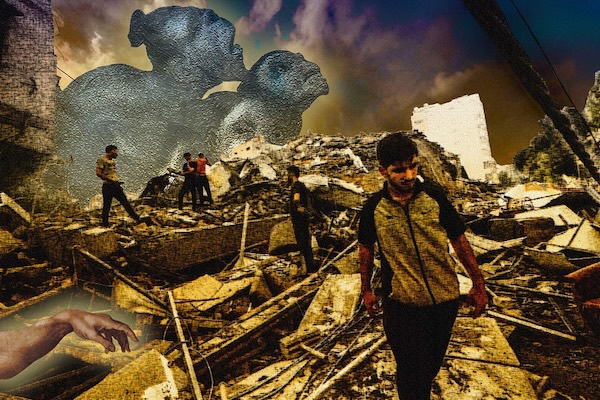 Life in Gaza, 2023, 7ʺ x 10ʺ
*
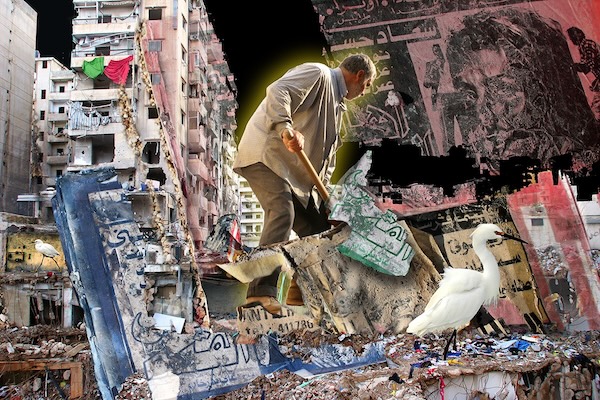
As a documentary photographer, I try to show the world as I see it: a Jerusalem through the eyes of a young Palestinian returning for the first time, a war-torn Lebanon after the 2006 Israeli assaults, the stories of the Palestinian-American community in the San Francisco Bay Area. For me now, Gaza is the center of the earth, yet it is neither possible nor desirable a place to go because, well, we all know why. As a result, I’ve chosen symbolic and ironic ways to convey a world fractured like Gaza itself. I’ve appropriated sections of art from powerful humanist artists and courageous Gaza photographers.
I achieved it with the ease and safety of my computer, along with dark dreams during many fitful nights.
For these digital collages (from a series called From My Pillow), I’ve invited Goya, Picasso, and Michelangelo to Gaza to join Palestinian photographers on these virtual canvases. How many times since he painted them have Goya’s frightful warring demons resurrected to terrorize humanity? Has Michelangelo’s Adam been forsaken by God? Is the Guernica I’ve reimagined even more disjointed than Picasso’s?
The symbolism can be cut multiple ways. Are Goya’s demons appalled by what they witness or, like many Western governments, feigning their repulsion? Is Adam’s lonely outstretched arm—representative of the supposed values of western civilization such as human rights, international law, etc.—diminished by double standards, hypocrisy, inconvenience? And the re-shattered Guernica, is it a crumbling stand-in for the West’s self-proclaimed moral standing? Or perhaps I am over-thinking something quite straightforward, that these images are simply a reflection of the primordial scream exploding from the shattered illusion of Never Again.
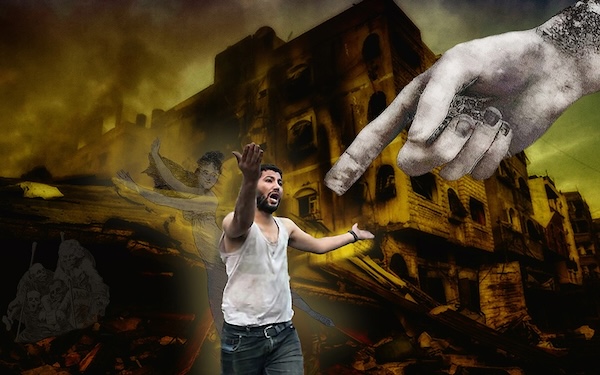 Dance of the Doomed, 2024, 8ʺ x 13ʺ
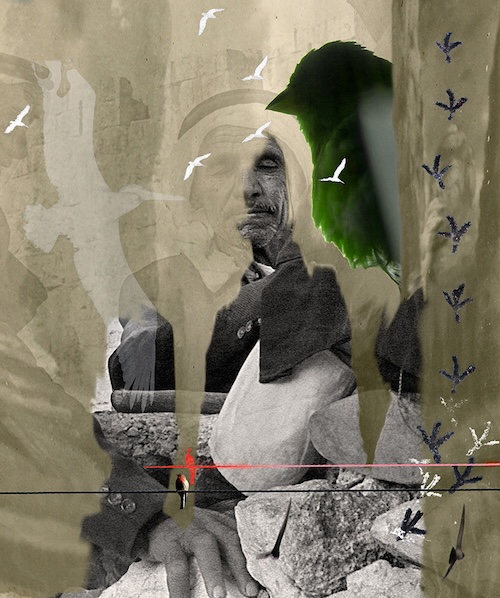 Dreams of Freedom, 2024, 10ʺ x 12ʺ
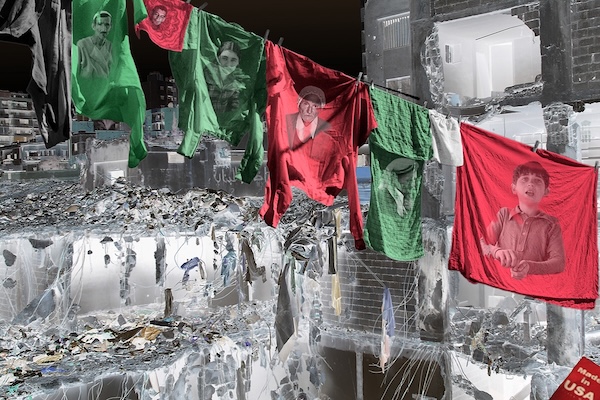 Hung Out to Dry, 2025, 14ʺ x 20ʺ
Making the Desert Bloom, 2026, 12ʺ x 18ʺ
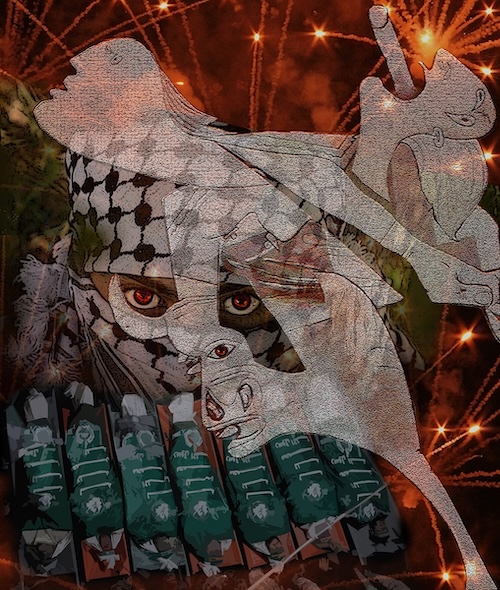 The Fire Next Time, 2026, 12ʺ x 14ʺ
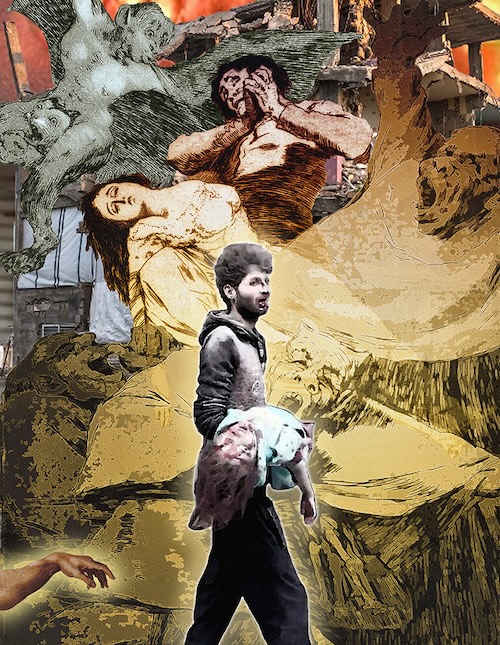 Ya es hora (It is time Again), 2023, 10ʺ x 13ʺ
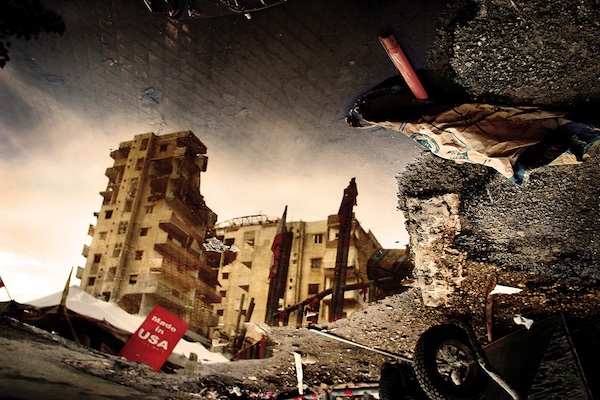
Bringing Democracy, 2006, 12ʺ x 18ʺ
Najib Joe Hakim is a documentary photographer, artist, and photography instructor. Hakim also serves as the President of the Board for the Network of Photographers for Palestine and is a founding member of Class Conscious Photographers. He is the recipient of the Rebuilding Alliance Storytellers Award for a trilogy of projects on Palestine, a Political Art Fellow at the Yerba Buena Center for the Arts, and a past nominee for the US Artist Fellowship. His books are available on MagCloud.