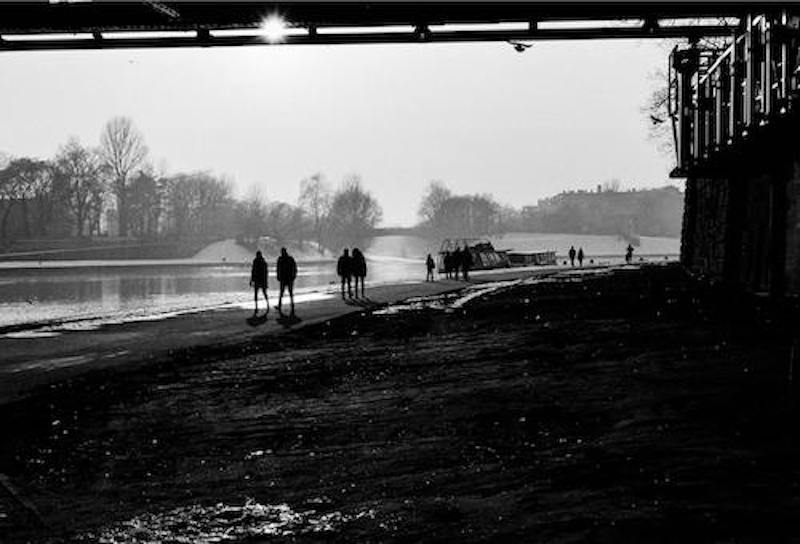
Kraków, Lesser Poland (Małopolska), Poland | Photo: Alexander Zvir
Author’s Note: This poem sprang out of the experience of crossing the border from Ukraine to Poland, seven months after the 2022 Russian invasion began, and while living in Poland, surrounded by the still-lingering effects of World War II. What sharpened for me particularly was how war can turn the most mundane things into lifelines, how the effects of war linger for generations in a place, and how war and geopolitical violence can devastate people and places—but can’t stop beauty and hope from enduring in some fashion and carrying on.
* * *
I. AT HOME
In the old haberdashery, I sit and I write
and I sit and I “write” until it’s time to trade
and I go back upstairs to worldschool
the kids. We talk about commas, we talk
about Poland, we talk about proper nouns.
You leave to go travel, and wherever you go,
there you are: with the bills, with the laundry,
with whatever else you store in your heart.
I walk in the evenings along the castle and river
and think about my sister who’s coming to visit,
and think about my mother, who’s not. I think
about how she would have loved Wieliczka,
and how good ‘Wieliczka’ feels in the mouth.
After nightfall, Chopin spills from a second
floor window. The bird woman’s pigeons
cascade over rooftops.
II. BEYOND
Here, speaking in gothic and baroque,
a luminous rynek. A Desi dining room,
Korean fried chicken. My children chase
bubbles and someone swings from streetlights,
another rides a pigeon. Someone is recycling,
someone is eating croissants, someone
is having a nap.
Toward castle 2.0, a fall off a scooter
I’d rather forget. The Warsaw tower
imposing out the windows, cement and iron
leading to the old wall. We choose shrimps
meant for dignitaries, ruskie and country broth
for our inner proletariat. Piles of pierogis steam
at a small table beside a window, curtains
embroidered by Mother Poland.
III. ON THE M10
Eight gas stations in five kilometers, a line
of cars back to the border. It is capitalism,
it is excess, it is over-consumption,
it is glass beads in a thin polished chain around
the neck, where we are the only car with a foreign
plate, the only car not filled to the brim
with belongings. The temperature
drops as tonight turns into tomorrow. Gas
stations crystallize into gems.
Hot sandwiches, coffee, paprika Pringles
and fuel, a unicorn in this world: a sparkling-
clean series of toilets.
How often is anything just what you’d expect?
It is ten, not sixty. It’s a Cupra. (What’s a Cupra?)
It’s a WOG, it’s an OKKO, it’s an AMIC, when
the sun comes up in the pale sheen of dawn,
it’s an explosion of gold.
IV. WYSPIAŃSKI
In the stillness, he holds out his hands, elements
curling in prismed rivulets, reaches of blue splashing
up from the life-giving sea, bound, like Apollo,
by gravity and lyre, by constellation and light
behind the glass.
This cathedral of brick is a basilica of beauty.
My own echoes with Chopin, with traffic on Dietla.
We arise. Like Wyspiański, we dedicate ourselves
to travel. I hold my breath to hear the Fourth Bard
and St. Francis, to put music to all this affection
for the greater light of Lesser Poland,
for the rolling uplands, also.