
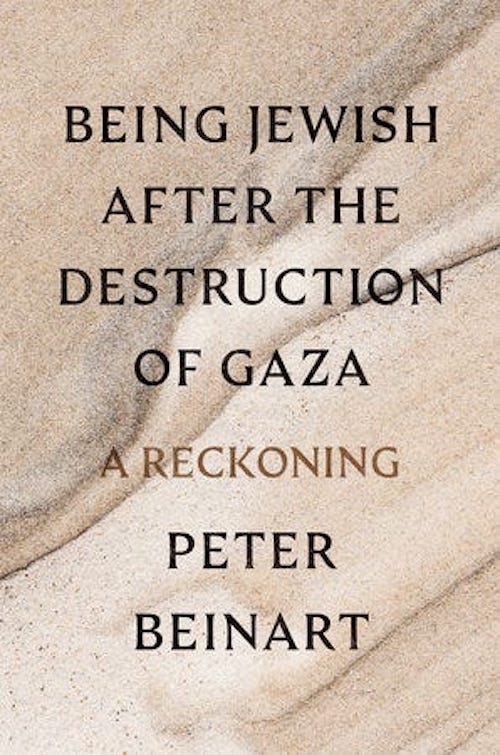
Peter Beinart’s new book, Being Jewish After the Destruction of Gaza: A Reckoning (Knopf, January 28, 2025), constructs a specific narrative for Jews wrestling with Israel’s actions in Gaza and its dire consequences. The title is perhaps misleading; a more fitting title would include the words “Being Jewish-American After the Destruction of Gaza,” because this is the book’s enduring perspective. I read the book with interest but, from my vantage point in Israel, I find myself standing outside Beinart’s carefully delineated “we.” He is largely talking to and about American Jews. Though packed full of facts and academic rigour, Beinart’s analysis creates a framework that, while compelling for a diasporic audience, fails to account for those of us who inhabit the complicated space of being Israeli Jews who oppose the violence while living within its epicenter.
Beinart documents the historical and theological foundations of his argument with citations ranging from Jewish religious texts to contemporary political analysis. It’s absorbing, and his exploration of how Jewish narratives on victimhood can blind us to Palestinian suffering is challenging. “For establishment Jewish organizations that want to avoid looking closely at what Israel has done in Gaza,” he writes, “accusing Israel’s critics of antisemitism is the single best way to avert one’s eyes.”
Despite interviewing Palestinian and Israeli experts, the book remains anchored in an essentially American framework. Perhaps this is what the author intended, yet the complex reality of Israelis who oppose their government’s actions on all levels while still living within Israel’s borders—our daily ethical negotiations, our participation in local protests, the threat that hangs over our heads—remains largely muted in his analysis. This absence creates a false binary, where inside Israel one either supports or at least tolerates the Israeli government’s actions, or opposes these actions from the safety of the United States.
Beinart strikes a resonant chord when he writes about how “the alibis change but the bottom line remains the same: Jews are victims. Israel has done nothing fundamentally wrong.” This observation captures a central dynamic in what can be witnessed in Israel on a daily basis. The Israeli government’s relentless messaging machinery reinforces this narrative, justifying every military action as essential to the security of the State of Israeli, and every diplomatic criticism of Israel as antisemitism. Most local media coverage focuses disproportionately on Israeli suffering (and there is plenty of that nowadays), working as a powerful psychological buffer against any kind of wider introspection or self-examination. Israelis who are reading solely Hebrew language news may be unaware of the rising numbers of Palestinians killed–more often than not, the dead are simply not mentioned if they are civilians, even children. Since October 2023, according to English language newspaper, Haaretz, and many other sources, at least sixteen thousand children in Gaza have been killed in Israeli military actions.
Meaningful dialogue is nearly impossible, thanks to a system of automatic justification that Beinart identifies but cannot fully portray from his position outside our daily reality. The power of the Israeli government’s narrative lies precisely in how it transforms even legitimate criticism into existential threat, a phenomenon many of us who oppose the violence experience firsthand when our loyalty is questioned.
In early May, I participated in a silent protest against the killing of children in Gaza. Along with a hundred or so other protestors, we stood on Kaplan Street in Tel Aviv, holding photos of Palestinian children. Above each photo was the name and age of the child in Hebrew and Arabic. In social media I was attacked for this by people who perceive me as ignoring Israeli children who have been killed. For me, one is not at the expense of the other. An acquaintance of mine, who read about my volunteer work, said I should have coffee with him so he can put the record straight for me. You’ve got your priorities wrong, he told me. You’re on the wrong side. But there are growing numbers of people like me who look beneath the headlines and who strive for an end to the war. On May 8 and 9, I went to the People’s Peace Summit in Jerusalem. There were more than five thousand people there.
Beinart does not dwell on the developing ecosystem of Israeli peace and coexistence organizations that work against the government’s narrative. Groups like Parents Circle Families Forum, which brings together Israeli and Palestinian families who have lost loved ones to the conflict; Road to Recovery, of which I am a member, whose volunteers drive Palestinians from border checkpoints to Israeli hospitals; Combatants for Peace, uniting former fighters from both sides; and Standing Together, a Jewish-Arab movement mobilizing for equality and justice—all demonstrate that many Israelis actively reject the victim-only narrative. The numbers are not large at the moment, but they are steadily growing, and they are important to an understanding of the overall situation.
These grassroots movements represent thousands of Israelis who daily engage in the difficult work of reconciliation and resistance to militarism, often at personal cost. By overlooking these significant forces within Israeli society, Beinart inadvertently reinforces the very binary he seeks to challenge, that Israeli Jews are either complicit with government policies or powerless to resist them. The reality is that there are Israelis who actively work against the occupation while navigating the complexities of living within Israel.
The essential first step toward justice and equality, which Beinart correctly advocates, must be the mutual acknowledgment of competing narratives. The first step begins not with agreement, but with recognition of the other—the willingness to hear the other’s history without immediately and automatically contesting its validity.
This acknowledgment demands a lot: it requires Israelis to listen to Palestinian accounts of the Nakba without defensiveness, and Palestinians to hear Israeli descriptions of the Holocaust without dismissal. This foundational work of narrative recognition must precede policy changes. The most profound moments I’ve witnessed haven’t been when people have suddenly agreed with each other, but when they have allowed the other’s truth to exist alongside their own, creating a shared space where neither trauma, however huge, invalidates the other. This is essential groundwork that needs to be laid down across multiple communities before any real political solution might follow.
I am privileged to meet Palestinians every week in my volunteer work with Road to Recovery, where theoretical discussions of occupation and rights are substituted by human connections during car rides to hospitals. Mostly, I take small children accompanied by one parent. I pick them up early in the morning from the Tarkumia checkpoint and take them to a hospital just outside of Tel Aviv. We don’t always talk on these journeys; sometimes language is a barrier, sometimes the mother or father takes advantage of the travel time to sleep. But there is trust between us, and there is a child who needs urgent medical attention. These regular encounters constitute an important and necessary perspective for me personally. The lived reality of cooperation amid conflict, the small kindnesses on both sides exchanged across supposedly impermeable boundaries are the experiences that create a nuanced understanding, an understanding that feels absent from Beinart’s argument.
*
The world I live in is indeed a nuanced one. Not all Jews in Israel avert their eyes or turn away. In fact, more and more are facing up to the fact that Israel is killing people in Gaza on a daily basis in the name of Israel’s security, in the name of hunting down and stamping out Hamas (something they will never manage to do) and even in the name of the fifty-eight hostages, dead and alive, still being held in the tunnels of Gaza.
Doing this in the name of Israel’s security whilst ignoring the safety and security of the hostages, and in fact endangering them even further, the vast majority of whom are Israeli citizens, is a lie told in order to keep the government in power and to push ahead with Jewish settlements in the occupied territories. Daniella Weiss, one of the most rabid leaders of the settler movement, held a press conference at the border with Gaza, where she had pitched her tent. “We came here with one clear purpose: the purpose is to settle the entire Gaza Strip, not just part of it, not just a few settlements, the entire Gaza Strip from north to south,” she claimed. Minister of National Security Itamar Ben-Gvir, a settler from Kiryat Arba, spoke recently on Israeli radio about how sacrifices must be made and how Israel will keep pounding Gaza, whatever the cost.
*
Beinart writes that he “sometimes heard expressions of sadness that innocent people [in Gaza] had died. But I never heard any of the dead described as individuals with their own stories, and personalities, and families they loved. I never heard a name. The message was unmistakable: our lives matter in a way that theirs do not.” But I have stood with many others at demonstrations in Israel holding up photographs of dead children in Gaza, with their names written in Hebrew. There are people who criticize me for caring about Palestinian children, but I’m not about to stop. I have also stood at solidarity meetings in Karmei Gat, where the wounded community of Kibbutz Nir Oz gathers to protest the continued holding of their loved ones in Gaza.
The dead and the hostages are not anonymous statistics to us, even as the Israeli government continues its campaign. These are crucial acts of witnessing and recognition—small but significant counters to the dehumanization Beinart critiques.
The path forward requires not just the equal rights that Beinart advocates for, but mutual recognition. It requires acknowledging the humanity on both sides, naming the dead on both sides, and creating space for conflicting traumas to coexist. This work happens not in the clean pages of academic texts, but in hospital waiting rooms, at checkpoints, in shared grief, and at protests—the very spaces where many Jews already stand, refusing to turn away.
Joanna Chen is a literary translator and essayist. She is a member of Road to Recovery, an organization that drives Palestinian children to hospitals in Israel for life-saving treatment. She is also a member of The Palestinian-Israeli Parents Circle Forum.