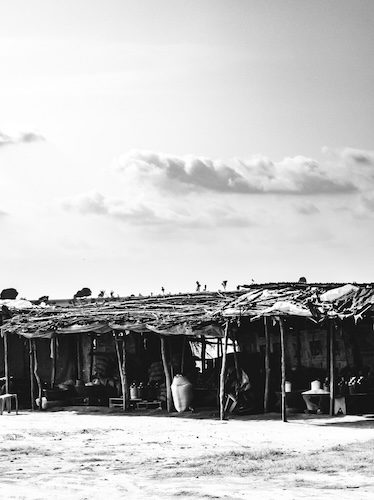
Author’s Note: The Nigeria-Biafra civil war ended fifty-six years ago. In that war, which was more of an attempt at erasure than a war, anywhere between two to three million Igbo lives are said to have perished. By centering my late grandmother as a victim, I have endeavored in this poem to ransack, document, and expose the multidimensional consequences of the war, and indeed any other war, be those consequences infrastructural, physiospiritual, or psychological.
❊
(for my grandmother, Onyeagom Osemeka)
Immobile she sits, on a stool, in a house
whose history or architecture none cares to
question. Folds arm over armless arm, crosses
leg over prosthetic leg, looks through the window
facing north. Receives no visits, pays no visits.
When you talk she stares at your lips: she wants
to make sure you will not mention once upon.
Only listens with her head tilted to one side:
the trick is to remove remnants of echoes,
lodged in her ears. Things she sees she
interprets as dead, half dead, living dead. Never
talks except when the phlegm catches in her throat
and then she screams Babies! The babies!
Rumor says she lost them the way a hen loses
hatchlings to a falcon. Secrets she knows she
hides under her wrap. Her mind, a door,
bolted from the inside: no matter how we try
we can’t open. We gave up trying memories ago.
Between us and Granma sprawls a world,
its walls, cracked, pillars, broken, inhabitants,
stricken by a disease known as dumb. Numb
the knife that splits youth and long past youth.
But say mad and she will laugh.
Say ill and she will smile.
❊