
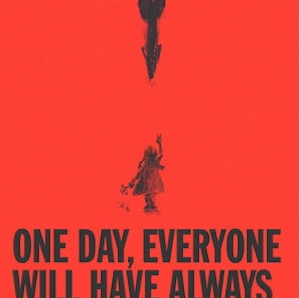
One Day, Everyone Will Have Always Been Against This
By Omar El Akkad
New York: Knopf, 2025. 187 pp.
This, in the title of Omar El Akkad’s remarkable book, refers to the slaughter of tens, perhaps hundreds, of thousands of Palestinians in Gaza; a slaughter perpetrated by the state of Israel and unconditionally supported, and funded, by the United States of America. For El Akkad, the most persistently horrifying feature of this has been the killing of countless, utterly innocent children. The book opens with the story of a little girl who, miraculously still alive, is pulled out of the rubble that was her home before it was destroyed by a missile. Nine of its ten chapters begin with a brief bit of reportage featuring a child. “An eighteen-month-old with a bullet wound to the forehead” (27); “a girl whose jaw has been torn off” (47); “a child still in diapers, pulled out of the tents after the firebombing, his head severed from his body” (47).
El Akkad’s book, however, is not simply a work of journalism that exposes the atrocities suffered by the people of Gaza, although it surely does that. It is in addition a beautifully crafted series of reflections of a thoughtful, keen-eyed, compassionate man who is being driven nearly mad, not only by the “world’s first livestreamed genocide” (165), but by the many who avert their gaze. It is replete with astute observations about American politics, modern journalism, the legacy of colonialism, immigration, and Western Liberalism. It is a cri de cœur, an elegy for those who are starving to death in Gaza, and a tribute to those who have courageously voiced their opposition. And it is a memoir.
Omar El Akkad was born in Egypt in 1982. He spent much of his childhood in Qatar, where his father worked as an accountant and he attended an American international school. His family moved to Montreal in 1998, and he entered Queens University in Ontario just prior to the bombings of the World Trade Center in 2001. Upon graduating in 2005 he began his ten-year career as a reporter for the Canadian newspaper The Globe and Mail. During this period, he covered everything from the tech industry to the War in Afghanistan to the Guantanamo Bay Detention Camp. He has published two novels, American War (2017) and This Strange Paradise (2021). He and his wife became US citizens in 2021.
Like many who grew up under authoritarian rule, the young El Akkad “wanted for the part of the world where I believed there existed a fundamental kind of freedom.” Even during “the very dark years” after 9/11, as the War on Terror targeted “hundreds of thousands of people with names and ethnicity and religion like mine,” he had faith in “this thing called ‘the free world.’” While its “cracks” were undeniable, he was convinced they could be fixed. But since the Fall of 2023, when “the Israeli military [ . . . ] with the support of the vast majority of the Western world’s political power centers, enacted a campaign of active genocide against the Palestinian people” (23), he is no longer so sure. On the one hand, El Akkad still believes that “active resistance—showing up to protests and speaking out and working to make change even at the smallest levels, the school boards and town councils—matters” (166). On the other, he has come to wonder whether a regime “that won’t flinch at the images of starving babies when it has the power to save their lives” can possibly be repaired. Perhaps, he asks himself, he should just “walk away from this system” (177).
This oscillation—between engagement and retreat, some measure of hope and anguish—ripples through the entire book and can even be felt in its title. At first blush, it may appear (relatively) optimistic since it seems to predict a future in which “everyone” will come to their moral senses and regret having either supported or ignored the genocide. In fact, however, this is not what it says. Instead, El Akkad thinks that one day “everyone” will claim to “have always been against this,” when, as the facts will clearly show, they were not. When the nightmare of Gaza finally recedes into the past, people—Western liberals in particular—will lament “all the innocent people killed in that long-ago unpleasantness” (184), when the truth is they gave the genocide their tacit approval. What El Akkad is predicting, then, is neither regret nor atonement, and certainly not moral progress, but self-deception. Consider this scathing remark: “Far enough gone, the systemic murder of a people will become safe enough to fit on a lawn sign. There’s always room on a liberal’s lawn” (185).
El Akkad is especially appalled by the mind-boggling hypocrisy of the Democrats, who, it must be remembered, controlled the White House for the first fourteen months of the Israeli invasion. As he puts it, “There is something stomach-churning about watching a parade of Biden administration press secretaries offer insincere expressions of concern for Palestinians as the same administration bankrolls their butcher” (56). In a strange and disturbing sense, he prefers the “deranged honesty” (56) of the Trumpists who shun all moral pretense.
To look upon the body of the little girl hanging from the wall, limbs severed by the force of the blast, and say: I’m fine with this, I am this. At least there’d be some measure of honesty in it (170).
Trapped between the mealy-mouthed moral vacuity of the Democrats and “the fascistic iteration of the modern Republican Party” (56), El Akkad asks both himself and his readers, “How does one live, hearing the screams?” (148). He offers no answer, for his “defining emotion is bewilderment. What is wrong with me,” he asks, “that I can’t keep living as normal? What is wrong with all those people who can?” (155).
El Akkad’s prose is lucid and precise, even when he is describing horror or struggling to to articulate emotional turmoil. Indeed, at times his writing is beautiful. He knows this and it gives him pause (106-107):
So much of my favorite literature orients in the direction of beauty. But surely any true appreciation of beauty would admit, exclaim even, that no description of the moon, no matter how stunning, how true, reflects as much beauty back into the world as a missile obliterating a family in their home takes out of it.
What art does is meet us at the site of our insanity, our derangement, the plainly irrational mechanics of what it means to be human. There comes from this, then, at least a working definition of a soul: one’s capacity to sit with the mysteries of a thing that cannot in any rational way be understood—only felt, only moved through. And sometimes that thing is so grotesque—what we do to one another is so grotesque—that sitting with it feels an affront to the notion of art as a conduit of beauty.
Still, sit. Sit.
El Akkad’s demand that his readers “sit” with the “grotesque” cruelty Palestinians are enduring at the hands of the Israelis and their American enablers reminds me of the proem of Primo Levi’s autobiographical work, Survival in Auschwitz (originally published in Italian in 1958). Echoing the V’ahavta, the Hebrew prayer commanding Jews never to forget to love God with all their might, Levi demands we read his harrowing account of the fourteen months he spent in the concentration camp and learn the hellish depravity of which human beings are shockingly capable. To quote a part of it:
You who live safe
In your warm houses,
You who find, returning in the evening,
Hot food and friendly faces. . . .
Meditate that this came about:
I commend these words to you.
Carve them in your hearts
At home, in the street,
Going to bed, rising;
Repeat them to your children.
Or may your house fall apart,
May illness impede you,
May your children turn their faces from you.
“Meditate that this came about:” Levi’s this was Auschwitz, and he warns of the dire consequences that will come upon us if we pretend it did not happen. El Akkad’s this is Gaza, and he is delivering much the same message. His voice is not as ferocious, as biblical and prophetic, as Levi’s, but it is equally adamant. To those who remain silent during the genocide he says this:
Know that a terrible thing is happening to you. You are being asked to kill off a part of you that would otherwise scream in opposition to injustice. You are being asked to dismantle the machinery of a functioning conscience. Who cares if diplomatic expediency prefers you shrug away the sight of dismembered children? Who cares if great distance from the bloodstained middle allows obliviousness. Forget pity, forget even the dead if you must, but at least fight against the theft of your soul (88).
In a particularly thought-provoking passage near the end of the book, El Akkad describes the “worst night of my life” (181). His one-and-a-half-year-old daughter contracted a severe respiratory illness and needed to be taken to the hospital, where she stayed for two terrifying days. (Thankfully, she recovered.) Recalling this ordeal now makes him wonder how far beyond one’s own family human empathy can extend. “I don’t know how to make a person care for someone other than their own. Some days I can’t even do it myself” (182). At the same time, however, one of the two epigraphs of this book comes from the poem “Vietnam” by Wislawa Szymborska: “‘Are these your children?’ ‘Yes.'” In his own voice, El Akkad echoes this sentiment: “It may seem now like it’s someone else’s children, but there’s no such thing as someone else’s children” (125).
The tension here is familiar to every parent. It is easy and natural to feel the pain of one’s own children. But what about the children of strangers who live in a distant land and about whom we only read or watch on the screen? How can we, how should we, empathize with them? And if we manage to do so, what is the proper response? Weep? Write another check and then go take a walk? This question has always been hard, and it’s only gotten harder now that images of human misery are available on our screens twenty-four hours a day. What particular version of hell should we watch tonight? Sudan? Ukraine? Yemen? Afghanistan? The choices are too many, and when we tire of seeing little bodies made of nothing but skin and bones, we—or at least those of us who live in the safe warm houses of America—can always change the channel.
Despite the fact that he lives with his family in Oregon and could spend his time writing novels, El Akkad has refused to turn away from Gaza. In words I found chilling, he says, “I have more than twenty tabs open, a bloody carnival of the worst crimes ever livestreamed” (11). However wrenching it may be, he refuses to stop watching. “Today,” he tells us, “I watched footage of a man kissing his son’s foot as he buried the body so torn apart by missiles that the foot was one of the only pieces the father could find in the rubble” (143).
Perhaps his capacity to witness the images of so much suffering—twenty tabs open!—derives from the fact that he was born in Egypt, not at all far from Gaza, and speaks the same language as those who are being systematically exterminated. Or perhaps he has a greater capacity for empathy than most of us. Or perhaps, even if he has never read it, he is heeding Levi’s call: human beings are obligated to confront the truth about the terrible things we can do to one another. Whether it is Auschwitz or Gaza, we are required not only to “meditate that this came about,” but also to carve words such as those written by Levi and El Akkad in our hearts and repeat them to everyone we know. “May your children turn their faces from you,” Levi inveighs, if we fail to do so. Feeling nothing, knowing nothing, saying nothing destroys the soul.
For this reason, we should be grateful that Omar El Akkad has written One Day, Everyone Will Have Been Against This. I believe anyone who reads this book may find a way to feel, to know, and possibly even to speak before it is too late.
After teaching Ancient Greek Philosophy for forty years, and having written seven books and more than forty articles, David Roochnik retired from Boston University in 2020. He is now devoting most of his considerable energy to what used to be his hobby: writing fiction.